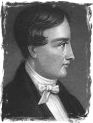
 A
career of surpassing loveliness, cut short by disease and death, is presented
in the Memoir of Robert Murray McCheyne, by his devoted friend and
admirer, the Rev. Andrew A. Bonar. McCheyne was a native of Edinburgh, Scotland,
and was the youngest child of Adam McCheyne. He was born, May 21, 1813; and,
in October, 1821, entered the High School of Edinburgh where he continued
six years. In 1827, he wrote a short poem, "Greece, but living Greece no
more." He entered the University of Edinburgh, November, 1827, and distinguished
himself in all his classes, gaining, also, the prize in the Moral Philosophy
Class for a poem, "On the Convenanters." The decease of his elder brother,
David, in July, 1831, led him "to seek a Brother who can not die," and determined
him to study for the ministry. In the winter of 1831, he entered the Divinity
Hall, and came under the instruction of the Rev. Drs. Chalmers and Welsh.
During his divinity course, he not only applied himself most diligently to
his studies, but sought, in all possible ways, to cultivate his own piety,
and to do good to the souls of the perishing. Music and poetry were his recreation
and delight.
A
career of surpassing loveliness, cut short by disease and death, is presented
in the Memoir of Robert Murray McCheyne, by his devoted friend and
admirer, the Rev. Andrew A. Bonar. McCheyne was a native of Edinburgh, Scotland,
and was the youngest child of Adam McCheyne. He was born, May 21, 1813; and,
in October, 1821, entered the High School of Edinburgh where he continued
six years. In 1827, he wrote a short poem, "Greece, but living Greece no
more." He entered the University of Edinburgh, November, 1827, and distinguished
himself in all his classes, gaining, also, the prize in the Moral Philosophy
Class for a poem, "On the Convenanters." The decease of his elder brother,
David, in July, 1831, led him "to seek a Brother who can not die," and determined
him to study for the ministry. In the winter of 1831, he entered the Divinity
Hall, and came under the instruction of the Rev. Drs. Chalmers and Welsh.
During his divinity course, he not only applied himself most diligently to
his studies, but sought, in all possible ways, to cultivate his own piety,
and to do good to the souls of the perishing. Music and poetry were his recreation
and delight.
He was licensed to preach, July 1, 1835, by the Presbytery of Annan, and in November became the Assistant of the Rev. John Bonar, pastor of Larbert and Dunipace, near Stirling. In August, 1836, he was called to the pastorate of the new Presbyterian Church, St. Peter's, Dundee, and was ordained, November 24, 1836. His preaching immediately arrested attention, and soon drew crowds to hear him. He became exceedingly popular, and calls from other churches were multiplied. But he declined them all, and continued steadfast in his work and abundant in labors, until he was compelled, by symptoms of alarming disease at the close of 1838, to desist for a season, spending the ensuing winter at Edinburgh.
At the suggestion of the Rev. Dr. Candlish, the General Assembly's Committee for the Conversion of the Jews determined to send a Deputation, on a Mission of Inquiry, to Palestine and other eastern countries. McCheyne and his friend, Rev. Andrew A. Bonar, were associated with the Rev. Drs. Black and Keith. They left their native land early in April, 1839, and returned home in the following November. McCheyne immediately resumed his parochial work, with health improved, but not fully restored. Conjointly with Bonar, he published (May, 1842) the "Narrative of a Mission of Inquiry to the Jews," a third edition of which was issued in 1843. His health again began to fail in the summer of 1842, and continued feeble through the following winter; and in March, 1843, he was seized with typhus fever, that resulted in his death, March 25, 1843. He had not completed his thirtieth year.
Short as had been his life, the fruits of his ministry were abundant. A large number of souls had been gathered into the communion of his own church; and numbers elsewhere, in Scotland and England, whither he had gone preaching the Word, acknowledged him as their spiritual father. His "Life and Remains" were published in 1844, by Rev. Andrew A. Bonar, and seventeen editions were sold in three years; in twenty-two years, 80,000 copies had been called for in Great Britain alone.
The hymn beginning
"I once was a stranger to grace and to God,"
is thus spoken of in his Memoir: "Mr. McCheyne was peculiarly subject to attacks of fever, and by one of these was he laid down on a sick-bed on November 15th [1834]. However, this attack was of short duration. On the 21st, he writes— 'Bless the Lord, O my soul! and forget not all his benefits. Learned more and more of the value of Jehovah Tzidkenu.' He had, three days before, written his well-known hymn,
'I once was a stranger,' etc.,
entitled, 'Jehovah Tzidkenu, the Watchword of the Reformers.' It was the fruit of a slight illness which had tried his soul, by setting it more immediately in view of the judgment seat of Christ; and the hymn, which he so sweetly sung, reveals the sure and solid confidence of his soul." The hymn has seven stanzas, in the original.
McCheyne was accustomed to pour forth his emotions in verse, and has left a considerable number of these pious effusions behind him. Fourteen of them are published in his "Remains," as "Songs of Zion." The following was written, at the "Foot of Carmel, June, 1839":
"Beneath Moriah's rocky side,
A gentle fountain springs,
Silent and soft its waters glide,
Like the peace the Spirit brings."The thirsty Arab stoops to drink
Of the cool and quiet wave,
And the thirsty spirit stops to think
Of Him who came to save.Siloam is the fountain's name,
It means one sent from God';—
And thus the holy Saviour's fame
It gently spreads abroad."Oh! grant that I, like this sweet well,
May Jesus' image bear,
And spend my life, my all, to tell
How full his mercies are."
From The Poets of the Church: A Series of Biographical Sketches of Hymn-Writers... New York: Anson D.F. Randolph & Company, ©1884.
>> More Robert Murray McCheyne