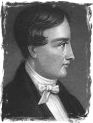
 Robert
Murray McCheyne (1813-1843), Scottish divine, youngest son of Adam McCheyne,
writer to the signet, was born in Edinburgh, 21 May 1813. At the age of four
he knew the characters of the Greek alphabet, and was able to sing and recite
fluently. He entered the high school in his eighth year, and matriculated
in November 1827 at Edinburgh University, where he showed very versatile
powers, and distinguished himself especially in poetical exercises, being
awarded a special prize by Professor Wilson for a poem on 'The Covenanters.'
In the winter of 1831 he commenced his studies in the Divinity Hall, under
Dr. Chalmers and Dr. Welsh; and he was licensed as a preacher by the Annan
presbytery on 1 July 1835. In the following November he was appointed assistant
to the Rev. John Bonar of Larbert and Dunipace, Stirlingshire. His health,
which had never been robust, broke down under the strain of his new office;
but his fame as a preacher spread through Scotland, and on 24 November 1836
he was ordained to the pastorate of St. Peter's Church, Dundee, which had
been erected into a quoad sacra parish in the preceding May. The congregation
numbered eleven hundred hearers, and McCheyne addressed himself to the work
of the ministry with so much ardour that his health again gave way, and in
December 1838 he was compelled to desist from all public duty. At this time
the general assembly of the church of Scotland decided to send a committee
to Palestine to collect information respecting the Jews, and McCheyne was
included in the number who set sail on 12 April 1839. The record of this
journey was written jointly by McCheyne and his companion Andrew Bonar (died
1892), and was published in 1842. After his return at the end of 1839 McCheyne
resumed his ministerial duties in Dundee with renewed energy. In the autumn
of 1842 he visited the north of England on an evangelical mission, and made
similar journeys to London and Aberdeenshire. On his return from the latter
place he was seized with sudden illness, and died on Saturday, 25 March 1843.
He was buried beside St. Peter's Church, Dundee, where an imposing tombstone
marks his grave.
Robert
Murray McCheyne (1813-1843), Scottish divine, youngest son of Adam McCheyne,
writer to the signet, was born in Edinburgh, 21 May 1813. At the age of four
he knew the characters of the Greek alphabet, and was able to sing and recite
fluently. He entered the high school in his eighth year, and matriculated
in November 1827 at Edinburgh University, where he showed very versatile
powers, and distinguished himself especially in poetical exercises, being
awarded a special prize by Professor Wilson for a poem on 'The Covenanters.'
In the winter of 1831 he commenced his studies in the Divinity Hall, under
Dr. Chalmers and Dr. Welsh; and he was licensed as a preacher by the Annan
presbytery on 1 July 1835. In the following November he was appointed assistant
to the Rev. John Bonar of Larbert and Dunipace, Stirlingshire. His health,
which had never been robust, broke down under the strain of his new office;
but his fame as a preacher spread through Scotland, and on 24 November 1836
he was ordained to the pastorate of St. Peter's Church, Dundee, which had
been erected into a quoad sacra parish in the preceding May. The congregation
numbered eleven hundred hearers, and McCheyne addressed himself to the work
of the ministry with so much ardour that his health again gave way, and in
December 1838 he was compelled to desist from all public duty. At this time
the general assembly of the church of Scotland decided to send a committee
to Palestine to collect information respecting the Jews, and McCheyne was
included in the number who set sail on 12 April 1839. The record of this
journey was written jointly by McCheyne and his companion Andrew Bonar (died
1892), and was published in 1842. After his return at the end of 1839 McCheyne
resumed his ministerial duties in Dundee with renewed energy. In the autumn
of 1842 he visited the north of England on an evangelical mission, and made
similar journeys to London and Aberdeenshire. On his return from the latter
place he was seized with sudden illness, and died on Saturday, 25 March 1843.
He was buried beside St. Peter's Church, Dundee, where an imposing tombstone
marks his grave.
McCheyne devoted all his energies to preaching; and although he was an accomplished Hebrew scholar, he left few permanent proofs of his erudition. He had refined musical taste, and was one of the first of the Scottish ministers to take an active part in the improvement of the congregational service of praise. Long after his death he was constantly referred to as 'the saintly McCheyne.' Several hymns by him—notably that entitled 'When this passing World is done'—are in constant use in the Scottish churches. His principal works are:
1. 'Narrative of a Mission of Inquiry to the Jews' (jointly with Dr. Andrew
Bonar), Edinburgh, 1842.
2. 'Expositions of the Epistles to the Seven Churches of Asia,' Dundee, 1843.
3. 'The Eternal Inheritance: the Believer's Portion, and Vessels of Wrath
fitted to Destruction, two Discourses,' Dundee, 1843.
4. 'Memoirs and Remains' (published by Dr. Andrew Bonar), Edinburgh, 1843
(second edition, with additional matter, Edinburgh, 1892).
5. 'Additional Remains, Sermons, and Lectures,' Edinburgh, 1844.
6. 'Basket of Fragments, the substance of Sermons,' Aberdeen, 1849.
References: Bonar's Memoirs; Jean L. Watson's Life of Robert Murray McCheyne; Dundee Celebrities; Scott's Fasti, iii. 700.
From Dictionary of National Biography. London: Smith, Elder, & Co., 1893.
>> More Robert Murray McCheyne