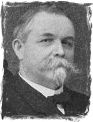
 James McGranahan was born July 4, 1840, near Adamsville, Pennsylvania, [United
States], his ancestry being mainly of Scotch-Irish descent. His father, George
McGranahan, was a farmer, hence James spent his boyhood on the farm.
James McGranahan was born July 4, 1840, near Adamsville, Pennsylvania, [United
States], his ancestry being mainly of Scotch-Irish descent. His father, George
McGranahan, was a farmer, hence James spent his boyhood on the farm.
His father sent him to singing school, and he soon became assistant by playing the bass viol. At the age of nineteen he organized his first singing class, and soon became one of the most popular teachers in his section of the state. He longed for the opportunity of further musical study, but how to get it was no ordinary proposition, for his father's notions of the value of a musical education were far from comforting to his rising ambition. With characteristic pluck, he finally gained his point and won his father's reluctant consent by not only earning all his expenses, but also employing a man in his place on the farm, while he pursued his musical studies.
It is easily surmised that he improved well his opportunities. That his father later revised his notions about the value of a musical education was very evident when no one rejoiced more than he that his son was being so marvellously used of God in winning souls through the power of persuasive song.
He entered the Normal Music School founded at Geneseo, New York, by Wm. B. Bradbury, where he pursued his studies under T. E. Perkins, Carlo Bassini, and other eminent teachers. Mr. McGranahan attended the sessions of 1861 and 1862. Here, too, he learned other lessons than those set down in the books, for here he first met Miss Addie Vickery, who afterwards became his wife, who being a ready accompanist, became a most efficient helper in his later institute, convention and evangelistic work.
In 1862 he became associated with the late J. G. Towner, and for two years they held conventions and made concert tours in the states of Pennsylvania and New York, giving great satisfaction in the work. He now continued his musical studies under Bassini, Webb, O'Neil, and others, studying the art of teaching with that prince of teachers, Dr. Geo. F. Root, the art of conducting with Carl Zerrahn, harmony under J. C. D. Parker, F. W. Root, and, later, Geo. A. Macfarren, of London.
In 1875 he accepted the position as one of the managers of Dr. Root's Normal Musical Institute, in which capacity he served as director and teacher for three years, Dr. Root continuing as principal.
During this time he was winning an enviable reputation in his convention work, and by his glee, chorus and class music, and Sabbath-school songs published from time to time. His equipment at this time for a successful career as a music teacher and composer was complete. He had become a cultured musician, with a wide and growing reputation, his solo work attracting much attention.
From his earliest years his rare tenor voice had been the wonder and delight of all who heard it, and now from some of his most eminent teachers came the proposal that he should enter upon a course of special training for the operatic stage, in which career it was felt he would certainly achieve fame and fortune.
It was a dazzling prospect; but, on the other hand, his intimate friend, P. P. Bliss, who had given his wondrous voice to the service of song for Christ, was urging him to do the same. Comparing his long course of study and training to a man whetting his scythe, he insisted that his friend should "stop whetting his scythe, and strike into the grain to reap for the Master." Mr. McGranahan, however, felt distrustful both of his adaptation to such work and of his call to enter upon it.
Only a week previous to the Ashtabula disaster, Mr. Bliss wrote a letter to Mr. McGranahan on this subject. Before sending it he read it to Major Whittle with whom he had been discussing the matter as to what evangelist they should select to associate with Mr. McGranahan should he consent to take up the work. On the morning after the disaster Major Whittle and Mr. McGranahan met for the first time at Ashtubula, both on the same errand of mercy — that of recovering, if possible, the bodies of their dear friends, Mr. and Mrs. Bliss.
Upon meeting Mr. McGranahan, Major Whittle's first thought was: "Here stands the man that Mr. Bliss has chosen as his successor." They went back to Chicago together, talked over the matter and prayed over it. Mr. McGranahan finally decided to give up all his future life to the service of God in song.
If the operatic world lost a star, the Christian world gained one of its sweetest gospel singers, and the hand of God was manifest in it all.
With a consecration that was most thorough, Mr. and Mrs. McGranahan entered their new field, and to their great joy found it most congenial. For eleven years he and Major D. W. Whittle were associated as true yoke fellows in evangelistic work in various parts of the United States, Great Britain, and Ireland. Two visits were made to Great Britain, the first in 1880, when they had great success in meetings in which the leading ministers of the kingdom cooperated, in London, Perth, Glasgow, Edinburgh, Aberdeen, Dundee, Belfast, and other places. The second visit was made in 1883, when they were associated with Messrs. Moody and Sankey.
Mr. McGranahan's music has a quality that is all its own. It is characterized by strength and vigor. Much that he has written will live in the permanent hymnology of the church. Such songs as "My Redeemer," "I Shall be Satisfied," "The Crowning Day," "Showers of Blessing," "O, How Love I Thy Law," and many others will voice the praise of future generations in their worship of God. Mr. Sankey once said, "I believe the most beautiful gospel song Mr. McGranahan ever wrote is "Sometime We'll Understand."
Mr. McGranahan was pioneer in the use of the male choir in gospel song. When holding meetings at Worcester, Mass., a [draft] which had not been noticed laid aside for the time being all the female voices, and he found himself with a chorus of male voices only. Always resourceful, he quickly adapted the music to male voices and the meetings went on with great power. What was necessity at first became a most popular and effective agency in the gospel work. Soon was published "Gospel Male Choir, Nos. 1 and 2," and the male choir and quartet are recognized forces in the church today.
The following is a list of his principal publications: "The Choice," and "Harvest of Song," in connection with C. C. Case; "Gospel Choir," with Sankey; "Gospel Hymns, Nos. 3, 4, 5, and 6," with Sankey and Stebbins; "Songs of the Gospel," and "Male Chorus Book" were issued in England.
It may be of interest to the reader to know that "El Nathan," to whom so many of the words are credited, is the nom de plume of Major Whittle.
In 1887, a break in Mr. McGranahan's health compelled him to give up active work in the evangelistic field. It was then that he built his beautiful home among his old friends at Kinsman, Ohio, and settled down to devote himself, in his semi-retirement, to the composition of music which would still make him a sharer in the evangelistic work of the period. Though his health demanded limited hours at his desk, yet he was a prodigious toiler while he could work, and a large number of his best hymns were written in these days.
Personally Mr. McGranahan was a most lovable man, gentle, modest, unassuming, in short, a refined and cultured Christian gentleman. He was a prince of entertainers. He loved good fellowship, and without effort, apparently, on his part, his guests would be treated to the most delightful social feast.
Mr. James McGranahan died July 9, 1907. He went home to meet the Saviour whom he loved so well, and served so faithfully.
From Biography of Gospel Song and Hymn Writers by J. H. Hall. New York: Fleming H. Revell, ©1914.
>> More James McGranahan