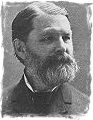
 The
author of "Shall we gather at the river," was born in Philadelphia, Pennsylvania,
[United States], March 12, 1826.
The
author of "Shall we gather at the river," was born in Philadelphia, Pennsylvania,
[United States], March 12, 1826.
At the age of seventeen years he became a disciple of Christ, and although his parents were members of the Associate Presbyterian church, his study of the Scriptures led him to cast in his lot with the Baptists, and having been baptized by Rev. Geo. B. Ide, D.D., he united with the First Baptist church in Philadelphia. At once he devoted himself to Christian work, especially in connection with Sunday-schools.
The desire to consecrate his life to Christ's cause, gradually took possession of him, and at length his pastor drew from him the confession that his thoughts had been directed to the work of the Christian ministry. Encouraged by Dr. Ide to prepare himself for this work, he entered Lewisburgh, now Bucknell University, where he was graduated with valedictory honors in 1854. The same year he was ordained and became pastor of the First Baptist church in West Chester, Penn., where he remained for five years.
In 1858, he accepted a call to the pastorate of the Bloomingdale Baptist church, New York. In 1861, he became pastor of the Hanson Place Baptist church, Brooklyn. Here he remained until 1869, when he accepted the professorship of belles-lettres in his alma mater, together with the pastorate of the Lewisburgh Baptist church. This double service he performed six years, and then removed to Plainfield, N.J. Here a new church was organized, and Dr. Lowry — the honorary degree of doctor of divinity having been conferred upon him by Lewisburgh University — was called to the pastorate of what has since been known as the Park Avenue Baptist church.
In 1880, Dr. Lowry took a rest of four years, and visited Europe. In 1885, he felt that he must have a longer respite, and after nine years of labor with a people to whom he was tenderly attached, he resigned. An effort was made to have him reconsider his action, and continue his ministry in Plainfield; but he was firm in the conviction that in taking this step he was in the path of duty, and for a time he traveled in the south and west, and subsequently in Mexico. At length, re-invigorated in health, he returned to Plainfield, where he still resides, devoting himself to the work which he loves so well, and in which he has achieved abundant success.
For, successful as Dr. Lowry has been as a pastor and preacher, multitudes know him better as a writer of hymns and composer of sacred music.
On the death of William B. Bradbury, the music publishing business which he had built up in New York was continued by Biglow & Main. The new firm made a proposal to Dr. Lowry to prepare a book for use in Sunday-schools. At first Dr. Lowry shrank from the undertaking, fearing that it would interfere with his ministerial duties. He was at length, however, induced to enter upon the preparation of the proposed book. The work then begun has been continued to the present time.
Dr. Lowry's fondness for music was exhibited in his earliest years. As a child, he amused himself with the various musical instruments that came into his hands. A love of melody was thus developed. When the obligations of musical editorship were laid upon him, he gave himself to the study of the best musical textbooks, and the highest forms of musical composition.
The music books he has edited are as follows: "Gospel Melodies" (1868); "Bright Jewels" (1869); "Pure Gold " (1871); "Royal Diadem" (1873); "Temple Anthems" (1873); "Hymn Service" (1871, 1872, 1873); "Tidal Wave" (1874); "Brightest and Best" (1875); "Welcome Tidings" and "Fountain of Song" (1877); "Chautauqua Carols" (1878); Gospel Hymn and Tune Book " (1879); " Good as Gold" (1880); "Our Glad Hosanna" (1882); "Joyful Lays" (1884); "Glad Refrain" (1886); also "Cantatas for Christmas" (1881-1886); "Cantatas for Easter" (1882-1887). These works have had a very wide circulation. Of " Bright Jewels" a half-million copies were sold in four years, and of "Pure Gold" more than a million copies have been sold. Some of the other books edited by Dr. Lowry have been received with almost equal favor, and all have been heartily welcomed.
In these various works are many hymns composed by Dr. Lowry, among those best known, beside
"Shall we gather at the river,"
are
"Shall we know each other there,"
"One more day's work for Jesus,"
"Weeping will not save me,"
"The Rifted Rock,"
"Where is my boy to-night,"
"Jesus is my Savior," etc.
The hymn
"Shall we gather at the river"
was written one afternoon in July, 1864, when Dr. Lowry was pastor of the Hanson Place Baptist church, Brooklyn, N.Y. The weather was oppressively hot, and the author was lying on a lounge in a state of physical exhaustion. He was almost incapable of bodily exertion, and his imagination began to take to itself wings. Visions of the future passed before him with startling vividness. The imagery of the Apocalypse took the form of tableaux. Brightest of all were the throne, the heavenly river, and the gathering of the saints. While he was thus breathing heavily in the sultry atmosphere of that July day, his soul seemed to take new life from that celestial outlook. He began to wonder why the hymn-writers had said so much about "the river of death," and so little about "the pure river of water of life, clear as crystal, proceeding out of the throne of God and of the Lamb." As he mused, the words began to construct themselves. They came first as a question of Christian inquiry, "Shall we gather?" Then they broke out in chorus, as an answer of Christian faith, "Yes, we'll gather." On this question and answer the hymn developed itself. The music came with the hymn. The author never has been able to tell which had priority of birth. They are twins. When song had formulated itself, the author sprang up, sat down at his organ, played the time through, and sang the first stanza and the chorus. Then he wrote it out.
In that same year Dr. Lowry was asked for some contributions to a song-book, which the American Tract Society was about to publish. He gave the editor some manuscripts, and subsequently added "Shall we gather." In the following spring, the Brooklyn Sunday School Union asked permission to use it for the May anniversary, Forty thousand children sang it on parade, and in their churches. Then it went everywhere. It was sung in conventions, in churches, in Sunday-schools, and at the bedside of the dying. It crossed the ocean, and became known in Great Britain and on the continent. At some of the most distant missionary stations in Asia it was translated and sung. It found its way to the Sandwich Islands, and soon encircled the globe. It is probably the one hymn by which its author is best known.
Many incidents connected with this hymn might be related. A young man had been stricken down with fever, in the military hospital in Alexandria, during the late war in Egypt. A lady visitor hearing him moan piteously for his mother, sat down by his side, and laid her hand on his burning brow. As the sun was just setting, she began to sing,
"Shall we gather at the river,"
and as she sang one weary head after another was raised in a listening attitude. When she stopped, one said, "O lady, sing that again!" and she repeated the hymn. Then turning to the lad, she said, "Will you be there?" Then a bright light shone in his eye, and a faint utterance fell from his lips, "Yes, I shall be there soon," and in a short time his spirit passed away.
A meeting not long ago was held in the Mission Hall in Salmon's Lane, Limehouse, London, to greet Lady Colin Campbell, who has shown in various ways her sympathy with the poor of the East End. The exercises consisted of cheers of welcome, prayer, singing and remarks by Walter Austin, the founder of the mission. The Pall Mall Gazette says: "But what every one was waiting for was to hear Lady Colin sing
"Shall we gather at the river,"
which she did with a refinement of tone and feeling that seemed to pass into the worn faces looking up into hers."
As a prelude to the Robert Raikes centennial in London, in 1880, the Sunday-school Union gave a reception to the delegates. Distinguished men from all parts of the world addressed the meeting. After the last of the appointed speakers had left the platform, the chairman, Sir Charles Reed, M.P., rose and said: "I am told that the author of
'Shall we gather at the river'
is in the room. We should all like to hear him." Making his way from the rear seats, Dr. Lowry advanced to the platform, where he was welcomed by the chairman, and introduced to the audience. The reception was so enthusiastic that for some minutes it was impossible for him to speak. The Presbyterian, reporting this episode, says: "It was a suitable recognition due to such a man, and a spontaneous testimony to the value of a song which doubtless the delegates present had made a household word."
Rev. Dr. D. Morrison, of Ontario, Canada, has made a Latin version of the hymn. The first stanza is as follows:
Fluvione colligemus
Qua'sint seraphim sancti,
Fluvio amœna cujus
Fons est throno Domini?
Beside his own hymns, Dr. Lowry has given vitality and popularity to many productions of other writers by the music with which they are sung, such as
"I need thee every hour,"
"The mistakes of my life have been many,"
"How can I keep from singing,"
"All the way my Savior leads me,"
"Shall we know each other there,"
"Savior, thy dying love,"
"One more day's work for Jesus,"
"When the Comforter comes,"
"We're marching to Zion,"
and a host of others.
The following hymn, written by Dr. Lowry in 1867, is entitled "None but Jesus":
Weeping will not save me.
Though my face were bathed in tears
That could not allay my fears,
Could not wash the stain of years;
Weeping will not save me.Chorus:
Jesus wept and died for Me,
Jesus suffered on the tree,
Jesus waits to make me free;
He alone can save me.Working will not save me.
Purest deeds that I can do,
Holiest thoughts and feelings too,
Cannot form my soul anew;
Working will not save me.Waiting will not save me.
Helpless, guilty, lost, I lie,
In my ear is mercy's cry;
If I wait I can but die;
Waiting will not save me.Faith in Christ will save me.
Let me trust thy weeping Son,
Trust the work that he has done,
To his arms, Lord, help me run;
Faith in Christ will save me.
[Dr. Lowry died in 1899.]
From Baptist Hymn Writers and Their Hymns by Henry S. Burrage. Portland, Maine: Brown Thurston & Co., ©1888.
>> More Robert Lowry