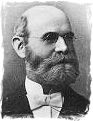
 There
are but few gospel song composers who are better and more favorably known
than the subject of this sketch, Wm. J. Kirkpatrick, born February 27, 1838.
His father, Thompson Kirkpatrick, was a school teacher and music teacher,
and well known as a musician in Mifflin, Juniata, Cumberland and Perry Counties,
Pennsylvania, [United States].
There
are but few gospel song composers who are better and more favorably known
than the subject of this sketch, Wm. J. Kirkpatrick, born February 27, 1838.
His father, Thompson Kirkpatrick, was a school teacher and music teacher,
and well known as a musician in Mifflin, Juniata, Cumberland and Perry Counties,
Pennsylvania, [United States].
William J. grew up in a musical atmosphere, and at an early age learned to play upon the fife, flute, violin, and later upon the violin cello. In the spring of 1854 he left his home in Duncannon, Perry County, Pennsylvania, for Philadelphia to study music and learn a trade, and served over three years at carpentering. He was much more interested in music than in mechanics, devoting all his leisure time to its study. His ambition at this time was to become a violinist.
In February, 1855, he joined the Wharton Street Methodist Episcopal Church, of Philadelphia, and from that time devoted himself mostly to sacred music, giving his services to the choir and Sunday-school. As there were few organs in the churches in that early day, his violin and cello were in constant demand for choir rehearsals, singing societies and church entertainments. During this preliminary time he composed a number of hymn tunes and anthems, but they were not offered for publication.
He studied vocal music under Prof. T. Bishop, then a leading oratorio and ballad singer, and became a member of the Harmonia and the Handel and Haydn Sacred Music Societies, where he heard the greatest singers of the day and became familiar with the principal choral works of the great composers.
His first published composition, entitled, "When the Spark of Life is Waning," appeared about 1858, in the Musical Pioneer, of New York.
In 1858, at twenty years of age, his first editorial work was begun in this way: One Sunday afternoon at the close of the Sunday-school, somebody was singing a hymn to Mr. A. S. Jenks, Bible-class teacher and musical enthusiast, who had recently published a large collection of camp-meeting songs which was very popular. While the hymn was being sung, young Kirkpatrick wrote off the melody, harmonized it and gave it to Mr. Jenks, who seemed amazed at this exhibition of home talent. Mr. Jenks, who was then collecting material for a music edition of his popular book, took the music to his musical friends in New York, where he expected to have the work done. The arrangement stood the test of criticism, and Mr. Kirkpatrick was engaged to prepare the matter for the typographers, read the proofs, and get up the book.
Soon he was to be found in company with Mr. Jenks, taking down melodies at camp-meetings and elsewhere from many of the famous singers of that kind of music. He prepared the music for publication in "Devotional Melodies," a book issued by Mr. Jenks. This experience had much to do in giving direction to the development of Mr. Kirkpatrick's talents and prepare him to write the many popular sacred songs which appeared later.
For several years he devoted himself exclusively to the study, practice, and teaching of music, giving special attention to theory, harmony, and composition under the excellent instruction of Dr. Leopold Meignen, conductor of the Harmonia Society.
Mr. Kirkpatrick was married in 1861, and in December of the same year connected himself with the 91st Regiment P. V. (Col. E. M. Gregory) as principal musician (fife major). He remained with the regiment in that capacity, mostly in Washington and Alexandria, until October 9, 1862, when his position was abolished by general orders. He returned to Philadelphia, but went into other pursuits at that time more remunerative than music, but continued his work and interest in choir, Sunday-school, and singing-class work, being leader, organist, and Sunday-school chorister in several of the prominent Methodist and other churches of that city.
In 1865 he was elected organist, and leader of all the music of the Ebenezer Methodist Episcopal Church, which position he held at three different periods for over seventeen years. He studied the pipe organ under the well-known blind teacher and organist of St. Steven's, Mr. David D. Wood. Vocal lessons were received from some of the great Italian teachers.
He was again engaged by Mr. A. S. Jenks to supervise the issue of a hymn and tune book, "Heart and Voice." The entire work of selecting, classifying, and arranging the twelve hundred hymns, with appropriate tunes, of this four hundred and forty-eight page book was committed to his care. On the completion of this book in 1866 he accepted a responsible position in a furniture manufactory, of Philadelphia, where he remained, with a short interruption, for ten years. During the latter part of this time, from 1872 to 1875, his first popular gospel songs, words and music were written and published. "Resting at the Cross," "Sweetly I'm Resting in Jesus," "Beautiful Day," "Companionship with Jesus," "Entire Consecration," "Wait and Murmur Not," etc. ; also "Leaflet Gems, Nos. 1 and 2," were all issued in 1875. "Precious Songs " was published in conjunction with Rev. J. H. Stockton, whose beautiful and popular melodies Mr. Kirkpatrick had been arranging and harmonizing for several years before.
Mr. Kirkpatrick's songs were now in great demand, and several publishers procured a number of his compositions. About this time he became acquainted with Mr. John R. Sweney, of Chester, Pennsylvania, who was then making his mark in musical composition, and it was not long before a proposition was made and accepted to unite their efforts on a book.
Upon the death of his wife in May, 1878, and the dissolution of the co-partnership of the firm with which he had been engaged, a month later, he resolved to abandon the furniture business entirely, and, after an extensive tour through the country during June, July and August, he began in September, 1878, to devote his entire time to the composition and teaching of music—organ, piano and singing. In 1880 his first book as an associate of Mr. Sweney, the "Quiver of Sacred Song," was published by Mr. John J. Hood.
From 1880 to 1897 in connection with Professor Sweney, forty-nine books were issued by eight publishers in the United States, and one in London, England. This list includes six books especially prepared for Sunday-schools, and five anthem books for the choir, but does not include the many small books, nor annuals and services for Easter, Children's Day, Christmas, etc. All of these publications sold well, and the aggregate sales foot up into the millions.
From 1886 to December, 1897, Mr. Kirkpatrick had charge of all the music in Grace Methodist Episcopal Church, Philadelphia. He gave up teaching music in 1889, and devoted all of his time to composition, church and Sunday-school work, convention and camp-meeting singing, where he has taken great pleasure and interest in leading the people in sacred song, and obtaining the best possible results with the least amount of self-display.
Since the death of Mr. Sweney, Mr. Kirkpatrick has given up all of his public leading and singing, but has still been adding to his list of books. And since 1897 no less than forty-two have been issued, upon which appears his name as editor or associate editor, besides many smaller books, services, etc., which bear the imprint of over a score of publishers.
Among the best known of his recent books are: "Young People's Hymnal, Nos. 1, 2 & 3," "Sunday School Praises," "Jubilant Voices," "Devotional Songs," "Glorious Praise," "The Redeemer's Praise," "Joy and Praise," "Hymns and Spiritual Songs, No. 2," etc.
Mr. Kirkpatrick was married the second time, October, 23, 1893, to Mrs. Sara Kellogg Bourne, of New York. During 1905 they traveled together through France, Germany, Switzerland and England.
Mr. Kirkpatrick is president of the Praise Publishing Company, of Philadelphia [at the time this biographical sketch was written, 1914]. He is a busy man and always does his work in a scholarly manner.
He resides in Philadelphia, but spends several months each year in his winter home, "Sunny Croft," Winter Park, Florida.
From Biography of Gospel Song and Hymn Writers by J. H. Hall. New York: Fleming H. Revell, ©1914.
>> More Wm. J. Kirkpatrick