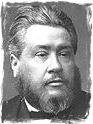
 Few men are so widely known as Charles Haddon Spurgeon. He was born June 19,
1834, at Kelvedon, Essex, [England], where his father was pastor of an
Independent church. At an early age he was placed under the care of his
grandfather, also an Independent minister, who lived at Stambourne, in
the same county. Later he attended a private academy at Colchester, which
had become his father's residence. When fifteen years of age he studied
a year at an agricultural college at Maidstone. Afterward he was an assistant
in a school at Newmarket.
Few men are so widely known as Charles Haddon Spurgeon. He was born June 19,
1834, at Kelvedon, Essex, [England], where his father was pastor of an
Independent church. At an early age he was placed under the care of his
grandfather, also an Independent minister, who lived at Stambourne, in
the same county. Later he attended a private academy at Colchester, which
had become his father's residence. When fifteen years of age he studied
a year at an agricultural college at Maidstone. Afterward he was an assistant
in a school at Newmarket.
In the autumn of 1850, he became deeply interested in his religious welfare, and a few months later, at the Primitive Methodist Chapel at Colchester, he heard a sermon from the text, "Look unto me, and be ye saved, all ye ends of the earth." The preacher's words reached his heart, and then and there, according to his own glad testimony, he gave himself to the Lord Jesus Christ. When considering the duty of publicly confessing his allegiance to his Master, he decided to unite with a Baptist church, and May 3, 1851, he was baptized at Isleham, near Newmarket.
For awhile he devoted himself to the work of tract distribution and Sunday-school teaching. He then removed to Cambridge, where he found employment as usher. Here he united with the Baptist church in St. Andrews Street, of which Robert Robinson and afterward Robert Hall had been pastors, and engaged in religious work as opportunity offered. His first sermon he preached at Teversham, when sixteen years of age, having received a license as a lay preacher.
In 1852, he was called to the pastorate of the little Baptist church at Waterbeach. Here crowds flocked to hear him. His fame soon reached London, and, in the autumn of 1853, the deacons of Dr. Rippon's old church in New Park Street invited him to come to London, and supply the pulpit. The invitation was accepted, and the impression which the young preacher made by his sermons was such that he at once received a call to the pastorate. This he accepted, and removing to London he entered upon his work in the metropolis under very bright prospects. Crowds attended his preaching services, and within a year it became necessary to enlarge the church edifice. Meanwhile Exeter Hall, was hired, and overflowing congregations greeted him there. The enlarged chapel proved inadequate to seat the throngs that assembled to hear him, and, in 1856, Mr. Spurgeon commenced preaching in the Music Hall in Surry Gardens, which had accommodations for seven thousand people.
To meet the wants of the rapidly growing church, the Metropolitan Tabernacle was erected, the corner-stone of which was laid in August, 1859. The building was completed in 1861, at a cost of one hundred and fifty thousand dollars. Here Mr. Spurgeon has since preached to large congregations, the house having seats for fifty-five hundred people, and standing-room for one thousand more. When the church took possession of the Tabernacle it had a membership of eleven hundred and seventy-eight; the membership is now upward of five thousand. Connected with the church are "The Pastor's College," for the training of young men for the ministry, and many benevolent institutions, including almshouses and orphan asylums. Since 1868, Mr. Spurgeon's brother, Rev. James A. Spurgeon, has been associated with him as assistant pastor.
Mr. Spurgeon's sermons have been published each week, and very widely circulated, either in the preacher's own tongue or in translations. He has also published many valuable works, of which especial mention should be made of his "Commentary on the Psalms," in seven volumes, entitled "The Treasury of David." In 1866, he published "Our Own Hymn Book, a Collection of Psalms and Hymns for Public, Social and Private Worship." In this admirable collection two hundred and twenty authors are represented by eleven hundred and twenty-nine hymns. Mr. Spurgeon's own contributions were fourteen psalms and ten hymns, with three which he had altered. Of the hymns a favorite is that which commences,
Sweetly the holy hymn
Breaks on the morning air;
Before the world with smoke is dim
We meet to offer prayer.
But the hymn by Mr. Spurgeon, which he himself likes best, and which has become best known perhaps, having found its way into many collections, is the following:
The Holy Ghost is here,
Where saints in prayer agree;
As Jesus' parting gift, he's near
Each pleading company.Not far away is he,
To be by prayer brought nigh;
But here in present majesty,
As in his courts on high.He dwells within our soul,
An ever welcome guest;
He reigns with absolute control
As monarch in the breast.Our bodies are his shrine,
And he th' indwelling Lord;
All hail, thou Comforter divine!
Be evermore adored.Obedient to thy will,
We wait to feel thy power;
O Lord of life, our hopes fulfil,
And bless this hallowed hour.
From Baptist Hymn Writers and Their Hymns by Henry S. Burrage. Portland, Maine: Brown Thurston & Co., ©1888.
>> More C. H. Spurgeon