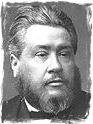
 Charles Haddon Spurgeon (1834-1892), preacher, came of a family of Dutch origin
which sought refuge in England during the persecution of the Duke of Alva.
Charles Haddon's grandfather, James Spurgeon (1776-1864), born at Halstead,
Essex, was independent minister at Stambourne. His son, John Spurgeon, the
father of Charles Haddon, born in 1811, was successively minister of the independent
congregations of Tollesbury, Essex, of Cranbrook, Kent, of Fetter Lane, and of
Upper Street, Islington.
Charles Haddon Spurgeon (1834-1892), preacher, came of a family of Dutch origin
which sought refuge in England during the persecution of the Duke of Alva.
Charles Haddon's grandfather, James Spurgeon (1776-1864), born at Halstead,
Essex, was independent minister at Stambourne. His son, John Spurgeon, the
father of Charles Haddon, born in 1811, was successively minister of the independent
congregations of Tollesbury, Essex, of Cranbrook, Kent, of Fetter Lane, and of
Upper Street, Islington.
Charles Haddon, elder son of John Spurgeon, by his wife, the youngest sister of Charles Parker Jarvis of Colchester, was born at Kelvedon, Essex, [England] on 19 June 1834. His early childhood was spent with his grandfather, James Spurgeon, but in 1841 he was sent to a school at Colchester conducted by Henry Lewis. In 1848 he spent a few months at an agricultural college at Maidstone. In the following year he became usher in a school at Newmarkert. His employer was a baptist, and although Spurgeon had been reared an independent, and converted in a primitive Methodist chapel, he was baptised and formally joined the baptist community at Isleham on 3 May 1850. In the same year he obtained a place in a school at Cambridge, recently founded by a former teacher and friend, Henry Leeding. There he became an active member of a baptist congregation, and while a boy of sixteen, dressed in a jacket and turndown collar, preached his first sermon in a cottage at Teversham, near Cambridge. His success was pronounced; his oratorical gifts were at once recognised, and in 1852 he became the pastor of the baptist congregation at Waterbeach, Cambridgeshire. In April 1854 he was 'called' to the pulpit of the baptist congregation at New Park Street, Southwark. Within a few months of his call his powers as a preacher made him famous. The chapel had been empty; before a year had passed the crowds that gathered to hear the country lad of twenty rendered its enlargement essential. Exeter Hall was used while the new building was in process of erection, but Exeter Hall could not contain Spurgeon's hearers. The enlarged chapel, when opened, at once proved too small, and a great tabernacle was projected. In the meantime Spurgeon preached at the Surrey Gardens music-hall, where his congregations numbered ten thousand. Men and women of all ranks flocked to his sermons. The newspapers, from the 'Times' downwards, discussed him and his influence. Caricature and calumny played their part. On 19 Oct. 1856 a malicious alarm of fire raised while Spurgeon was preaching at the Surrey Gardens music-hall led to a panic which caused the death of seven persons and the injury of many others; but the preacher's position was not endangered. At twenty-two Spurgeon was the most popular preacher of the day.
In 1861 the Metropolitan Tabernacle in Newington Causeway was opened for service. It cost £31,000, and accommodated six thousand persons. There Spurgeon ministered until his death, and, until illness disabled him, fully maintained his popularity and power as a preacher. The Tabernacle quickly became, under Spurgeon's impressive personality, an energetic center of religious life. Many organisations grew up under his care and were affiliated to it. All are now flourishing institutions. A pastors' college, in which young men prepared for the ministry under his active guidance, was founded at Camberwell in 1856; it was removed to the Metropolitan Tabernacle in 1861, and is now located in Temple Street, Southwark. An orphanage, an unsectarian institution, was founded in 1867 at Stockwell for the maintenance and education of destitute orphan boys and girls...; while a colportage association founded in 1866 to circulate 'religious and healthy literature among all classes' by means of colporteurs, who were to be paid a fixed salary and to devote all their time to the work, derived in 1891 over £11,000 by the sale of books and pamphlets.
A convinced Calvinist, staunchly adhering till the day of his death to every point in the system of theology in which he had been educated, Spurgeon was resolved to sacrifice nothing in the way of doctrine, even in the interests of peace among Christian churches. In 1864 he invited a controversy with the evangelical party in the church of England. In a powerful sermon on baptismal regeneration which he preached in that year he showed that that doctrine, to which he was strenuously hostile, was accepted in the church of England prayer-book, and he reproached evangelical churchmen, who in principle were equally antagonistic to the doctrine, with adhering to an organisation which taught it. The attack occasioned much ferment. Three hundred thousand copies of Spurgeon's sermon were sold; and while high churchmen were elated by Spurgeon's admission that a doctrine, which they openly avowed, found a place in the prayer-book, low-churchmen were proportionately irritated. Numberless pamphlets set forth the views of the various parties. The most effective reply to Spurgeon was made by Baptist Wriothesley Noel, then a baptist minister. In his 'Evangelical Clergy Defended,' Noel censured Spurgeon for introducing needless divisions among men of like faith. But Spurgeon remained obdurate, and emphasized his attitude by withdrawing from the Evangelical Alliance, which was largely supported by the low-church party of the church of England.
Spurgeon's strenuous and unbending faith in Calvinism loosened in course of time the bonds of sympathy between him and a large section of his own denomination. He long watched with misgivings the growth among baptists of what he regarded as indifference to orthodoxy. He thought they laid too little stress on Christ's divine nature, and that the Arminian views which were spreading among them tended to Arianism. He keenly resented what he called the 'down grade' developments of modern biblical criticism, and the conviction grew on him that faith was decaying in all Christian churches. Consequently on 26 Oct. 1887 he announced his withdrawal from the Baptist Union, the central association of baptist ministers, which declined to adopt the serious view that he took of the situation. Opposition to the rationlising tendency of modern biblical criticism brought him in his later days into sympathy with many churchmen. It was perhaps on that account that he withdrew from the Liberation Society, of which he had been previously a vigorous supporter.
On the completion in 1879 of the twenty-fifth year of his pastorate at the Tabernacle, Spurgeon was presented with a testimonial of £6,263. During the latter part of his life he lived in some style at Norwood. He never practiced or affected to practice asceticism, but was generous in the use of the ample means with which his congregation supplied him. His opinions on social questions were always remarkable for sanity and common-sense. A liberal in politics, Spurgeon was, after 1886, a prominent supporter of the liberal-unionist party in its opposition to home rule for Ireland. Towards the end of his life he suffered severely from gout, and was repeatedly forced to take long rests. He died at Mentone on 31 Jan. 1892, and was buried at Norwood cemetery, London. The Memorial Hall at Stockwell and the Beulah Baptist Chapel at Bexhill (commenced in 1895) were erected in memory of him. The best portrait of Spurgeon is an oil painting in the pastor's vestry, Metropolitan Tabernacle, and there is a bust by Mr. Acton-Adams at the Pastors' College.
Spurgeon married, in 1856, Susannah, daughter of Robert Thompson of Falcon Square, London, by whom he had twin sons, Charles and Thomas. His widow and sons survived him.
Spurgeon's early fame as a preacher was largely due to his extreme youth, to the free play of his humour, and to the fervour of his unconventional appeals to the conscience. But he was by nature endowed with much oratorical power. He managed with the utmost skill a clear and sympathetic voice, while his gesture was easy and natural. Throughout life his matter united shrewd comment upon contemporary life with the expository treatment favoured by the old puritan divines. In later life he spoke in the pulpit with somewhat less oratorical effect, but with an intenser earnestness. His humour was spontaneous; it marked his private as well as his public utterances (see especially W. Williams, Personal Reminiscences of C. H. Spurgeon).
Spurgeon was a prolific author, writing with the directness and earnestness that distinguished him as a speaker. From 1865 he conducted a monthly magazine, entitled 'Sword and Trowel.' From 1855 a sermon by him was published every week. These have been collected in numerous volumes, and many of them have been translated into the chief European languages. As many as 2,500 sermons are still on sale. Of his other works, nearly all of which ran into many editions, the most important were:
1. 'The Saint and his Saviour,' 1857.
2. 'Morning by Morning,' 1866.
3. 'Evening by Evening,' 1868.
4. 'John Ploughman's Talks,' 1869.
5. 'The Treasury of David,' 1870-85.
6. 'Lectures to my Students,' 1st. ser. 1875; 2nd ser. 1877.
7. 'Commenting and Commentaries,' 1876.
8. 'John Ploughman's Pictures,' 1880.
9. 'My Sermon Notes,' 1884-7.
An autobiography compiled by his wife and the Rev. W. J. Harrald, his private secretary, from his dairy, letters, and records, appeared in four volumes in 1897-8.
[Pike's Life and Work of C.H. Spurgeon; Shindler's From Pulpit to Palm Branch; Stevenson's Sketch of the Life of Spurgeon, 1887; Needham's Life and Labours of C.H. Spurgeon; Douglas's Prince of Preachers; Drew's Charles H. Spurgeon; Record, 5 Feb. 1892; Times, February 1892; Review of Reviews, 1892, i. 239-55; information from the Rev. Thomas Spurgeon.]
From Dictionary of National Biography. London: Smith, Elder, & Co., 1898.
>> More C. H. Spurgeon