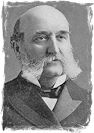
 Ira
David Sankey was born in the village of Edinburg, Pennsylvania [United States],
August 28, 1840. He was of Scotch-Irish ancestry. After some years his father,
the Hon. David Sankey, and his mother, moved to a farm where young Ira grew
up assisting in the farm work. He received the usual school privileges of
those days.
Ira
David Sankey was born in the village of Edinburg, Pennsylvania [United States],
August 28, 1840. He was of Scotch-Irish ancestry. After some years his father,
the Hon. David Sankey, and his mother, moved to a farm where young Ira grew
up assisting in the farm work. He received the usual school privileges of
those days.
In 1857 the family moved to Newcastle, Pennsylvania. This afforded him the opportunity of attending high school. Soon after arriving in Newcastle he joined the M. E. Church. Here he began his first choir work. His voice soon began to attract attention and crowds of people came into the Sunday-school to hear the singing.
In 1860 he responded to the call of President Lincoln for volunteers and enlisted in the Twelfth Pennsylvania Regiment. While in the army he frequently led the singing in the religious services. When his term of service as a soldier expired, he returned home to assist his father as a collector of internal revenue.
In 1863 he married Miss Fanny V. Edwards, who was truly a blessing and helpmate to him throughout his entire lifework.
Mr. Sankey was in possession of a fine voice which had been enriched by cultivation and his services as a gospel singer were in great demand in both Pennsylvania and Ohio.
In 1870 he was a delegate to the Y.M.C.A. Convention at Indianapolis, Indiana. Here he first met Mr. Moody. The singing had been rather poor, and Mr. Sankey was asked to lead. He began by singing the familiar hymn, "There is a fountain filled with blood." The congregation joined heartily in the song which put new life into the meeting. At the close of the service, the singer was introduced to Mr. Moody. Mr. Sankey describes their meeting thus: "As I drew near Mr. Moody he stepped forward and taking me by the hand looked at me in that keen, piercing fashion of his as if reading my very soul. Then he said abruptly, 'Where are you from?' 'Pennsylvania,' I replied. 'Are you married?' 'I am.' 'How many children have you?' 'Two.' 'What is your business?' 'I am a government officer.' 'Well, you'll have to give it up!' I was too much astonished to make any reply and he went on as if the matter had already been decided: 'I have been looking for you for the last eight years. You'll have to come to Chicago and help me in my work.'"
In 1871, after a delay of several months and much urging on Mr. Moody's part, he consented to spend a week with him in Chicago; and before the week was over he resigned his government position and joined forces with him for their life-work. Thus began the great work of Dwight L. Moody and Ira D. Sankey that made the names of Moody and Sankey household words the world over.
Mr. Moody's keen intellect foresaw the great future for the young singer. He did not sing himself; but he said: "I feel sure the great majority of people do like singing. It helps to build up an audience — even if you do preach a dry sermon. If you have singing that reaches the heart, it will fill the church every time. There is more said in the Bible about praise than prayer, and music and song have not only accompanied all Scripture revivals, but are essential in deepening spiritual life. Singing does at least as much as preaching to impress the word of God upon people's minds. Ever since God first called me, the importance of praise expressed in song has grown upon me."
In October, 1871, the great fire occurred in Chicago, which compelled them to suspend their work for a short time. In 1872 Mr. Sankey moved his family to Chicago. The evangelists then accepted an invitation to hold services at Springfield, Illinois. Their efforts were crowned with success.
In 1873 they sailed for England, where they held many successful meetings. Mr. Sankey's solo singing was very effective. "Jesus of Nazareth passeth by" was the most popular at this time.
The expression, "singing the gospel," was first used by the Rev. A. A. Rees of Sunderland, England, in describing Mr. Sankey's soul-stirring hymns. Gospel songs were something new in that country at that time. In Scotland they only used the Psalms of David; others were called "human hymns," but with Mr. Sankey's tact and skill as a singer and evangelist, he soon won the hearts of even the bonny Scotland people to sing "human hymns," and in such a prayerful spirit that scores were brought into the kingdom.
Mr. Sankey composed his first gospel song, entitled "Yet There is Room," while in Edinburgh, Scotland. Dr. Horatius Bonar, who attended the meetings, wrote the words.
While holding meetings in London, many of the prominent people attended, among whom might be mentioned the Hon. Wm. E. Gladstone, Lord Kinnaird, Queen Victoria, the Princess of Wales, and others. They enjoyed Mr. Sankey's solos, especially "The Ninety and Nine." The evangelists remained in Great Britain for two years, and held meetings in many of the leading cities of England, Scotland and Ireland. They returned to America in 1875.
Their first meeting after their return was held at Northfield, Massachusetts. Then followed meetings in Brooklyn, Philadelphia, New York, Chicago, Boston, St. Louis, and hundreds of other cities were visited, not only throughout the United States, but in Canada and Mexico, and great good was accomplished wherever they labored. During the years which followed the evangelists made several trips to Great Britain. The campaign of 1881-1884 was a memorable one.
Mr. Sankey had delightful experiences on his visit to the Holy Land in 1898. He traveled over the road that Jesus traveled on His way to Calvary to die for the sins of the world. He sang on the Tower of David while at Jerusalem. He visited many of the ancient cities, and other places of interest, and wherever he went his fine baritone voice was heard singing the songs of salvation.
Mr. Sankey was not only a great singer and his own best accompanist, but he proved a prolific composer, his original work being of a character that instantly commended itself to religious audiences. Mr. Sankey was one of the authors of the famous "Gospel Hymns," and of various other hymnals.
Among his most popular songs are: "The Ninety and Nine," "The Cross of Jesus," "Jesus of Nazareth," "Onward and Upward," "There'll Be No Dark Valley," "Call Them Now," "A Little While," "Room For Thee," "A Shelter in the Time of Storm," "Tell It Out," "When the Mists Have Rolled Away," "While the Days Are Going By," "Hiding in Thee," etc.
The history of the famous "Ninety and Nine" is most extraordinary. While in Scotland Mr. Sankey found the poem in a newspaper which he was reading on a train. He clipped the poem from the paper and put it in his pocket. That very week Mr. Moody preached upon "The Prodigal Son." At the conclusion of his discourse he asked Mr. Sankey to sing something appropriate with which to close the service. "I had nothing suitable in mind," writes Mr. Sankey, "but at that moment a voice seemed to say to me, 'Sing the hymn you found on the train!' I thought it impossible, but I placed the little slip on the organ in front of me, lifted my heart in prayer, and began to sing. Note by note the tune was given, and it has not been changed from that day to this."
Mr. Sankey was a noble man. Among his gifts he presented a handsome new building to the Y.M.C.A. at Newcastle, the town in which he spent his boyhood.
Mr. Sankey spent the last few years of his life in blindness. He died at his residence at Brooklyn, N. Y., August 13, 1908.
"Out of the shadow-land into the sunshine,
Cloudless, eternal, that fades not away."
From Biography of Gospel Song and Hymn Writers by J. H. Hall. New York: Fleming H. Revell Company, ©1914.
>> More Ira D. Sankey