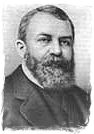
 D.
L. Moody was undoubtedly one of the greatest evangelists of all time.
The meetings held by Moody and Sankey were among the greatest the
world has ever known. They were the means under God of arousing the
church to new life and activity, and were the means of sweeping tens
of thousands of persons into the kingdom of God.
D.
L. Moody was undoubtedly one of the greatest evangelists of all time.
The meetings held by Moody and Sankey were among the greatest the
world has ever known. They were the means under God of arousing the
church to new life and activity, and were the means of sweeping tens
of thousands of persons into the kingdom of God.
Mr. Moody was one of the weak instruments which God has chosen to confound the mighty. Like Christmas Evans, he had very little education before his conversion to Christ. At seventeen years of age he could scarcely read or write, and in a Bible class he could not turn to the book of John but searched for it in the Old Testament. After his conversion he became a proficient scholar. Few men have learned so much in the school of observation.
Dwight Lyman Moody was of old New England Puritan stock. For seven generations, or two hundred years, his ancestors lived the quiet lives of farmers in the Connecticut Valley. Moody inherited the vigorous constitution and hardy common sense of the typical New Englander. He was the sixth child in a family of nine children, and was born February 5, 1837, in the town of Northfield, Massachusetts, where he afterwards founded his famous Bible schools. His home town was always very dear to him, and it was one of the greatest pleasures of his life to return to it after a long and arduous evangelistic campaign.
Moody's father died at the early age of forty-one, and left his widow in poverty with a mortgage on the home and seven children to support. The creditors seized everything they could, even to the firewood, and the children had to stay in bed until school-time to keep warm. A brother of the widowed mother then came to their rescue and helped to relieve their immediate needs. In their extremity Rev. Mr. Everett, the Unitarian minister, was very kind to them, and all the Moody children became members of his Sunday School, and were enlisted as workers to bring in other children. It was here, therefore, that young Moody began his successful career as a Sunday School worker. Moody's mother had sought to bring up her children as a Christian mother should and Dwight never wandered into gross sins as so many young men have done. Lying, complaining, breaking of promises, or talking evil about others, was never allowed in the home. One evening when the children had but little to eat, they divided their scant supply with a beggar. When Dwight was eight years of age, he and an elder brother were crossing the river in a skiff with a boatman who was too drunk to row the boat, and who would not let them touch the oars. They were drifting with the current, but Dwight urged his brother to trust in the Lord, and they came safely to land. Dwight was mischievous but not wicked as a boy. The Moody family were so poor that the boys would carry their shoes and stockings in their hands on their way to church, to save them from wear, and when in sight of the church would put them on. Dwight thought it hard, after working all week, to have to go to church and listen to a sermon he did not understand. Once the preacher had to send someone to the gallery to awaken him. But he got in such a habit of going that he could not stay away, and he afterwards said that he thanked his mother for making him go when he did not feel like going.
At ten years of age Dwight left home in company with another brother to work at a place about thirteen miles away. This nearly broke his mother's heart, as she had striven so hard to keep the family together. He was fondly attached to his mother and sorrowed over leaving her. When he arrived at the new place an aged man gave him a penny and bade him trust the Lord. "That old man's blessing has followed me for fifty years," said Mr. Moody.
At seventeen years of age, Moody, tired of farm life and ambitious to work his way upward in the world, decided to go to Boston. He arrived there without any money, and tried in vain to find work until he was almost in despair. He then found employment with an uncle who was in the shoe business. He succeeded well as a salesman, and became a regular attendant at the Mount Vernon Congregational Sunday School. Having but little schooling, he took but little part in the discussions in the class in Sunday School, but gradually became deeply interested in the study of the Bible, and finally took part in the discussions in the class. His teacher, Mr. Kimball, took great interest in him, and gradually led him to see the plan of salvation until all that was necessary was a personal interview to lead him to Christ. Mr. Kimball prayerfully sought for a proper time for this interview.
"I determined to speak to him about Christ and about his soul," says Mr. Kimball, "and started down to Holton's shoe store. When I was nearly there I began to wonder whether I ought to go in just then during business hours. I thought that possibly my call might embarrass the boy, and that when I went away the other clerks would ask who I was, and taunt him with my efforts in trying to make him a good boy. In the meantime I had passed the store, and discovering this, I determined to make a dash for it and have it over at once. I found Moody in the back part of the building wrapping up shoes. I went up to him at once, and putting my hand on his shoulder, I made what I afterward thought was a very weak plea for Christ. I don't know just what words I used, nor could Mr. Moody tell. I simply told him of Christ's love for him and the love Christ wanted in return. That was all there was. It seemed the young man was just ready for the light that then broke upon him, and there, in the back of the store in Boston, he gave himself and his life to Christ."
Moody's whole life was now changed, and became one of joyful Christian service. "Before my conversion," says he, "I worked towards the Cross, but since then I have worked from the Cross; then I worked to be saved, now I work because I am saved." Again, he says: "I remember the morning on which I came out of my room after I first trusted Christ. I think the sun shone a good deal brighter than it ever had before — I thought that it was just smiling upon me; and as I walked out on Boston Common and heard the birds singing in the trees, I thought they were all singing a song to me."
Moody was now running over with zeal and love for the Master, but he does not seem to have received much help and encouragement from the conservative deacons and church members in the church which he was attending. Next year after his conversion he was denied church membership, because he was "not sufficiently instructed in Christian doctrine." Three of the committee who examined him were appointed to instruct him in the way of God more perfectly.
In 1856, the second year after his conversion, Moody went to Chicago, where he united with the Plymouth Congregational Church and became a very active Christian worker, putting his soul and energy into the work of winning men to Christ. He rented a pew in the church, and filled it with young men every Sunday. Then he rented another and another until he had rented and filled four pews. The great revival awakened by Finney spread to Chicago, and Moody was in his element. Meanwhile he was prospering in his business, and was so good a salesman of shoes that his employer sent him out as a commercial traveler.
He found a little mission Sunday School in Chicago where they had sixteen teachers and only twelve scholars. Here he applied to become a teacher. They consented on condition that he would find his own scholars. This just suited his taste and next Sunday he arrived with eighteen little hoodlums which he had gathered from the streets. He soon had the building crowded. In the fall of 1858 he began another mission school on a larger scale in another part of the city. The large hall was soon overcrowded. He then procured a larger hall, which afterward developed into one of the leading churches of Chicago. This big hall he soon had filled with street "gamins." The children loved him and crowded in by the hundreds and sung the hymns with great enjoyment. Moody also enticed them in with prizes, free pony rides, picnics, candies, and other things dear to the hearts of children. Scholars were allowed to transfer to any class they desired by simply notifying the superintendent; and this plan resulted in the survival of the fittest teachers. The school soon numbered 1,500. Moody decided to build a church and issued certificates on the "North Market Sabbath School Association; capital $10,000; 40,000 shares at 25 cents each." The Sunday School grew to such proportions that parents were drawn in, and then meetings were held almost every night in the week. Many prominent men assisted Moody in the Sunday School and in the meetings, but so much devolved on him that he had sometimes to be both janitor and superintendent. This practical training contributed much to his success as a preacher. Doubtless he needed such training, as at first he seems to have spoken very awkwardly in public. When he first arose to speak in a prayer-meeting one of the deacons assured him that, in his opinion, he would serve God best by keeping still. Another critic, who praised Moody for his zeal in filling the pews at Plymouth Church, said that he should realize his limitations and not attempt to speak in public. "You make too many mistakes in grammar," said he. "I know I make mistakes," was the reply, "and I lack many things, but I'm doing the best I can with what I've got." He then paused, and looking at the man searchingly, inquired, in his own inimitable way, "Look, here, friend, you've got grammar enough — what are you doing with it for the Master?
Mr. Moody's great Sunday School work was accomplished before he was more than twenty-three years of age. With all his work for Christ he had no thought of entering the ministry until he found that souls were being led to Christ through his efforts. He then decided to give up the business in which he had been engaged, and in which he had already made over $7,000, and to devote all his time to Christian work.
During the Civil War Moody became a prominent member of the Christian Commission, and did a great work holding meetings and distributing gospels and tracts among the soldiers and prisoners of war quartered in Chicago and on many leading battle-fields of the Southern States. After the war he returned to Chicago and again devoted himself to Sunday School and Young Men's Christian Association work. His Sunday School was so great a success that it made him famous all over the country. Inquiries concerning his methods of work came from all directions, and people traveled thousands of miles to learn them. He was called to many places to address Sunday School conventions and to help organize Sunday School work. Through his efforts many Sunday Schools were led to agree to use the same lessons each Sunday, and thus the International Sunday School lessons were started.
Moody became one of the most prominent Young Men's Christian Association workers in America, and it was at a Y.M.C.A. convention in Indianapolis, Indiana, in 1870, that he first met Ira David Sankey, who was destined to become his great singing partner. Moody was so impressed with his singing that he asked him to come with him and sing for him, and in Indianapolis they held their first meeting together, in the open air. Some months afterward Sankey gave up his business and joined Mr. Moody in his work.
In 1867 Mr. Moody made up his mind to go to Great Britain and study the methods of Christian work employed in that country. He did so, accompanied by Mrs. Moody, who was suffering from asthma. He was particularly anxious to hear Spurgeon, the great English preacher, and George Muller, who had the large orphanages at Bristol. Moody was then unknown in England except to a few prominent Sunday School leaders, but he spoke a number of times in London and Bristol with good results.
It was during this first visit to Britain that Moody heard the words which set him hungering and thirsting after a deeper Christian experience and which marked a new era in his life. The words were spoken to him by Mr. Henry Varley, the well known evangelist, as they sat together on a seat in a public park in Dublin. The words were these: "The world has yet to see what God will do with and for and through and in and by the man who is fully consecrated to Him." "He said 'a man'" thought Moody, "he did not say, a great man, nor a learned man, nor a 'smart' man, but simply 'a man.' I am a man, and it lies with the man himself whether he will or will not make that entire and full consecration. I will try my utmost to be that man." The words kept ringing in his mind, and burning their way into his soul until finally he was led into the deeper, richer, fuller experience for which his soul yearned. The impression the words made was deepened soon afterward by words spoken by Mr. Bewley, of Dublin, Ireland, to whom he was introduced by a friend. "Is this young man all O and O?" asked Mr. Bewley. "What do you mean by 'O and O'?" said the friend. "Is he out and out for Christ?" was the reply. From that time forward Moody's desire to be "O and O" for Christ was supreme.
Moody's hunger for a deeper spiritual experience was deepened by the preaching of Henry Moorhouse, the famous English boy preacher, who visited Moody's church in Chicago soon after Mr. Moody returned to America. For seven nights Moorehouse preached from the text, John 3:16, "For God so loved the world, that he gave his only begotten Son, that whosoever believeth in him should not perish, but have everlasting life." Every night he rose to a higher and higher plain of thought, beginning at Genesis and going through the Bible to Revelation, showing how much God loved the world. He pointed out how God loved the world so much that He sent patriarchs and prophets, and other holy men to plead with the people, and then He sent His only Son, and when they had killed Him, He sent the Holy Ghost. In closing the seventh sermon from the text, he said: "My friends, for a whole week I have been trying to tell you how much God loves you, but I cannot do it with this poor stammering tongue. If I could borrow Jacob's ladder and climb up into heaven and ask Gabriel, who stands in the presence of the Almighty, to tell me how much love the Father has for the world, all he could say would be, 'God so loved the world, that he gave his only begotten Son, that whosoever believeth in him should not perish, but have everlasting life."' Moody's heart was melted within him as he listened to the young preacher describing the love of God for lost mankind. It gave him such a vision of the love of God as he had never seen before, and from that time forward Moody's preaching was of a more deeply spiritual character.
Moody continued to hunger for a deepening of his own spiritual life and experience. He had been greatly used of God, but felt that there were much greater things in store for him. The year 1871 was a critical one with him. He realized more and more how little he was fitted by personal acquirements for his work, and how much he needed to be qualified for service by the Holy Spirit's power. This realization was deepened by conversations he had with two ladies who sat on the front pew in his church. He could see by the expression of their faces that they were praying. At the close of the service they would say to him, "We have been praying for you." "Why don't you pray for the people?" Mr. Moody would ask. "Because you need the power of the Spirit," was the reply. "I need the power! Why," said he, in relating the incident afterwards, "I thought I had power. I had the largest congregation in Chicago, and there were many conversions. I was in a sense satisfied. But right along those two godly women kept praying for me, and their earnest talk about anointing for special service set me thinking. I asked them to come and talk with me, and they poured out their hearts in prayer that I might receive the filling of the Holy Spirit. There came a great hunger into my soul. I did not know what it was. I began to cry out as I never did before. I really felt that I did not want to live if I could not have this power for service."
"While Mr. Moody was in this mental and spiritual condition," says his son, "Chicago was laid in ashes. The great fire swept out of existence both Farwell Hall and Illinois Street Church. On Sunday night after the meeting, as Mr. Moody went homeward, he saw the glare of flames, and knew it meant ruin to Chicago. About one o'clock Farwell Hall was burned; and soon his church went down. Everything was scattered."
Mr. Moody went East to New York City to collect funds for the sufferers from the Chicago fire, but his heart and soul were crying out for the power from on high. "My heart was not in the work of begging," says he. "I could not appeal. I was crying all the time that God would fill me with His Spirit. Well, one day, in the city of New York — oh, what a day! — I cannot describe it, I seldom refer to it; it is almost too sacred an experience to name. Paul had an experience of which he never spoke for fourteen years. I can only say that God revealed Himself to me, and I had such an experience of His love that I had to ask Him to stay His hand. I went to preaching again. The sermons were not different; I did not present any new truths; and yet hundreds were converted. I would not now be placed back where I was before that blessed experience if you should give me all the world — it would be as the small dust of the balance." His soul was set on fire in such a way that his work would soon became a world-wide one.
Moody's church was soon rebuilt in Chicago, thousands of Sunday School scholars contributing five cents each to place a brick in the new edifice. Desiring to learn more of the Scriptures from English Bible students, he visited England again in 1872. He did not expect to hold any meetings during this visit, but he accepted an invitation to preach at the Sunday morning and evening service at Arundel Square Congregational Church in the North part of London. In the evening the power of the Spirit seemed to fall upon the congregation, and the inquiry room was crowded with persons seeking salvation. Next day he went to Dublin, Ireland, but an urgent telegram called him back to continue his meetings at the North London Church. He continued there for ten days and four hundred persons were added to the church. He was invited to Dublin and Newcastle but decided not to go at that time, and he returned to America.
Next year, at the invitation of two English friends, he started for England, accompanied by Mr. Sankey. His English friends had promised funds for the visit, but the money did not come and Mr. Moody borrowed enough to enable him to go to England. On arriving there he learned that both of his friends had died. No door seemed open for him. But before leaving America he had received a letter from the Secretary of the Y.M.C.A. at York, England, inviting him to address the young men there if he ever came to England. He and Mr. Sankey went to York, and began a series of meetings there which lasted for five weeks. Interest gradually increased until the meeting places were crowded half an hour before the time of service, and many souls decided for Christ.
The evangelists went from York to Sunderland, where they had still greater meetings than in York. The largest halls in the city had to be secured for the services. Their next series of meetings was in Newcastle. Here the meetings were gigantic, special trains bringing people from surrounding cities and towns. Here the evangelists published their first hymn-book, which soon became popular all over Britain. On their return to America, in 1875, they published a similar hymn-book entitled "Gospel Hymns, No. 1," which was followed by Numbers 2,3,4,5, and 6. These books have been a means of blessing to multitudes throughout the world. They marked a new era in the history of the Christian church. The royalties on them were at first devoted to a number of benevolent purposes, but afterwards to the founding and carrying on of Mr. Moody's great Bible schools at Northfield.
From the North of England the evangelists went to Scotland, and began a series of meetings in Edinburgh. Here they had one of the greatest series of meetings ever known in the world's history. No building was large enough to accommodate the immense throngs which flocked to their meetings. "Never, probably," says Professor Blaikie, "was Scotland so stirred; never was there so much expectation."
In Glasgow, Scotland, the evangelists had similar meetings to those at Edinburgh. At the closing service at the Crystal Palace, in the Botanic Gardens, the building was packed so tightly with people Moody could not enter, and there were still twenty or thirty thousand persons on the outside. Moody spoke to the great throng from the seat of a cab, and the choir led the singing from the roof of a nearby shed. When the Crystal Palace was filled with inquirers seeking salvation, there were still about 2,000 inquirers on the outside of the building. Moody probably addressed as many as thirty thousand persons at one time in Edinburgh and as many as forty thousand in Glasgow.
Other great meetings were held in Liverpool and many other British cities, and finally in London. When the evangelists left Britain in 1875, after a campaign of two years and one week, the whole country had been stirred religiously as it had not been stirred since the days of Wesley and Whitefield. About 14,000 children attended the children's meeting in Liverpool. Over 600 ministers attended the closing services in London. Moody said that he had such a consciousness of the presence of God in the London meetings that "the people seemed as grasshoppers." Professor Henry Drummond said that Moody spoke to exactly "an acre of people" every meeting during his campaign in the East End of London.
On their return to America, Moody and Sankey held great meetings in Brooklyn, Philadelphia, New York, Boston, Chicago, and in many other cities of the United States. In 1881 they again visited Great Britain, and conducted another gigantic evangelistic campaign. After this Moody made repeated trips to Britain, and once he visited the Holy Land. He devoted much time to building up his great Bible schools at Northfield and in Chicago. During the World's Fair in Chicago, in 1893, he conducted great meetings in the largest halls in the city and in Forepaugh's Circus tent, with the assistance of famous preachers from all over the world. Millions heard the gospel preached during this campaign.
Moody continued his evangelistic campaigns until his death in 1899. His last great series of meetings was in a gigantic hall in Kansas City. While there he was seized with heart trouble and hastened home to die. Among his last words were, "This is my triumph; this is my coronation day! I have been looking forward to it for years." This old world had lost its charms for him and for a long time he had been "home-sick for heaven." His earthly remains were laid to rest on "Round Top," at his beloved Northfield. By his special request there were no emblems of mourning at his funeral services. It is estimated that no less than a hundred million people heard the gospel from his lips, and his schools are training many others to carry the Glad Tidings throughout the world.
From Deeper Experiences of Famous Christians... by J. Gilchrist Lawson. Anderson, Ind.: Warner Press, 1911.
>> More D. L. Moody