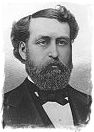
 A
useful life, early closed, was that of the well known song-evangelist,
Philip P. Bliss. He was born in Clearfield County, Pennsylvania, [United
States], July 9, 1838. His parents were Methodists, and at family worship,
where daily there was the offering of praise as well as prayer, he received
his first musical impressions. Such, too, were the sacred influences that
surrounded him in his home from his earliest years that he could not remember
the time when he was not a believer in Jesus Christ, and when twelve years
of age he united with the Baptist church of Cherry Flats, Tioga County,
Pennsylvania.
A
useful life, early closed, was that of the well known song-evangelist,
Philip P. Bliss. He was born in Clearfield County, Pennsylvania, [United
States], July 9, 1838. His parents were Methodists, and at family worship,
where daily there was the offering of praise as well as prayer, he received
his first musical impressions. Such, too, were the sacred influences that
surrounded him in his home from his earliest years that he could not remember
the time when he was not a believer in Jesus Christ, and when twelve years
of age he united with the Baptist church of Cherry Flats, Tioga County,
Pennsylvania.
In 1864, Mr. Bliss took up his residence in Chicago, where, with George F. Root, he was engaged in conducting musical institutes, conventions, etc. He owed much by way of instruction and inspiration to William B. Bradbury, and one of his first published songs was a tribute to the memory of Mr. Bradbury.
In 1874, Mr. Bliss accepted an invitation to engage in evangelistic work with Major Whittle, and his sacred songs became not only effective gospel utterances, moving hearts, but they soon made the name of the singer known in all parts of the land.
Mr. Bliss published his first musical work, "The Charm," in 1871. This was followed by the "Song Tree" in 1872, "Joy," and "Sunshine for Sunday Schools" in 1873, "Gospel Songs for Gospel Meetings," in 1874, and "Gospel Hymns and Sacred Songs" in 1875. In the preparation of this last book he was associated with Ira D. Sankey.
He had now found his life-work, and certainly he was equipped for the most successful service. But the end was at hand. December 29, 1876, with his wife, Mr. Bliss left Rome, Penn., for Chicago. Near Ashtabula, Ohio, a bridge over which the train was passing gave way, and the cars were precipitated many feet to the stream below. Mr. Bliss succeeded in extricating himself from the wreck, but was burned while vainly endeavoring to rescue his wife.
At a memorial meeting held in Chicago not long after, the fact was recalled that at the last meeting which Mr. Bliss attended in that city, he remarked, "I don't know as I shall ever sing here again, and I want to sing this hymn as the language of my heart"; and he sang most impressively his own hymn,
I know not the hour when my Lord shall come.
In "Gospel Hymns Consolidated " are thirty-seven hymns by Mr. Bliss. The first lines of the best known, are as follows:
"'Tis the promise of God, full salvation to give,"
"'Whosoever heareth,' shout, shout the sound,"
"Ho! my comrades, see the signal,"
"Free from the law, oh, happy condition,"
"I am so glad that my Father in heaven,"
"Have you on the Lord believed,"
"The whole world was lost in the darkness of sin,"
"Brightly beams our Father's mercy,"
"Almost persuaded now to believe,"
"Only an armor-bearer, proudly I stand,"
"Light in the darkness, sailor, day is at hand,"
"More holiness give me,"
"Repeat the story o'er and o'er,"
"Standing by a purpose true,"
"In Zion's Rock abiding,"
"Tenderly the Shepherd,"
"I will sing of my Redeemer,"
"Sing them over again to me."
Of these hymns,
Almost persuaded now to believe
has aided many a soul in taking a stand for Christ. It was suggested by the last words of a sermon, "He who is almost persuaded is almost saved, but to be almost saved is to be entirely lost;" Mr. Bliss was impressed with the thought and composed the hymn.
'Whosoever heareth,' shout, shout the sound,
was written in the winter of 1869-70, after hearing a sermon from the text, "God so loved the world," etc.
The whole world was lost in the darkness of sin
was written in 1875. The words and the music came to Mr. Bliss at home one morning while passing through the hall to his room.
Repeat the story o'er and o'er
was suggested by reading some notes by Dr. Brooks of St. Louis, upon the queen of Sheba's visit to Solomon. The hymn
I am so glad that our Father in heaven
was suggested to Mr. Bliss by hearing the chorus,
Oh, how I love Jesus.
"I have sung long enough of my poor love to Christ," said Mr. Bliss, "and now I will sing of his love for me." With this thought in mind he wrote the hymn. Mr. Sankey says that a little girl who was dying bore beautiful testimony to the power of these sweet words. "Don't you remember," she said, "One Thursday when you were teaching us to sing
I am so glad that Jesus loves me,
and don't you remember how you told us that if we only gave our hearts to him, he would love us? and I gave mine to him." And Mr. Sankey adds, "What that little dying girl said to me helped to cheer me on more than anything I had done before, because she, was my first convert."
The following hymn has this added interest, that it was Mr. Bliss's last hymn [refers to the hymn, "He Knows" which was written by Mary G. Brainard; P. P. Bliss added the chorus and composed the music]:
I know not what awaits me,
God kindly veils mine eyes;
And o'er each step of my onward way
He makes new scenes to rise;
And every joy he sends me comes
A sweet and glad surprise.One step I see before me.
'Tis all I need to see,
The light of heaven more brightly shines,
When earth's illusions flee;
And sweetly thro' the silence comes
His loving "Follow me."O blissful lack of wisdom,
'Tis blessed not to know;
He holds me with his own right hand,
And will not let me go,
And lulls my troubled soul to rest
In him who loves me so.So on I go, not knowing,
I would not if I might;
I'd rather walk in the dark with God
Than go alone in the light;
I'd rather walk by faith with him
Than go alone by sight.
In his later years Mr. Bliss became a member of the First Congregational church in Chicago.
From Baptist Hymn Writers and Their Hymns by Henry S. Burrage. Portland, Maine: Brown Thurston & Co., ©1888.
>> More P. P. Bliss