 All
agree that children should sing. The time for discussing that question
ceased when music, as a science, began to be taught in our common schools;
when piano and organ became as common in household furniture as bookcase
and bureau, and when instruction book and sheet music came to be as familiar
to our boys and girls as spelling-book and newspaper.
All
agree that children should sing. The time for discussing that question
ceased when music, as a science, began to be taught in our common schools;
when piano and organ became as common in household furniture as bookcase
and bureau, and when instruction book and sheet music came to be as familiar
to our boys and girls as spelling-book and newspaper.
All know that children love to sing. Next after the adoption of a resolution that the birds "can and are hereby authorized to warble," may come the question of granting the children—God's own bright birds of Paradise—permission to express their delights in song. All thoughtful, observing people admit the power of children's songs. We may question the introduction into Sunday Schools of object teaching, of blackboard exercises, or of the library books; but we must have singing books. A Sunday School may prosper in a dark basement room, with low walls and poor ventilation, but music is indispensable. You may have a flower garden without a fountain, a parlor without pictures, or a summer day without the sunshine; but do not expect a wide-awake, stirring, effective Sunday School—a school that shall enjoy a healthful popularity, and be in the highest sense successful, without Sunday School singing—the "Sunshine of Songs."
Therefore, we are not here to meet the question, "Shall the children sing?" but to suggest WHAT and HOW. Singing is emotional utterance. Singing "earnestly," "heartily," "lustily," as Wesley directs, is one thing, and a good one; making a loud, harsh, discordant sound is quite another and different exercise.
While all that really deserves the name of music is usually regulated by the law of musical form, it does not follow that all emotional utterance is singing. All music is sound; but all sounds are not music.
What shall the children sing? Unquestionably we cannot be too careful to guard against putting a cup of poisoned song to their youthful lips, and yet I cannot sympathize with those who would have only doctrinal, didactic, dogmatic songs, or rather sermons. If a child really sings, he must not only fully understand, but love the meaning of the words employed.
We must not expect the infant class or ten-year-olds to appreciate and enjoy as we do that which we call the best, in sentiment or in song. Remember, "milk for babes, strong meat for men." Make the difference apparent; strive to lead them to a higher musical taste and nobler spiritual enjoyments, but do let the children sing of birds as well as of burdens; of beauty as well as of duty; of earth pleasures as well as of heavenly treasures; of temporal employments as well as of spiritual enjoyments. Let song develop feeling, while it never fails to direct and purify the affections.
I well remember a loving, large-eyed lad who in the day-school could scarcely sing the old song of A B C D E F G, but that the tears would fall and mark the time. The lad knew not why he wept, but the faithful Christian teacher turned this mighty motive power to heavenly purposes, and gave these outflowing sympathies wholesome food. So the love of song grew and prevailed; so the channel of the affections widened, and so the lad, though taller grown stands here to plead for song.
Thank God for simple school-day song,
Scorn not the childish lay;
The feeble spark of love-light fanned
May end in heavenly day.
In order to sing properly and profitably, the time must be entirely given to and the attention wholly fixed upon the exercise. No slamming of doors, no communication among officers, no walking, talking nor parade of visitors should be allowed to disturb. We might as well walk or talk during a prose prayer (I did not say prosy) as to thus disturb a prayer in verse. I would as soon think of speaking to a brother while praying as while singing.
Then it seems to me the leader of children's singing needs often to say. "Not too loud." Earnestness is not always best manifested by loudness. Noise is not always power. Besides, more voices are injured by forced, screamy sounds than, perhaps, by all other evil means combined. "Like pastor, like people;" so, like chorister, like choir. If the leader be careless in style, intonation pronunciation, etc., those led will very likely be even more so. "Good singing" means, first, sweet, pleasant tones, true intonation, distinct articulation, etc. Earnestness, vigor, life, spirit, etc., come afterwards, and depend upon the first. Mr. O. Blackman, teacher of music in the high and primary schools of Chicago, and author of "Graded Singers," for juvenile instruction, says that the Sunday hour in some of the mission schools nearly counteracts all the week's work, by this terrible practice of screaming.
In teaching children new songs, is, perhaps, the greatest care necessary. Let the chorister sing over two or three times, in easy, pleasant, correct manner, lines and stanzas of the hymn, thus giving good examples, which in music as in morals, are much more powerful than precepts; especially if precept and example differ.
May not the Sunday School meet once a week, say on Thursday or Friday evening, and practice their music? Now, don't frown and say, "impracticable," unless you have tried and found it so. Usually young people are glad enough to be called together; and cannot a "singing meeting" be made interesting and profitable? Engage some earnest lady or gentleman leader at a fair salary; if convenient, have a piano or organ to accompany; invite the choir of the church to assist, and singing meetings will "pay." Invariably question the children as to the meaning of the difficult and unusual words of the song, so that first of all they may be able to sing with the head—that is, "with the understanding." I have a painful recollection of some ridiculous misconceptions of such words as "Prone to wander," which I thought meant a long-legged fowl wandering in a swamp! "Fearless I'll launch away," was simply a mis-pronunciation of lunch away. Nor do I like to admit that my comprehension was unusually dull; in proof of which, let me mention the case of a little imaginative listener—he sings among the angels now, and can understand their song better I am sure — who came home from Sunday School one day praising the song, but wondering at the request, "Let me die in a harness-shop!" You smile at the mistake; but is it not a serious neglect not to give the dear children more light? One of the greatest evils of fashionable singing is the inarticulate delivery of words.
Adaptation of songs to the lesson, especially that of the closing piece, is very important, though often disregarded by superintendents and choristers. How much more effective a lesson when "harrowed in" by an appropriate song; and, on the other hand, how often have we seen the impression of a lesson almost completely removed by the unfortunate introduction of some inappropriate rattle-te-bang song, because the children could "make it go" well, or visitors were present, and the school must be made to "show off."
A great need in all Sunday school work is sincerity. Nowhere is hypocrisy so woefully apparent, so generally tolerated, and so powerfully taught, as in singing. What else can we expect when children see the church members turning leaves or idly gazing about the room while singing "Nearer, my God, to Thee," or witness a solo or quartet display the words, "Jesus, Lover of my Soul," to the tune "When the Swallows Homeward Fly?" Not to speak of a singing master who, if he be not otherwise intemperate, stands before them with tobacco-stained teeth, or with smoke-tainted breath, singing the sweet, pure songs of Zion.
Above all things, then, sing and thereby teach others to sing feelingly, with the spirit. Show your sincerity in song worship, and the children will learn to be sincere. In a word, if you would have them sing sweetly, earnestly and devotionally, sing thus before them; for in nothing are children more apt at imitation than in singing.
Sing not alone with lip and voice,
But with the heart and soul rejoice;
Then they that hear will join thy praise,
And real, heartfelt songs shall raise.
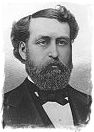
From Memoirs of Philip P. Bliss edited by D.W. Whittle... New York: A.S. Barnes & Company, ©1877. p. 221-224. Two children's Sunday school songs in which Bliss wrote both the words and music are "Dare to Be a Daniel" and "Jesus Loves Even Me."
>> More P. P. Bliss