Born: July 9, 1838, Rome, Pennsylvania 1
Died: December 29, 1876, Ashtabula, Ohio
Life Span: 38 years, 5 months, 20 days
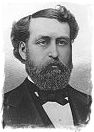 Philip Paul Bliss is the second most famous Christian song writer in history.
Had he lived as long as his peers, Fanny Crosby, Charles Wesley and Ira Sankey,
he may have surpassed them all, as the greatest song writer of all time and
the most widely used singer of all time, but a tragic accidental train wreck
snuffed out his life in his 38th year.
Philip Paul Bliss is the second most famous Christian song writer in history.
Had he lived as long as his peers, Fanny Crosby, Charles Wesley and Ira Sankey,
he may have surpassed them all, as the greatest song writer of all time and
the most widely used singer of all time, but a tragic accidental train wreck
snuffed out his life in his 38th year.
Should anyone challenge this conclusion, let us check out his contributions. For twelve years, he wrote both words and music to such hymns as the following: Almost Persuaded, Dare to Be a Daniel, Hallelujah 'Tis Done!, Hallelujah, What a Saviour!, Hold the Fort, Jesus Loves Even Me, Let the Lower Lights Be Burning, Once for All, The Light of the World Is Jesus, Whosoever Will, and Wonderful Words of Life. He wrote only the words for My Redeemer and wrote only the music for I Gave My Life for Thee, It Is Well with My Soul, and Precious Promise. How is that for a starter! There were and are hundreds more. Some of his songs widely used back when he wrote them, are not so well known today. They are: Are Your Windows Open Toward Jerusalem, Only an Armour-Bearer, More Holiness Give Me, Pull for the Shore, and Will You Meet Me at the Fountain?. None of his songs were ever copyrighted.
Mr. Bliss was born with a melody in his heart, in a log cabin home in a mountain region [see Birthplace of P. P. Bliss]. His father, Mr. Isaac Bliss, was a dedicated Christian man. The first spiritual recollections that Bliss had of his father were the daily family prayers. These prayers were ingrained upon childhood memory, ever to follow him throughout life.
His father was a lover of music and it was through his father that he developed a passion for singing. They attended the Methodist Church.
When Philip was about six the family moved to Trumbull City, Ohio, but three years later returned to Pennsylvania, settling in Tioga City. During the first ten years of his life, the lad had little schooling, save his father's singing and his mother's teachings. The Holy Bible became an ever-growing influence in his life.
At the age of ten, he heard the piano for the first time and it deepened his burden to become a musician. The occasion is worth telling. At times, he was allowed to go in to town to sell vegetables from door to door. This was a means of helping the family budget but it also put him in contact with others.
One Saturday, with his basket of vegetables, the barefooted, gawky, ten-year old boy was to hear the sweetest music that he had ever listened to. The only things that he could play melodies on were reeds plucked from the marshes. Almost unconscious of what he was doing, he climbed the garden fence of a country estate and entered [the] home unobserved. Standing in the door of the parlor, he listened to a young lady playing the piano, the first he had ever seen. When she stopped, impulsively, he exclaimed, "O lady, please play some more!" Somewhat startled, the woman wheeled and saw the awkward, barefooted boy standing before her and immediately exclaimed, "Get out of here with your big, bare feet!" The boy was unaware that he had trespassed, and he went back to the streets crestfallen.
When Philip was eleven years old, in 1849, he left home to make a living for himself. He was to spend the next five years working in logging and lumber camps and sawmills. Having a strong physique, he was able to do a man's work. The next several years took him to many places and tutored him in many trades.
At the age of twelve, in 1850, he made his first public confession of Christ and joined the Baptist Church of Cherry Flats, Pennsylvania. He does not recall a time when he did not love Christ, but this was the official time of his conversion.
In 1851 he became assistant cook in a lumber camp at $9 per month. Two years later, he was promoted to a log cutter. The following year he became a sawmill worker. Between jobs, he attended school. Uncertain as to what vocation he wanted, he just planned to be prepared for any opportunity that might arise. He spent some of his money in musical education as well. Young Philip remained strong in the Lord amongst the rowdy, laboring men of the camp, although it was not easy, but the spiritual implants of the godly parents were now bearing fruit. He also began to participate in Methodist camp meetings and revival services.
At age seventeen, in 1855, he decided that he would take the final step in preparation for his life's work. He went to Bradford City, Pennsylvania and finished the last requirements for his teaching credentials. The next year Philip was the new schoolmaster at Hartsville, New York. When school was not in session, he hired out for summer work on a farm. In 1857 he met J. G. Towner who conducted a vocal school in Towanda, Pennsylvania. Recognizing that young Bliss had an unusually fine singing voice, he proceeded to give him his first formal voice training. Towner also made it possible for him to go to a musical convention in Rome, Pennsylvania, later that year. Here he met William B. Bradbury, a noted composer of sacred music. By the time the convention was over, Bradbury had talked Philip Bliss into surrendering himself to the service of the Lord. The strong influence of these men in his life helped him to decide to be a music teacher. While still in his teens, Philip discovered that he had ability to compose music. His first composition was sent to George F. Root with this strange request, "If you think this song is worth anything, I would appreciate having a flute in exchange for it." He received the flute.
In 1858 he was appointed a teacher in the Rome, Pennsylvania, Academy. Here he met a fine young lady named Lucy Young, who was to become his bride. She was a poet from a musical family and greatly encouraged him in developing his musical talents. She was an earnest member of a Presbyterian Church, which he then joined. In later years they were to sing beautiful duets in the service of Christ. Not quite 21, on June 1, 1859, he married Lucy who was also his sister's special friend. He had grown to love her deeply and to admire her for her wonderful Christian life. The young groom worked on his father-in-law's farm for $13 a month while he continued to study music.
He took music pupils in the evening to supplement his income and at 22 had sufficient knowledge of music to become an itinerant music teacher. He went from community to community with a $20 melodeon and an ancient horse. It was the day of the old-fashioned singing school which was frequently conducted by a teacher traveling from place to place. Mr. Bliss delighted in these exercises and his musical ability began to attract the attention of his friends. As a teacher of one of these schools, he recognized his limitations and longed to study under some accomplished musician.
His wife's grandmother provided that opportunity in the summer of 1860, by giving him $30 so that he could attend the Normal Academy of Music of New York. This meant six weeks of hard study and inspiration. Upon completion, he took the occupation of professional music teacher in earnest. Within three years, having attended each summer session and studying the rest of the year at home, Mr. Bliss was now recognized as a music authority in his home area, while continuing to travel his circuit. His talent was turning to composition, and his first published number ... Loral Vale ... though not a sacred number, caused him to believe that he could write songs. This number was published in 1865, one year after it was written.
The Blisses moved to Chicago in 1864 when Philip was 26. It was here he began to conduct musical institutes and became widely known as a teacher and a singer. His poems and compositions flowed out with regularity. He collaborated with George F. Root in the writing and publishing of gospel songs. In the summer of 1865, he went on a two-week concert tour with Mr. Towner. He was paid $100. Amazed that so much money could be made in so short a time, he began to dream dreams. These dreams were short lived. The following week a summons appeared at his door stating that he was drafted for service in the Union Army. Since the war was almost over, the decision was cancelled after two weeks, and he was released. He then went on another concert tour but this one was a failure. However, during the tour he was offered a position with a Chicago Music House, Root and Cady Musical Publishers, at a salary of $150 per month.
For the next eight years, between 1865 and 1873, often with his wife by his side, he held musical conventions, singing schools, and sacred concerts under the sponsorship of his employers. He was becoming more popular in concert work, not yet directing his full efforts into evangelical singing. He was, however, writing a number of hymns and Sunday school melodies, and many of these were incorporated into the books, The Triumph and The Prize.
One summer night in 1869, while passing a revival meeting in a church where D. L. Moody was preaching, Mr. Bliss went inside to listen. That night Mr. Moody was without musical help for the singing and Mr. Bliss was aware of it. The singing was rather weak. From the audience, Philip attracted Mr. Moody's attention. At the door, Mr. Moody got the particulars about Mr. Bliss quite quickly and asked him to come to his Sunday evening meetings to help in the singing any time he could. He further urged him to give up his business and become a singing evangelist.
Another chance acquaintance came with Major Daniel W. Whittle, when Mr. Bliss was a substitute song leader in a gospel meeting. Impressed with his voice, Mr. Whittle recommended the young man for the position of choir director at the First Congregational Church in Chicago. This was in 1870. The Blisses moved into an apartment in the Whittle home, and while living there, he wrote two of his most popular hymns... Hold the Fort and Jesus Loves Even Me. Yearly, new songs were published with many of Bliss's songs included. His fame began spreading.
In the fall of 1870, Mr. Bliss assumed the additional task of Sunday school Superintendent at the Congregational Church, which work lasted for three years until his busy schedule made it impossible for him to continue. His first Sunday school book, The Charm, was issued in 1871.
Early in 1873 Moody asked Bliss to be his music director for some meetings in England. Bliss declined and Sankey was then asked to go. Little did Bliss realize the opportunity he had turned down, for it might have been "Moody and Bliss" instead of "Moody and Sankey," for that tour bought Moody into international prominence.
During the winter of 1873 Moody again urged him in a letter from Scotland to devote his entire time to evangelistic singing. Mr. Bliss was facing a time of decision. At a prayer meeting, Mr. Bliss placed himself at the disposal of the Lord, and he decided to lay out a fleece. He would join his friend Major Whittle, a good evangelist, in Waukegan, Illinois, and see what would happen. That was March 24-26, 1874. At one of the services as Mr. Bliss sang Almost Persuaded, the Holy Spirit seemed to fill the hall. As he sang, sinners presented themselves for prayer and many souls were won to Jesus Christ that night. The following afternoon, as they met for prayer, Mr. Bliss made a formal surrender of his life to Jesus Christ. He gave up everything — his musical conventions, his writing of secular songs, his business position, his work at the church, so that he would be free to devote full time to the singing of sacred music in evangelism, in particular to be Mr. Whittle's song evangelist and children's worker. At the same time, Mr. Whittle dedicated his life to full-time evangelism. A gospel team was born. Little did Mr. Bliss know that he only had two and one-half years to live.
Depending upon the Lord to take care of his wife and two children, he joined Whittle in a successful evangelistic career. Mr. Bliss compiled a revival song-book for use in their campaigns entitled Gospel Songs. It was a tremendous success, bringing royalties of $30,000, all of which he gave to Whittle for the development of their evangelistic efforts. Another source mentions $60,000 was made and given to charities. Later when Moody and Sankey returned from England, Sankey and Bliss combined their respective books, Sankey's Sacred Songs and Solos with Bliss's book. The new compilation was called Gospel Hymns and Sacred Songs by Bliss and Sankey. Mr. Bliss, of course, was elated at this further exposure of his ministries. Several editions were later published with George C. Stebbins collaborating also. Meanwhile, the Whittle-Bliss team held some twenty-five campaigns in Illinois, Wisconsin, Pennsylvania, Kentucky, Minnesota, Mississippi, Alabama, and Georgia. The 1875 Louisville, Kentucky, meeting was an especially good one. Mr. Bliss especially enjoyed working with young people and often conducted his own "praise meetings." where he would preach and sing.
On Friday, November 24, 1876, Mr. Bliss sang at a ministers' meeting conducted by D. L. Moody in Chicago's Farwell Hall. Over 1,000 preachers were present. A favorite song that was sung, was Are Your Windows Open Toward Jerusalem. Also, he introduced to the gathering a new song that he had just written the music for ... It is Well with My Soul. He now had one month to live.
Next, he conducted a service for the 800 inmates of the Michigan State prison. In genuine repentance, many of them wept as he spoke of the love of God and sang, Hallelujah, What a Saviour! The last hymn that he ever sang in a public meeting was one of his own, called Eternity.
Mr. Bliss spent the Christmas holidays with his mother and sister at Towanda and Rome, Pennsylvania, and made plans to return to Chicago for work with Moody in January. A telegram, however, arrived asking him to return sooner, in order to take part in meetings advertised for the Sunday following Christmas. He wired a message. "Tickets for Chicago, via Buffalo and Lake Shore Railroad. Baggage checked through. Shall be in Chicago Friday night. God bless you all forever." He decided to leave his two little children, Philip Paul age 1 and George age 4, with his mother.
Then, the day that was to stun the Christian world arrived, December 29, 1876. The train, the Pacific Express, was struggling along in a blinding snowstorm and was about three hours late on a Friday afternoon. Eleven coaches pulled by two engines were creeping through the huge drifts, approaching Ashtabula, Ohio. Passing over a trestle bridge that was spanning a river, the first engine reached solid ground on the other side but everything else plummeted 75 feet into the ravine below into the icy water. Later, it was determined that flood waters had weakened the bridge.
Five minutes after the train fell, fire broke out. Fanned by gale like winds, the wooden coaches were ablaze. Mr. Bliss succeeded in extricating himself and crawling to safety through a window. Finding his wife was pinned under the ironwork of the seats, he returned into the car, and bravely remained at her side, trying to extricate her as the flames took their toll. All that remained was a charred mass. No trace of their bodies was ever discovered. For days it was not known who were among the dead, as there had been no passenger list. It was tabulated that out of 160 passengers there were only 14 survivors. Later official sources said 92 died. In most cases, there was nothing to recover. [See Ashtabula Bridge Disaster]
Mr. Bliss's trunk reached Chicago safely. When it was opened, it was found that the last song that he had written before his death [refers to the hymn, "He Knows" which was written by Mary G. Brainard; P. P. Bliss added the chorus and composed the music], began as follows: "I know not what awaits me. God kindly veils my eyes..." The trunk contained many hymn-poems which he had not yet written the music for. One such was My Redeemer, which became world famous, when music was added by James McGranahan. McGranahan, by the way, age 36 at the time of Bliss's death, was so moved by the tragedy that he decided to give up his miscellaneous works and succeed Bliss as Whittle's evangelistic singer.
The funeral was held in Rome, Pennsylvania, where a monument was erected bearing the inscription, "P. P. Bliss, author... Hold the Fort!" Memorial services were held throughout the nation for the beloved couple. No private citizen's death brought more grief to the nation. On December 31st, D. L. Moody spoke at a memorial gathering in Chicago. On January 5th, a song service was held to honor Mr. Bliss there and 8,000 filled the hall, and another 4,000 were on the outside.
Here are the stories of a few of his hymns:
Almost Persuaded... Outside of Just as I Am, this has been the most successful gospel invitation song ever written. In the early 1870's, Mr. Bliss was listening to a sermon by Rev. Brundage, a friend of his, in a little church in the east. The preacher closed his appeal with, "He who is almost persuaded is almost saved. But, to be almost saved is to be eternally lost!" These words impressed Bliss so deeply that it led him to write this great hymn.
Hold the Fort... In 1864, General Hood, during the Civil War, was successful in harassing Colonel Sherman's Army from the rear, thereby delaying its advance to the objective. As the situation looked hopeless they saw a white flag waving on a distant mountain twenty miles away signaling this message, "Hold the Fort! I am coming. Sherman." Three hours later the enemy had to retreat as the reinforcements came. In May, 1870, at a special Sunday School meeting in Rockford, Illinois, Whittle's telling of this story greatly moved Bliss. The next day in a Chicago YMCA meeting. Mr. Bliss wrote a chorus on a blackboard and sang for them extemporaneously. The audience joined in and the effect was electric.
Jesus Loves Even Me... One night, MR. Bliss, weary after many days of labor in downtown Chicago, was resting at the Whittle home at 43 South Street. His heart was overflowing with joy and he sat meditating upon Romans 5:5. As he meditated and prayed, with tears in his eyes, he took pencil and paper and wrote, "I am so glad that our Father in heaven, Tells of His love in the Book He has given..."
Let the Lower Lights be Burning... On occasion, Mr. Bliss would travel with Moody and be a participant at his meetings. One time Mr. Moody was telling the story of a shipwreck in one of his messages. On a dark stormy night, a large passenger boat cautiously edged toward the Cleveland harbor. The pilot knew that he could only find the harbor channel by keeping two lower shore lights in line with the main beacon. "Are you sure this is Cleveland?" asked the captain. "Quite sure, Sir," replied the pilot. "Where are the lower lights?" he asked. "Gone out, Sir!" was the reply. The pilot turned the wheel, but in the darkness, he missed the channel. The boat crashed on the rocks and many lives were lost that night. Mr. Moody's closing words were, "Brethren, the Master will take care of the great lighthouse; let us keep the lower lights burning." At the next meeting with Mr. Moody, Mr. Bliss sang this song... Let the Lower Lights Be Burning. It was published in 1874. It is said that this was the favorite hymn of Billy Sunday.
We end this sketch noting It is Well with My Soul whose words were written by Horatio G. Spafford. On November 22, 1873, this preacher and good friend of Mr. Bliss lost his four children in the depths of the Atlantic Ocean, as a result of a collision. Mr. Spafford had sent his wife and children ahead, promising to meet them in France, shortly. He wrote the verses in mid-Atlantic on his way over to join his bereaved wife. He asked Mr. Bliss to write the music for his verses. It was introduced publicly for the first time at the previously mentioned ministers' meeting in Chicago in November, 1876. One month later, it was well with Mr. Bliss's soul, as he was reunited with the Spafford children.
Used with permission, 7/13/99. From one of 49 booklets by Ed Reese in his Christian Hall of Fame series.
>> More P. P. Bliss