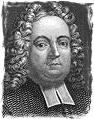
 Matthew
Henry: Non-conformist minister and commentator; born at Broad Oak, near Bangor-Iscoed,
Flintshire, Wales, October 18, 1662; died at Nantwich (17 miles southeast
of Chester), Cheshire, June 22, 1714. He was educated privately at the home
of his father, the Rev. Philip Henry, and at the academy of Thomas Doolittle,
Islington, which he attended 1680-82. In May, 1685, he began the study of
law at Gray's Inn; but he already desired to enter the ministry, and devoted
much time to theological studies.
Matthew
Henry: Non-conformist minister and commentator; born at Broad Oak, near Bangor-Iscoed,
Flintshire, Wales, October 18, 1662; died at Nantwich (17 miles southeast
of Chester), Cheshire, June 22, 1714. He was educated privately at the home
of his father, the Rev. Philip Henry, and at the academy of Thomas Doolittle,
Islington, which he attended 1680-82. In May, 1685, he began the study of
law at Gray's Inn; but he already desired to enter the ministry, and devoted
much time to theological studies.
In June, 1686, he began to preach in the neighborhood of Broad Oak, and in the following January he preached privately in Chester. He was asked to settle there, and consented conditionally, but returned to Gray's Inn. After the declaration of liberty of conscience by James II in 1687, he was privately ordained in London, and on June 2, 1687, he began his regular ministry as pastor of a Presbyterian congregation at Chester. He remained in this charge for twenty-five years. After having several times declined overtures from London congregations, he finally accepted a call to Hackney, London, and entered upon his ministry there May 18, 1712. He visited Chester for the last time in May, 1714. On his return journey he was seized with apoplexy, and died at Nantwich.
Henry's reputation rests upon his celebrated commentary, An Exposition of the Old and New Testaments (5 vols., London, 1708-10; afterward enlarged and often reprinted; new ed., 5 vols., New York, 1896). He lived to complete it only as far as to the end of the Acts; but after his death certain non-conformists prepared the Epistles and Revelation from Henry's manuscripts. This work was long celebrated as the best of English commentaries for devotional purposes. The author betrays a remarkable fertility of practical suggestion; and, although the work is diffuse, it contains rich stores of truths, which hold the attention by their quaint freshness and aptness, and feed the spiritual life by their Scriptural unction. It has no critical value; and Henry in the preface expressly says that, in this department, he leaves the reader to Poole's Synopsis. Robert Hall, Whitefield, and Spurgeon used the work, and commended it heartily. Whitefield read it through four times, the last time on his knees; and Spurgeon says (Commenting and Commentaries, p. 3): " Every minister ought to read it entirely and carefully through once at least."
Other works by Henry are Memoirs of...Philip Henry (1696); A Scripture Catechism (1702); A Plain Catechism (1702); The Communicant's Companion (1704); A Method for Prayer (1710); and numerous sermons, which are included in his Miscellaneous Works (1809; ed. Sir J. B. Williams, 1830; also 2 vols., New York, 1855, containing funeral sermons by Daniel Williams, John Reynolds, and William Tong).
Bibliography: W. Tong, An Account of the Life and Death of Matthew Henry, London, 1716; J. B. Williams, Memoirs of Matthew Henry, ib. 1850 (uses Henry's diaries); C. Chapman, Matthew Henry, his Life and Times, ib. 1859; A. B. Grosart, Representative Nonconformists, ib. 1879; DNB, xxvi. 123-124.
From The New Schaff-Herzog Encyclopedia of Religious Knowledge... New York: Funk and Wagnalls Company, 1909.
>> More Matthew Henry