 The
songs of a nation are as important as its laws; and the hymns of the church
have had as great influence on its life and doctrine as the decrees of councils
or the systems of theologians.
The
songs of a nation are as important as its laws; and the hymns of the church
have had as great influence on its life and doctrine as the decrees of councils
or the systems of theologians.
For nearly two generations, Christian people have been singing:
Take my life and let it be
Consecrated, Lord, to Thee.
Can any one measure the influence of this one hymn upon the lives of those who have loved it and sung it?
Its origin is interestingly significant. Miss Havergal, the author, was invited to a house party of five days in London. There were ten in the party, some unconverted to Christ, and some of the Christians "not rejoicing." Now, personal joy in the Lord, the bubbling of an ever-flowing fountain of peace, was to Miss Havergal so constant and precious an experience that she wished all to share it. Accordingly, her heart went out toward them all; and she prayed, "Lord, give me all in this house." She adds, "And He just did. Before I left the house, every one had got a blessing." They had all come to Jesus and believed His promises; "and so coming, so believing, they found rest unto their souls. They found, too, that His word was true and that His taking away our sins was a reality." That night, she was too happy to sleep. A deep joy possessed her. "I passed most of the night in renewal of my consecration; and these little couplets formed themselves and chimed in my heart one after the other till they finished with 'ever, only, all for Thee.' " Surely that which is born in such an experience is endowed with vitality and predestined of God for real accomplishment.
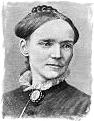
Frances Ridley Havergal was born at Astley, Worcestershire, England, December 14, 1836, and died at Caswell Bay, Swansea, South Wales, June 3, 1879, in the forty-third year of her life. She was a bright and winsome child, precocious in affection as well as in intellect. At the age of seven she wrote verses. Soon after, she became a linguist; she acquired mastery of French, German and Italian and of Latin, Greek and Hebrew—of the last two that she might better understand the Bible. To the study of the Scriptures all her powers of scholarship, and intuition were bent, as a look into her annotated and underlined Bible would show and as a study of her hymns would abundantly testify. During her visits to Wales, she learned enough Welsh to enable her to take part in worship.
Her conversion was thorough and, as is generally the case, profoundly influenced her theology. As a child she felt herself a sinner, and this feeling was intensified at her mother's death, which occurred when Frances was only eleven years old. At fourteen, Diana, her room-mate at school, "found peace," and cried out to her friend: "Oh, Fanny, dearest Fanny, the blessing has come to me at last. Jesus has forgiven me, I know. He is my Saviour and I am so happy. He is such a Saviour as I never imagined, so good, so loving. Only come to Him and He will receive you." Thus encouraged and exhorted, Frances assiduously sought the Saviour till she finally could "trust," and that surrender brought assurance that her sins were forgiven. In successive stages throughout her life this assurance deepened.
Later, when she was sent away to a boarding school in Germany, she was surrounded by a hundred and ten girls who shared neither her experience nor her aspirations. Her personal religion was too vital a thing for them to understand. A lesser nature might have succumbed, but she found that nipping atmosphere "very bracing" to her Christian life. She wrote home, "I must walk worthy of my calling."
The formal seal upon this "calling" occurred after her return to England, when she was seventeen years old. Of her experience as she stood before the altar at Worcester Cathedral she writes: "My feelings when his [the bishop's] hands were placed on my head I can not describe. When the words, 'Defend, O Lord, this Thy child with Thy heavenly grace, that she may continue thine forever, and daily increase in Thy Holy Spirit more and more, until she come into Thy everlasting Kingdom' were solemnly pronounced, if ever my heart followed a prayer it did then, if ever it thrilled with earnest longing not unmixed with joy, it did at the words, 'Thine forever.'"
This deep, sacred experience found expression in a stanza of self-dedication, written on the day of her confirmation, July 17, 1854:
| Thine Forever Oh! "Thine for ever," what a blessed thing To be forever His who died for me! My Saviour, all my life Thy praise I'll sing, Nor cease my song throughout eternity. |
She always kept the anniversary of her confirmation as a day of retirement and prayer; often she then renewed her pledges in verse as the following stanza, written but two years before her death shows:
Only for Jesus! Lord, keep it for ever,
Sealed on the heart and engraved on the life!
Pulse of all gladness, and nerve of endeavor,
Secret of rest, and the strength of our strife!
The vows solemnly taken in youth thereafter ruled her life. She lived for her Saviour. Her friends and acquaintances could not but feel her complete consecration. A teacher wrote of her: "What imprinted the stamp of nobility upon her whole being and influenced all her opinions was her true piety, and the deep reverence she had for her Lord and Saviour whose example penetrated her young life through and through."
This piety of hers, however, had nothing dark and dismal about it. Upon a visit to Ireland when she was but twenty years old, Miss Havergal left this impression upon an Irish school girl: "Five o'clock P. M. was the hour appointed for the girls to arrive at the Lodge. We were in a great state of delight at the thought of seeing 'the little English lady.' In a few seconds Miss Frances, caroling like a bird, flashed into the room. Flashed! Yes, I say the word advisedly, flashed in like a burst of sunshine, like a hillside breeze, and stood before us, her fair sunny curls falling around her shoulders, her bright eyes dancing, and her fresh sweet voice ringing through the room. I shall never forget that afternoon, never! I sat perfectly spellbound as she sang chant and hymn with marvelous sweetness, and then played two or three pieces of Handel which thrilled me through and through. She finished with singing her father's tune (Hobah) to 'The Church of our Fathers.' She shook hands with each, and said with a merry laugh: 'The next time I come to Ireland, we must get up a little singing class and you must all sing with me.' As we walked home, one and another said: 'O, isn't she lovely? and doesn't she sing like a born angel!' 'I love her, I do; and I'd follow her every step of the way back to England if I could!
Looking through the eyes of this enthusiastic Irish girl, is it hard to guess why throughout her life Miss Havergal radiated Christian happiness? She was indeed an accomplished musician; she played the pianoforte with skill, sang with charm, and composed. Her friends delighted to hear her interpret the great masters, especially Handel, Beethoven and Mendelssohn, much of whose work she knew by heart. Her playing of Beethoven's Moonlight Sonata was unforgettable. Even the great Hiller said she had decided talent.
This musical taste and ability she inherited from her father, the Reverend William Henry Havergal, M.A., a devout rector. He composed cathedral services and many hundred chants and tunes, and several sacred songs, the profits of which were always devoted to various forms of benevolence and missions, and the repair of churches. A cathedral service in A won him a prize medal and a second gold medal came for his anthem, Give Thanks. His home life with his six children, of whom Frances was the youngest, was ideal. Frances, like her father, delighted in making religious use of her musical talent. "Literal singing for Jesus is to me, somehow, the most personal and direct commission I hold from my beloved Master. Every line in my little poem, 'Singing for Jesus,' is from personal experience."
She became increasingly interested in the great cause of temperance, in which there was then an even greater need than to-day for earnest work. Hospital visitation, foreign missions, Sunday school work for boys, and gospel work among sailors enlisted her cooperation and in these practical ways her religion found expression. She was greatly interested in the religious possibilities of the Young Women's Christian Association, and was a zealous worker in it. It is little wonder that a life of such devoutness should be marked by trust, praise, and spiritual insight. "A disappointment," she said, "is His appointment." " 'Thy will be done' is not a sigh but a song." Later in life, she wrote to a friend: "I have been so happy lately, and the words 'Thou hast put gladness in my heart' I can use, as true of my own case."
Her happiness was not dimmed by the fact that her health was never robust and ailments came with increasing frequency. Her last illness was brought on by an exertion characteristic of her whole life. She had promised to meet some men and boys on the river bank; and though the day proved to be very damp, she went with her Bible and temperance book, held the meeting, and returned wet and chilly with the rain and sea-mist. Though feeling poorly, she insisted on going to communion the following day, and rode back on a donkey, attended by quite a procession of people. Her donkey boy recalls that Miss Frances told him, "I had better leave the devil's side and get on the safe side; that Jesus Christ's was the winning side; that He loved us and was calling us, and wouldn't I choose Him for my Captain?" Arriving at home, Miss Havergal ran in for her book and the boy signed the pledge on the saddle. A young sailor, also, W. Llewellyn by name, seemed interested. He was going to sea the next day. Miss Havergal dragged herself to the cottage to speak with him. He signed the pledge and his last letter, written from Brazil, states that he has faithfully kept it. This was the last time Miss Havergal's feet were
Swift and beautiful for Thee.
These exertions caused her to take to her bed. Her illness took a sudden turn for the worse. She seemed to divine what the end would be. When suffering the most, she whispered, "It's home the faster." Later, she said to her sister, "God's will is delicious; He makes no mistakes."
The vicar of Swansea hurried to her bedside. "Is Jesus with you now?" he asked. "Of course he is!" was the reply; "it is splendid! I thought He would have left me here a long while; but He is so good to take me now. Tell — that God's promises are all true, and the Lord Jesus is a good big foundation to rest upon. Ask Mr. A— to speak plainly about Jesus; I want all young ministers to be faithful ambassadors, and win souls. Oh, I want all of you to speak bright, BRIGHT words about Jesus, oh, do, do! It is all perfect peace. I am only waiting for Jesus to take me in " A sharp spasm ensued, after which she sank back, folded her hands on her breast and said: "There, now it's all over. Blessed rest!" Those who looked on in awe said that her death was almost a visible meeting with her King. Her countenance lighted up as if she were already talking to Him, a glorious radiance on her face. Then, as her brother was praying, her spirit fled away.
In forming an estimate of the value of Miss Havergal's life for posterity, first place must be given to her hymns. It is by these that she, "though dead, yet speaketh." Fifty of them are now found in common use in English-speaking countries. One will readily recall familiar lines, such as "I gave my life for thee," "Lord, speak to me that I may speak," "Tell it out among the heathen," "O Saviour, precious Saviour," "True-hearted, wholehearted." Still other hymns have won immortality, such as "Our yet unfinished story," "I could not do without Thee," "I am trusting Thee, Lord Jesus," "Thou art coming, O my Saviour." If this list seems large it is an evidence of the magnitude of her life-task. If, on the contrary, it seems incomplete, and lovers of her work wonder at the omission of their favorites from the lists, this fact too, is evidence of the quality and permanence of her contribution to hymnology.
These hymns first saw the light in a very humble way. Intimate friends urged their publication, and they were printed as leaflets or ornamental cards. Their success was immediate and they were scattered by the tens of thousands. With their message of gospel cheer, they reached humble homes in all parts of the world; afterwards they were gathered into inexpensive booklets. It was not till 1869 that a collection of her poems was published under the title The Ministry of Song. Under the Surface followed in 1874, Life Mosaics in 1879; and other volumes appeared posthumously, through the devotion of a sister.
The origin of "I gave my life for thee" shows the spontaneity of all her work. Miss Havergal was visiting in Germany in 1858; and coming in weary, one afternoon, her eye rested on an Ecce Homo. It was such a picture of the suffering Saviour as touched the heart of Count Zinzendorf in 1719 and made a missionary of him. Whether the experience of the great Moravian was in Miss Havergal's mind or not, the motto beneath the picture, "Hoe feci pro te; quid facis pro me?" touched her emotions, and she rapidly wrote the hymn upon a bit of paper. But it seemed poor to her, and she started to throw it into the open fire. Something restrained her, however, and she put it, crumpled and singed, into her pocket. Soon after she read it to an old saint in an almshouse who was much helped by it. She was encouraged to print it, and it met with wide favor. Her father composed a tune for it, Baca, and it was widely sung. The tune by P. P. Bliss is generally used in the United States, although many musicians have composed for it; but it remained for Barnby's genius to wed the hymn to perfect music, in his St. Olave. It was the hearing of three of her hymns sung at church, among them Baca, which led Miss Havergal to note the wide influence of religious music and to resolve to concentrate her energies upon its production for her Master.
"Tell it out among the heathen that the Lord is King" followed much later in her career. It was born on a snowy Sunday morning in 1872 when Miss Havergal's ill health debarred her from going to church. Her friends, on returning from service, were surprised to find her at the piano, a new hymn already written in her hand. In explanation, she said that she was following the church service in her room when a sentence from the prayer book struck her attention. "What a splendid first line!" she thought, and so the hymn came. It was popularized by Mr. Sankey in a tune of his own composition.
Miss Havergal always felt that her poems were "given" to her from above. "Writing is praying with me, for I never seem to write even a verse by myself and feel like a little child writing what is dictated." In 1874, she wrote to a friend: "The Master has not put a chest of poetic gold into my possession and said, 'Now use it as you like!' but He keeps the gold and gives it to me piece by piece just when He will and as much as He will and no more."
More of her theory of hymn writing she gives in the introduction to her book Specimen-Glasses. She calls them "flowers," and continues: "Far-wafted fragrance, exquisite workmanship, delicate and striking beauty of form and color, stores of hidden honey, are not the only points of comparison. There should be in every such flower incorruptible seed, which may spring up in the heart of many a gatherer, blossoming there in the beauty of holiness, and bearing fruit unto life eternal. ...Some hymns are true amaranths, and never die, rather gaining than losing the power of their fragrance and loveliness as years and even centuries pass on."
Later on, in this same book, she writes an illuminating comment on the hymns of Charlotte Elliott which not only is inherently true but also applies perfectly to Miss Havergal herself. "Her hymns are all heart-work, and whether written in first, second or third person, we feel that she has lived every line; and that is why they touch other lives so magnetically. ...It may take many a year of living to produce a hymn which comes to the surface in a flash of thought."
Work of this quality naturally is attractive to the musicians of the highest skill; and Miss Havergal's verse has been set to music by some of the best composers of the nineteenth century. Among them can be mentioned Gounod, Blumenthal, Randegger, Pinsuti, Dykes and Abt...
Miss Havergal's hymns echo her theology; it was warmly evangelical and deeply subjective. If it were to be criticised at all, it would be for its lack of the social emphasis now so common in Christian thinking. Moreover, to one whose experience has not been so deep as hers, she seems over-intense. The, writer remembers the repugnance he felt as a boy to some of the sentiments he found in Kept for the Master's Use. He had a feeling that a college song was all right on occasion and revolted against the pietism which would "sing"
Always, only, for my King.
It seemed an undue renunciation of innocent pleasures, a false, demarcation between the world and the church, the secular and the Christian. This fact is noted here simply for the enlightenment of those who may have felt the same way, as if Miss Havergal were
A creature quite too bright and good
For human nature's daily food,
to alter Wordsworth for this purpose!
This feeling, however, does an injustice to Miss Havergal. There was no cant about her. There was absolutely none of the holier-than-thou in her relations with others. She was simple, unaffected, genuine, true. She lived higher up on the mountain-side of Christian experience than most mortals; but she beckoned to all who dwelt below and bore consistent witness to the quality of life up there.
Her life has been seized upon by ardent sectarians of different schools to illustrate their pet theories of "sinless perfection," of "second blessing," and the like; but her experience was far too large and genuine to fit into any molds so narrow and irregular. Her career illustrated not a second blessing but a score of blessings; it was a running commentary on the text: "Grow in grace and in the knowledge of Jesus." "You know something of how He can 'come,' " she once wrote, "but do you think you have reached the end of His gracious comings?" She was a little suspicious of a too-easy consecration. "There is always a danger that just because we say 'all' we practically fall shorter than if we said 'some' but said it very definitely.
Sanity, reasonableness, a sunny, human temper, a sense of humor, marked her work as well as her life and kept her from flying off on any tangent. Greater than her music, greater than her hymns was the person herself. Her religious life was pure, deep, constant. She fed upon her Bible. All her work is pervaded by its teachings. In one poem of sixty-four lines, the writer has counted one hundred and eleven references to the Christian Scriptures! One is not surprised, therefore, at her spiritual development. To her nearest and dearest she was the embodiment of her own words:
The fullness of His blessing encompasseth our way;
The fullness of His promises crowns every brightening
day;
The fullness of His glory is beaming from above,
While more and more we realize the fullness of His
love.
Thus, through devotional poetry and music, her intense life sings happiness into Christian hearts. Her middle name, Ridley, was given her in memory of the great Oxford martyr of the sixteenth century; did she not bear it worthily? Hers was the living sacrifice, daily laid on the altar, a service of reason and persuasion. Reverend James Davidson says: "She carved out a niche which she alone could fill. Simply and sweetly she sang the love of God and His way of salvation. ...She lives and speaks in every line of her poetry. Her poems are permeated with the fragrance of her passionate love of Jesus."
After Miss Havergal's death, a sum of money amounting to nineteen hundred pounds was raised as a memorial to her, to be used for supporting native Bible women in India and circulating her books. Her life is her best memorial, however, just as, in turn, it is a memorial of her Saviour's power to save from sin and enrich the life of the believer. Her body was buried in a quiet English churchyard, and the stone bears this verse: "The blood of Jesus Christ His Son cleanseth us from all sin." No Scripture could be more fitting for her whose life was so truly redeemed and whose influence is still a redeeming force.
God's singer! In a land
Of alien thought and language thou didst sing
The songs of Zion; now before thy King,
Blest singer, thou dost stand!
Thine earthly singing o'er—
Thy singing sweet and strong and glad and wise—
Thou art, among the choir of paradise
A singer evermore.
From Heroines of Modern Religion edited by Warren Dunham Foster. New York: Sturgis & Walton Co., 1913.
>> More Frances Ridley Havergal