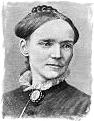
 Frances Ridley Havergal, the "sweet singer and yet strong," was the
writer of this and of many other exquisitely beautiful poems and hymns.
I think hardly any can read the marvelously interesting story of her
life, written by her sister, without feeling how far they themselves
fall short of what a Christian can and ought to be. The possibilities
of a life wholly yielded to Jesus Christ are great indeed. I pray that
we may all be stirred, as we shall hear today of her close following
of her King and Saviour, to imitate her life and follow her faith.
Frances Ridley Havergal, the "sweet singer and yet strong," was the
writer of this and of many other exquisitely beautiful poems and hymns.
I think hardly any can read the marvelously interesting story of her
life, written by her sister, without feeling how far they themselves
fall short of what a Christian can and ought to be. The possibilities
of a life wholly yielded to Jesus Christ are great indeed. I pray that
we may all be stirred, as we shall hear today of her close following
of her King and Saviour, to imitate her life and follow her faith.
I will mention four points that especially impress me in reading her life:
1. Her consecration to Christ.
2. Her devotion to her Saviour.
3. Her love of the Bible.
4. Her habit of Prayer.
1. Her Consecration to Christ. — Her hymn:
"Take my life, and let it be
Consecrated, Lord, to Thee,"
was true of her in every line. Mind, hands, feet, money, influence, love, her very self, were all devoted to the service of her Master and her King. The story of the writing of this hymn is given in her own words. She says: "Perhaps you will be interested to know the origin of 'The Consecration Hymn,' 'Take my Life.' I went for a little visit of five days. There were ten persons in the house, some unconverted and long prayed for; some converted, but not rejoicing Christians. He gave me the prayer: 'Lord give me all in this house!' And He just did. Before I left, everyone had got a blessing. The last night of my visit I was too happy to sleep, and passed most of the night in praise and renewal of my own consecration; and these little couplets formed themselves, and chimed in my heart, one after another, till they finished with 'Ever, ONLY, ALL for Thee."'
Henceforth she sang only for Jesus. All secular songs were laid aside. This was in December, 1873. In August, 1878, she wrote to a friend: "The Lord has shown me another little step, and of course I have taken it with extreme delight. 'Take my silver and my gold,' now means shipping off all my ornaments to the Church Missionary House (including a jewel cabinet that is really fit for a countess), where all will be accepted and disposed of for me. I retain a brooch or two for daily wear, which are memorials of my dear parents, also a locket containing a portrait of my dear niece in Heaven, my Evelyn, and her two rings; but these I redeem, so that the whole value goes to the Church Missionary Society. Nearly fifty articles are being packed up. I don't think I ever packed a box with such pleasure."
Miss Havergal had copies printed of her Consecration Hymn which she gave sometimes at the end of a meeting, asking those who really meant it to sign their names on the blank line at the bottom of the paper, when alone, and on their knees before God, as a pledge of their resolve to be "Ever, only, all for Jesus."
2. Her Devotion to her Saviour. — Her love to the Lord Jesus was a passion, it was so intense and strong. In her love there was the lowliest adoration, and also the highest worship. She says: "There are times when I feel such intensity of love to Jesus that I have not words to express it. I rejoice in Him as my Master and my King, but I want to come nearer still and have His promise in St. John 14:21 fulfilled to me, 'I will love him, and will manifest Myself to him.'"
Her hymns are full of passionate love of the Lord Jesus. What adoration there is in her glorious Advent hymn; and how wonderfully throughout it she adds name to name, to try to express all that the Lord Jesus was to her: "My Saviour!" "My King!" "My glorious Priest!" "My own beloved Lord!" "My Master and my Friend!"
"Thou art coming, O my Saviour!
Thou art coming, O my King!
In Thy beauty all-resplendent,
In Thy glory all transcendent;
Well may we rejoice and sing!
Coming! In the opening east
Herald brightness slowly swells;
Coming! O my glorious Priest,
Hear we not Thy golden bells?Thou art coming, Thou art coming!
We shall meet Thee on Thy way;
We shall see Thee, we shall know Thee,
We shall bless Thee, we shall show Thee
All our hearts could never say!
What an anthem that will be,
Ringing out our love to Thee,
Pouring out our rapture sweet
At Thine own all-glorious feet!Oh, the joy to see Thee reigning,
Thee, my own beloved Lord!
Every tongue Thy name confessing.
Worship, honour, glory, blessing,
Brought to Thee with glad accord!
Thee, my Master and my Friend,
Vindicated and enthroned!
Unto earth's remotest end
Glorified, adored, and owned!"
3. Her Love of the Bible. — God's Holy Word was her constant companion. She "read" it. Her sister says: "At her study table she read her Bible by seven o'clock in the summer, and eight o'clock in winter; her Hebrew Bible, Greek Testament, and lexicons being at hand." She "marked " it. "Sometimes on bitterly cold mornings I begged that she would read with her feet comfortably to the fire, but she would say: 'But then, Marie, I can't rule my lines neatly. Just see what a find I've got. If one only searches, there are such extraordinary things in the Bible!'" In the memoir of her life there are two specimen pages from her Bible — one showing the way in which she underlined and marked the verses; the other is full of notes, the results of her diligent searchings. She "learned" it. She knew by heart the whole of the four Gospels, the Epistles, the Revelation, and all the Psalms. In later years she learned Isaiah and the Minor Prophets.
She was fond of persuading children to commit the Holy Scriptures to memory. Once, to encourage some village children to learn God's Word perfectly, she offered a new Bible to every child who could repeat to her the fifty-third chapter of Isaiah. Good Friday was the day fixed when they were to come. But she was ill then. A few days afterwards she was delighted with the perfect repetition of many of them; and though she would not excuse a single mistake, she gave some another trial. Once she said to her sister: "Marie, it is really very remarkable, how everything I do seems to prosper and flourish. I thought this morning why it was so. I think I have the promise of the First Psalm. You know it says: 'His delight is in the law of the LORD ... and whatsoever he doeth shall prosper.' You know how I do love my Bible more and more; and so, of course, the promise comes true to me."
4. Her Habit of Prayer. — No one ever, I suppose, prayed more earnestly and regularly and systematically than she did. It was her joy to pray "three times a day." She kept a paper in her Bible, on which were arranged the subjects of her prayers.
For Daily Morning Prayer.
Watchfulness. Guard over temper. Consistency. Faithfulness to opportunities.
For the Holy Spirit. For a vivid love to Christ.
Midday Prayer.
Earnestness of spirit in desire, in prayer, and in all work. Faith,
hope, love.
Evening Prayer.
Forgiveness. To see my sinfulness in its true light. Growth in grace.
Against morning sleepiness as hindrance to time for prayer.
She also distributed the initials of all her relatives and friends throughout the days; and added various special items of intercession, such as: "That my life may be laid out to the best advantage as to God's glory and others' good. For the Church Missionary Society and Zenana work. For the poor whom I visit. For my Sunday School class. For the servants."
Shall we not resolve to pray more than ever we have done, inspired by this holy and beautiful example? I will name one other matter before I give you, as briefly as I can, a short sketch of her life. Miss Havergal never kept a diary, but in 1879 (the last year of her life) a friend gave her A Journal of Mercies, and in her memoir her entries for the first three months are given. These are some of the mercies for which she gave thanks:
"Able to come downstairs. Sleep. Marie and all her care of me. Opportunities of speaking of Christ. Finding great spoil in the Word. Milder weather. A happy Sunday. Our good maid. Fresh air. Beautiful sunset. Donkeys. Clearer views of Jesus. Preservation from fire. A Gospel sermon at church."
What a happy thing it is to "Praise the Lord and not to forget his benefits":
"Count your blessings, name them one by one,
And it will surprise you what the Lord hath done."
Short Sketch of Her Life
Frances Ridley Havergal was born December 14, 1836, at Astley, Worcestershire [England], at which place her father was Rector. She was a bright, happy, pretty child, and so lively that her father used to call her his "Little Quicksilver." She was passionately fond of music from her babyhood, and sang almost as soon as she could talk. One of her godmothers used to say: "I believe Fanny will die singing," and so she did.
The first sorrow of her life was the death of her mother, when she was eleven years old. She never forgot two remarks made to her by her mother. The one was made when Frances had been given, for the first time, a little bedroom to herself: "Dear child, you have your own little bedroom now. Let it be a little Bethel." She says: "I could not then make head or tail of what mother meant, till some months after, when reading in Genesis I came to the twenty-eighth chapter, and then I understood it." The other words were spoken to her only a few weeks before her mother's death: "Ask God to prepare you for all He is preparing for you." "These words," said Miss Havergal, "have been a life prayer with me." Her great desire, even as a little child, was to be a Christian. She tried and tried, but never felt any different.
When she was fourteen, she went to school to a Mrs. Teed, under whose prayerful and loving influence her religious desires were deepened and strengthened; but it was not until a year later that she first experienced real faith in Jesus as her Saviour. During a visit at Okehampton to the one who afterwards became her "second mother" (as she loved to call her), she was enabled to trust the Lord Jesus, and earth and heaven were bright from that moment. She tells the story herself: "I was sitting on the sofa alone with Miss Cooke, and I told her how I longed to know that I was forgiven. She said: 'Do you desire it above everything else?' I said 'I do.' She paused and then said slowly: 'Then, Fanny, I think — I am sure, it will not be long before your wish is granted.' After a few more words she said: 'Why cannot you trust yourself to your Saviour now? If you saw Jesus coming in the clouds of Heaven, and heard Him call you, could not you trust Him then?' 'I could, surely,' was my reply; and running to my room, I fell on my knees and committed my soul to Jesus. I could and I did trust myself to the Saviour for all eternity, and peace and joy flowed in."
In July, 1854, when she was eighteen, she was confirmed in Worcester Cathedral. The service was a great blessing and help to her. In her manuscript book of poems she wrote:
Thine for Ever."
"Oh! Thine for ever, what a blessed thing
To be for ever His Who died for me!
My Saviour, all my life Thy praise I'll sing,
Nor cease my song throughout eternity."
In the Cathedral, July 17, 1854.
It is impossible, in the short time we have, to tell you anything of her busy life. Brain, hands, feet, all were used for the Master. She spoke, she taught, she sang, she visited, she prayed, she wrote for Him, at home and abroad, and most marvelously was she used. This glad and strenuous labour was broken into at times by seasons of sickness and pain, but in suffering, as in works, she was ever ready to do God's will.
Before saying a few words about the last days of her beautiful life, I will read what I think is the most perfect hymn she ever wrote. It tells the story of her secret life, a life lived in vital union with the Lord Jesus. A life lived IN HIM, and therefore bringing forth "much fruit."
In the original manuscript it is headed "A Worker's Prayer." "None of us liveth to himself" (Rom. 14:7).
"Lord, speak to me that I may speak
In living echoes of Thy tone;
As Thou hast sought, so let me seek
Thy erring children lost and loneO lead me, Lord, that I may lead
The wandering and the wavering feet;
O feed me, Lord, that I may feed
Thy hungering ones with manna sweet.O strengthen me, that while I stand
Firm on the Rock, and strong in Thee,
I may stretch out a loving hand
To wrestlers with the troubled sea.O teach me, Lord, that I may teach
The precious things Thou dost impart;
And wing my words, that they may reach
The hidden depths of many a heart.O give Thine own sweet rest to me,
That I may speak with soothing power
A word in season, as from Thee
To weary ones in needful hour.O fill me with Thy fulness, Lord,
Until my very heart o'erflow
In kindling thought, and glowing word,
Thy love to tell, Thy praise to show.O use me, Lord, use even me,
Just as Thou wilt, and when, and where;
Until Thy blessed Face I see,
Thy rest, Thy joy, Thy glory share."
Miss Havergal was only forty-two when she died at Caswell Bay, Swansea, on June 3, 1879. I will turn to the end of her memoir, and tell you a few of the beautiful words she said before she passed away. At the beginning of her illness she rather astonished her doctor by saying, "Do you think I've a chance of going?" He told her he did not think she was seriously ill. Later when he told her that the inflammation was increasing, she said: "I thought so, but if I am going, it is too good to be true!"
Another time she said: "Ever since I trusted Jesus altogether, I have been so happy. I cannot tell you how lovely, how precious He is to me." She asked for the hymn, "How Sweet the Name of Jesus Sounds," and at the beginning of her illness had her own text hung up close to her bed, where she could see it constantly: "The Blood of Jesus Christ His Son cleanseth us from all sin." She chose this text to be placed on her coffin, around and underneath her name; the word from heaven, under the shelter of which she could peacefully, yea triumphantly, fall asleep. This text was also put on her grave-stone.
Amongst her last utterances were these: "Not one thing hath failed; tell them all round. Trust Jesus; it is simply trusting Jesus. Spite of the breakers, not a fear! I am just waiting for Jesus to take me in. How splendid to be so near the gates of Heaven. I have an intense craving for the music of Heaven." Again and again she murmured: "So beautiful to go! So beautiful to go!" Her last effort was to sing. Her sister Ellen repeated the first verse of the hymn:
"Jesus I will trust Thee,
Trust Thee with my soul;
Guilty, lost, and helpless,
Thou hast made me whole:
There is none in Heaven,
Or on earth like Thee;
Thou hast died for sinners,
Therefore, Lord, for me!
To their surprise she began to sing it to her own tune "Hermas," and sang the verse clearly, though faintly, right through. Then another attack of suffering compelled her to cease. It was the beginning of the end. When it was over she folded her hands on her breast, saying, "Blessed rest." After a few moments she tried again to sing, but after one sweet high note, "He," her voice failed, and, as her brother commended her soul into her Redeemer's hand, she passed away to Him, Who was all her salvation and her desire. "So beautiful to go!"
"'So beautiful to go!' yea, it will be 'far better'!
'Twas always better far to bow to Thy sweet will;
And I have trusted, Saviour, to the very letter
Thy well-tried promises—am dying, trusting still!'And thus she passed away—so beautiful in dying,
As she had been in living—grand in simple faith.
Her watchword, 'Trust Him,' tells the secret underlying
Her fragrant life of beauty, her victorious death.'So beautiful!' And now she, being dead, yet speaketh!
Her songs of faith and hope shall never, never die!
And even by her last, sweet, lifelike words she seeketh
To prove that simple trust will our last foe defy!Then be it ours to garner, as a peerless treasure,
Those living words that such a vital courage show;
Ever to trust in Jesus—love Him without measure;
Then, too, our song shall be, 'How beautiful to go!'"
E. C. Wrenford.
Before we sing our hymn, "I gave My Life for Thee," I will tell you its story.
Miss Havergal was staying in the house of a pastor in Germany. In his study there was a picture of the crucified Saviour; underneath which was the motto: "I did this for thee. What hast thou done for me?" It was January 10, 1858. She had come in weary, and sitting down before the picture the Saviour's eyes seemed to rest upon her. She read the words, and the lines of her hymn flashed upon her. She wrote them in pencil on a scrap of paper. Looking them over, she thought them so poor that she tossed them into the stove, but they fell out untouched. Some months after she showed them to her father, who encouraged her to preserve them and wrote the tune "Baca" specially for them.
We have not time to speak in detail of this hymn. By some it has been thought to be the best of all her hymns. I would beg you, each one, to listen to the appeal as I read the lines, as coming to you from the suffering Christ Himself. "I did all this for thee what hast thou done for Me?"
"I gave My Life for thee,
My precious blood I shed
That thou might'st ransomed be,
And quickened from the dead.
I gave My life for thee:
What hast thou given for Me?I spent long years for thee,
In weariness and woe,
That an eternity
Of joy thou mightest know.
I spent long years for thee:
Hast thou spent one for Me?My Father's home of light,
My rainbow circled throne,
I left, for earthly night,
For wanderings sad and lone.
I left it all for thee:
Hast thou left aught for Me?I suffered much for thee;
More than thy tongue may tell
Of bitterest agony,
To rescue thee from hell.
I suffered much for thee:
What canst thou bear for Me?And I have brought to thee,
Down from My home above,
Salvation full and free,
My pardon, and My love.
Great gifts I brought to thee:
What hast thou brought to Me?Oh let thy life be given
Thy years for Him be spent,
World-fetters all be riven,
And joy with suffering blent.
Bring thou thy worthless all:
Follow thy Saviour's call."
From Bright Talks on Favourite Hymns... by J. M. K. London: The Religious Tract Society; Chicago: John C. Winston Co., [1916?].
>> More Frances Ridley Havergal