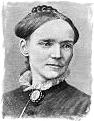
 The
story of Frances Ridley Havergal's life is the history of the growth of love
to Christ in her own soul. In the simple records of herself and her nearest
relatives this growth has been so clearly placed before us that we are able
to trace it from its first stirrings in her childish heart right up to the
moment when, her dying face lighted with heavenly radiance, her earthly voice
failed for ever as she saw her King in His beauty in the land
The
story of Frances Ridley Havergal's life is the history of the growth of love
to Christ in her own soul. In the simple records of herself and her nearest
relatives this growth has been so clearly placed before us that we are able
to trace it from its first stirrings in her childish heart right up to the
moment when, her dying face lighted with heavenly radiance, her earthly voice
failed for ever as she saw her King in His beauty in the land
"Where all His singers meet."
To Frances Ridley Havergal was given not only to feel in a most wonderful degree that ecstatic love to Christ and entire consecration to Him, which are such marked and blessed characteristics of much of the Christian life of the present day, but an almost unique power of so expressing that love that wherever an English book can be read, there hearts have felt the glow of her devotion. In her case the love came slowly, and so did the power of pouring it out. Her alabaster box of precious ointment was long in filling; but when it was filled, with what rapture did she break it at the blessed feet of her King!
Frances Ridley Havergal was born at the end of the year 1836. She was the sixth and youngest child of the Rev. Henry Havergal and of Jane his wife. Her father was at that time Rector of Astley, Worcestershire. He and his wife were both very earnest, spiritually-minded, evangelical Christians; and their home was rich in all holy influences, in much beauty, and in a delightful musicalness. Mr. Havergal was, indeed, " a living song," filling the house with holy melodies, and his wife a most lovely woman. The last baby, Frances, shared the happy fate of most last babies; she was the special pet of the family, and seems to have been designed by nature for that position. At two years old she was a very fairy-like creature, with light curling hair, bright expression, and a most fair complexion. A prettier child, writes her elder sister, Miriam, was seldom seen. Much of this sunny fairness and brightness she kept throughout her life.
At two years of age she could speak with perfect distinctness. This easy command of language grew with her growth, and is very noticeable in her books. Like all other young children, she liked to have stories told her, and was very fond of animals, especially of a certain Flora or Flo, a beautiful white-and-tan spaniel, who was her great friend and companion. This love of animals never left her. Many years afterwards she wrote: "Guess my birthday treat? To the Zoological Gardens. I don't know anything I would rather see in London."
At a very early age Frances picked up a good bit of knowledge without much trouble to herself. At morning prayers she always sat on her father's knee whilst he read the Scriptures, and from him she learned to sing hymns very sweetly. When she was three she could read easy books, and was often found, hidden under a table with some engrossing story.
On her third birthday she was crowned with a wreath of pink China roses, which Miriam made for her, and on her fourth birthday she was brought down to dessert garlanded with bay leaves; and a most lovely little picture she made, with her exquisite fairness, and her bright sparkling eyes full of merriment. At four Frances could read the Bible, but great care was always taken not to tire her, or to, excite the precocity of her mind.
The little maiden was, however, so fond of learning that she could not be kept from it. For instance, while the others were having their German lesson, she would take care to be in the room, and without any one's knowing that she was listening, picked up so much that the master begged to be allowed to teach her.
Rhymes came naturally to her. Her father was a great composer of hymn tunes and sacred poetry and music filled the atmosphere in which she lived.
At that early age she had a little book in which she did a great deal of scribbling, mostly in rhyme. Her sister Miriam married, and when Frances was promoted to the dignity of aunt she wrote a copy-book full of simple tales for her little niece.
From nine years old she wrote long and amusing letters to her brother Frank and her young friends. In fact, it seems she took to her pen quite naturally and writing, in those early days, does not seem to have been any trouble to her. Indeed, to those who saw only her outward life, Frances, in her early childhood, was a very merry little girl, much given to sitting up in trees and climbing walls; though the poor child had one very great trouble in her heart, which she carefully hid away even from the most loving eyes.
Perhaps we should have known nothing about this trouble, which was very heavy and very great, if she had not left us an account of it. When she was twenty-two years of age she wrote a little autobiography of her own inner life, which you will see was far from being as bright as her outer one. How many a girl, or woman, when she reads, as hundreds of thousands have done, that simple but deeply thoughtful unveiling of a girl's inner life, must have exclaimed with wonder: "Ah! that is just what I am, feeling!" or, "So I felt when I was young!"
The great trouble and sorrow of her young life were that she felt she ought to love God, but that she did not. "Up to the time I was six years old," she writes, "I have no remembrance of any religious ideas whatever; I do not think I could ever have said any of those 'pretty things' that little children often do, though there were sweet and beloved and holy ones round me who I must have often tried to put good thoughts into my little mind. But from six to eight I recall a different state of things. The beginning of it was a sermon at Hallow. Of this I even now retain a distinct impression. It was to me a very terrible one, dwelling much on hell and judgment, and what a fearful thing it is to fall into the hands of the living God. This sermon haunted me. I began to pray a good deal, though only night and morning, with a sort of fidget and impatience, almost angry at feeling so unhappy, and wanting and expecting a new heart, and to have everything put straight and be made happy all at once.
"This sort of thing went on at intervals, for often a month or two would pass without a serious thought or a true prayer. At such times I utterly abominated being 'talked to,' and would do anything on earth to get away. Any cut or bruise (and such were more the rule than exception in those wild days of tree-climbing, wall-scaling, etc.) was a reason why I could not possibly kneel down when dear M---- offered prayer for me. Then after a time of this sort, some mere trifle, a calm, beautiful evening, or a 'Sunday book' would rouse me up to uncomfortableness again. One sort of habit I got into in a steady way; every Sunday afternoon I went alone into a little front room over the hall and read a chapter in the Testament, and then knelt down and prayed for a few minutes, after which I usually felt soothed and less naughty. Once when Marian P---- was my only little visitor, I did not like any omissions, and so took her with me, saying a few words of prayer 'out of my head' without any embarrassment at her presence.
"I had a far more vivid sense of the beauty of Nature as a little child than I have even now. I have hardly felt anything so intensely since, in the way of a sort of unbearable enjoyment. The golden quiet of a bright summer's day used to enter into me and do me good. What only some great and rare musical enjoyment is to me now, the shade of a tree under a clear blue sky, with a sunbeam glancing through the boughs, was to me then. But I did not feel happy in my very enjoyment; I wanted more. I do not think I was eight when I hit upon Cowper's lines, ending:
'My Father made them all!'
That was what I wanted to be able to say; and, after once seeing the words, I never saw a lovely scene again without being teased by them.
"One spring (I think 1845) I kept thinking of them, and a dozen times a day said to myself, 'Oh, if God would but make me a Christian before the summer comes,' because I longed so to enjoy His works as I felt they could be enjoyed.
"All this while I don't think any one could have given the remotest guess of what was passing in my mind. I knew I was a 'naughty child'; in fact, I almost enjoyed my naughtiness in a savage, desperate kind of way, despairing of getting better, except by being made a Christian."
In her latest little book, "Kept for the Master's Use," published after her death, she tells us how, at this time, she longed for some one (who did not belong to her own family to whom she would not listen, good and holy though she knew them to be) to tell her about Christ. She says good men used to come and preach beautiful sermons in her father's church, but when they went home with them they talked of all sorts of other things, "and I did so wish they would talk about the Saviour whom I wanted, but had not found. It would have been so much more interesting to me, and oh! why didn't they ever talk to me about Him, instead of about my lessons or their little girls at home? They did not know how a hungry little soul went empty away."
When she was about nine, Frances left the large Henwick garden, where she had played with her dear dog Flora, for the town rectory of St. Nicholas. Her father called her in those days "a caged lark." "There," she writes, "I had a tiny room of my own; its little window was my 'country,' and soon the sky and the clouds were the same sort of relations to my spirit that trees and flowers had been.
"Soon a sermon by the curate, on 'Fear not, little flock,' struck me very much. I did so want to be happy and a 'Christian.' I had never yet spoken to any mortal about religion; but now I was so uneasy, that after nearly a fortnight's hesitation, being alone with the curate one evening, when almost dark, I told him my trouble, saying I thought I was getting worse. He said moving, and coming to new scenes was the cause, most likely, of my feeling worse, and that it would soon go off; I was to try to be a good child and pray, etc., etc. So after that my lips were utterly sealed to all but God for five years."
When Frances was eleven the most terrible sorrow a child can know fell upon her.
After long suffering her mother died.
The poor child's grief was intense, for she had clung wildly to hope until the very last, and even after her mother had passed away she had still tried to believe that she was but in a trance. "And so," she tells us herself, "when no one was near she had gone again and again into that room and drawn the curtain aside, half expecting to see the dear eyes unclose, and to feel the cold check warm again to her kiss."
She has left a touching word-picture of herself, standing by the window in a front room looking through a little space between the window and blind. All the shops were shut up, though it was not Sunday. She knew it would be dreadful to look out of that window, and yet she felt she must look. She did not cry, she only stood and shivered in the warm air. Very slowly and quietly a funeral passed out of the rectory gate, and in another minute was out of sight turning into the church. Then she stood no longer, but rushed away to her own little room, and flung herself on her little bed, and cried: "Oh, mamma! mamma! mamma!" It seemed as if there were nothing else in her little heart but that one word. All the strange hope of the past week was gone; she knew that she was motherless.
But though her grief was very deep, she ever tried to conceal it; nor, indeed, was it always heavy upon her, for she had the happy faculty, common to most children (or, poor wee things, how could they live at all through a great sorrow!) of forgetting everything else for the moment when some new interest occupied her attention. "Thus," she writes, "a merry laugh or a sudden light-heeled scamper led others to think I had not many sad thoughts, whereas not a minute before my little heart was heavy and sad."
After her mother's death she was often a good deal with her eldest sister, Miriam, at Oakhampton, where she is remembered as a clever, amusing child, sometimes a little wilful and troublesome from mere excess of animal spirits, but always affectionate and grateful for any little treat; much given to reading poetry, and not so tidy as she afterwards became, for she used to leave books about in the hay-loft, manger, and all sorts of garden nooks.
But all this while the little girl still carried about with her, wherever she went, that burden of hidden trouble she had borne so long. "I know," the autobiography goes on, "I did not love God; the very thought of Him frightened me." She would try to force herself to think about God, hard as it was to do so. Going to bed, she would begin "How good it was of God to send Jesus to die," while she by no means felt or believed that wonderful goodness. No one had written "Little Pillows" in those days, nor had rung for children "Morning Bells."
"Between thirteen and fourteen," Frances writes, "a soberising thoughtful time seemed to fall on me like a mantle, and my strivings were no longer the passionate spasmodic meteor flashes they had been, but something deeper, more settled, more sorrowful. All this was secret, and only within my own breast very few knew me to be anything but a careless, merry girl, light-hearted in the extreme. Now came a more definite and earnest prayer, for faith. Oh, to believe in Jesus, to believe that He had pardoned me! I used to lie awake in the long summer twilight praying for this precious gift. I read a great deal of the Bible in a 'straight on' sort of way. Once I determined, if eternal life were in the Scriptures, find it I would, and resolved to begin giving an hour a day to very careful and prayerful reading of the New Testament.
"August 15th, 1850, to my great delight, I was sent to school. The night before I went, Ellen, dear, gentle, heavenly sister, stood by me brushing my hair. She spoke of God's love. I could not stand it, and for the first time for five years I spoke out; ' I can't love God yet, Nellie,' was all I said, but I felt a great deal more. Mrs. Teed, the principal of the school, had a sweet and holy power. She prayed and spoke with us with a fervour I have never seen equaled. There were many Christian girls. I envied them. Mary was one. I longed to tell her how unhappy I was. At last I did. The simple, loving words of my little Heaven-taught schoolfellow brought dewy refreshment to my soul as she said, in French (we always had to speak French): Jesus said, 'Suffer the little children,' etc. It is every little child who ought to come to Him, every little child whom He calls, every little child whom He embraces.
"After this I had many talks with Mary, but with no one else. To Diana, the goddess among my school friends, and whom I believed to be like Mary, not a word could I speak; though I longed to hear her speak to me as Mary did.
"I drank in every word I heard about Jesus and His salvation. I came to see that it was Christ alone that could satisfy me. I wept and prayed day and night; but 'there was no voice nor any that answered.' I shall never forget the evening of Sunday, December 8th. Diana, whom I loved with a perfectly idolatrous affection, had hardly seen me all day. For some time I had noticed a slight depression about her. That evening, as I sat nearly opposite to her at tea, I could not help seeing (nobody could) a new and remarkable radiance about her countenance. It seemed literally lighted up from within while her voice, even in the commonest remarks, sounded like a song of gladness. I looked at her almost with awe. As soon as tea was over she came round to my side of the table, sat down by me on the form, threw her arm around me and said: 'Oh Fanny, dearest Fanny, the blessing has come to me at last. Jesus has forgiven me, I know. He is my Saviour, and I am so happy! Only come to Him and He will receive you. Even now He loves you, though you don't know it.'
"Having broken the ice at Belmont (my school), it was the less difficult to do so again; and before long I had a confidante in Miss Cooke, who afterwards became my loved mother. We were visiting at the same time at Oakhampton, and had several conversations, each of which left me more earnest and hopeful. At last, one evening in the twilight, I sat on the drawing-room sofa alone with her. I told her how I longed to know I was forgiven; how even my precious papa, brothers and sisters, all I loved were nothing in comparison. She paused, and then said slowly: 'Then, Fanny, I think, I am sure it will not be very long before your desire is granted, your hope fulfilled.' After a few more words, she said: 'Why cannot you trust yourself to your Saviour at once? Supposing now, at this moment, Christ were to come, could you not trust Him? Would not His call, His promise, be enough for you? Could you not commit your soul to him, to your Saviour, Jesus?'
"Then came a flash of hope across me, which made me feel literally breathless. I remember how my heart beat. 'I could, surely,' was my response; and I left her suddenly and ran away upstairs to think it out. I flung myself on my knees in my room, and strove to realise the sudden hope. I was very happy at last; I could commit my soul to Jesus. I could trust Him with my all for eternity. It was so utterly new to have any bright thoughts about religion that I could hardly believe that it could be so.
"Then and there I committed my soul to the Saviour; I do not mean to say without any trembling or fear, but I did; and earth and heaven seemed bright from that moment; I did trust the Lord Jesus.
"For the first time my Bible was sweet to me, and the first passage I distinctly remember reading, in a new and glad light, was the fourteenth and following chapters of St. John's Gospel."
This was in February, 1851, when Frances Havergal was fourteen. With this new glad light there came to her a great eagerness for study. She threw herself into her lessons with intense enjoyment until December came, when a severe attack of erysipelas in her face and head put a stop to the work she loved only too well. She was at once taken home, and was for some time nearly blind.
She bore it with great patience, although it was a great trial to one of her active temperament. She was so extremely agile in every movement, a very fairy with her golden curls and light step, that her father used to call her his "Little Quicksilver." To lie still was a difficult task for her; but to know that she must neither go to school nor study at home for a long time was indeed dreadful news.
Her father's eyesight was now causing his family great anxiety. He had married the Miss Cooke whose words had done Frances so much good; and after Frances had been away from school for some months, and had grown well again in North Wales, she accompanied Mr. and Mrs. Havergal to Germany, where her father placed himself under the care of a great oculist, and his daughter in the Louisenschule, Düsseldorf. Her progress was wonderful there. Here is her own account of the position she took:--
"All the masters were so well pleased with the English girl's papers and conduct that they honoured me with a Numero I a thing they had never done before. In religion I stood alone (as far as I know) among a hundred and ten girls. This was very bracing. There was very much enmity to any profession, and I came in for more unkindness than would have been possible in an average English school."
Leaving school, Frances spent a little time in the home of a German pastor, where she was very happy. "I get up at five, breakfast at seven; then study for four hours. My books are nearly all German, and I write abstracts. How I do enjoy myself when I get to the German poets and Universal History, which I dive into with avidity!
After her death, Pastor Schulze-Berge wrote to her sister: "I instructed her in German composition, literature, and history; I learned to appreciate her rich talents and mental powers. She showed from the first such application, such depth of comprehension, that I can only speak of her progress as extraordinary. What imprinted the stamp of nobility upon her whole being was her true piety, and the deep reverence she had for her Lord and Saviour, whose example penetrated her young life through and through."
At home, although supposed to be "finished," she carefully kept up her foreign studies, and by her father's help learned Greek enough to be able to enjoy studying the New Testament.
Her pen was always going. It seemed a sort of tap connected with her brain that could be turned on only too easily. Of course, the young people who would give anything, as they say, to be able to write wonder and envy this fast-flowing pen. But a flowing pen is a very doubtful literary gift: don't envy it. Write, if you must write, with the pen you have. The tap-like pen often runs mere twaddle or gush, unless it draws its supplies from a well-stocked brain.
Frances Ridley Havergal, at eighteen or nineteen, wrote and wrote and wrote. She would send her enigmas and charades to various "pocket-books" (which in those days used to contain such things), get prizes for them, and give money to the Church Missionary Society. Her brain was full of "wild, lovely, intangible ideas flitting across her mind, like the shadows of a flying bird," and she was always trying to fly after them.
In her twentieth year she paid her first visit to her sister Ellen (Mrs. Shaw), who was married, and living in Ireland. An Irish schoolgirl thus describes her: "Mrs. Shaw brought us into the drawing-room. In a few seconds Miss Frances, carolling like a bird, flashed into the room! Flashed, yes, like a burst of sunshine, like a hill-side breeze, and stood before us, her fair sunny curls falling round her shoulders, her bright eyes dancing and her fresh sweet voice ringing through the room. I shall never forget that afternoon, never! I sat perfectly spell-bound as she sang chant and hymn with marvellous sweetness, and then played two or three pieces of Handel, which thrilled me through and through.
"As we girls walked home down the shady avenue, one and another said: 'Oh, isn't she lovely and doesn't she sing like a born angel!' 'I love her I do; and I'd follow her every step of the way back to England if I could.' 'Oh, she's' a real Colleen Bawn!' Another felt there must be the music of God's own love in that fair singer's heart; and that so there was joy in her face, joy in her words, joy in her ways. And the secret cry went up from that young Irish heart: 'Lord, teach me, even me, to know and love Thee too.'"
But Frances herself felt very keenly that she was only a little child in the spiritual life. "Gleams and glimpses," she writes in 1858, "but, oh, to be filled with joy and the Holy Ghost! oh, why cannot I trust Him fully?" She read and learned the Scriptures systematically with her friend, Elizabeth Clay (the one to whom she so constantly wrote). In their country walks Frances and her sister Maria would repeat whole chapters in alternate verses. She knew by heart the whole of the New Testament, the Psalms, and, Isaiah when about twenty-two, and afterwards learned the minor prophets. Her home life was beautiful, though only one knew the self-restraint and the self-denial of actions, trivial in themselves, but wrought for love to God.
The first definite notice of a literary success outside her own circle dated 1863, when she was about twenty-seven. She had been asked for poetical contributions by the editor of a monthly magazine and received a cheque for £10 17s. 6d. This was much more than she had expected. She at once sent it to her father for Church purposes. Her father's note on receiving it was found among her papers: "My dear little Fan can hardly think how much her poor papa loves her, thinks about her, and prays for her. Yes, he does. Thank you, dear child, for remembering, me; I will keep all your love, but not the cheque. Our God send you His sweetest and choicest blessings.
Her father died suddenly in 1870, to the intense grief of his family. This loss, however, as all other losses, only made the Divine promises more real to Frances. "Thou art the Helper of the fatherless," flashed brightly upon his daughter soon afterwards when puzzling over a tune her father would have decided at once. "I think," she adds, " that even in music the Lord is my helper now." She now added hymn tunes to her other work.
She had grown much in simple trustfulness. "Writing is praying with me. You know a child would look up at every sentence and say, 'And what shall I say next?' That is just what I do; I ask Him that at every line He would give me not merely thoughts and power, but also every word, even the very rhymes."
Three years or so after this we, however, find her declaring that she had recently received a blessing that had "lifted her whole life into sunshine, of which all she had previously experienced was but as pale and passing April gleams compared with the fulness of summer glory."
This blessing came to her through a tiny book called "All for Jesus." It set forth a fulness of blessing to which she felt she had not attained. She was gratefully conscious of having for many years loved the Lord, and delighted in His service; but "I want," she wrote, "to come nearer stil', to have full realisation of John xiv.21." A few word on the power of Jesus to keep those who abide in Him made her joyously exclaim" I see it all; I HAVE the blessing!" "I saw it," she says, "as a flash of electric light, and what you see you can never unsee. There must be full surrender before there can be full blessedness. He Himself showed me all this most clearly."
One of the intensest moments of my life was when I saw the force of that word 'cleanseth.' The utterly unexpected and altogether unimagined sense of its fulfilment to me, on simply believing in its fulness, was just indescribable. I expected nothing like it short of heaven. Thus accepting, in simple unquestioning faith, God's commands and promises, one seems to be at once brought into intensified views of everything. Never before did sin seem so hateful, watchfulness so necessary, and with a keenness and uninterruptedness, too, beyond what one ever thought of, only somehow different; not a distressed but a happy sort. Then, too, the "all for, Jesus" comes in; one sees there is no half-way, it must be absolutely all yielded up, because the least unyielded or doubtful point is sin, let alone the great fact of owing all to Him."
Every visit seemed now to open doors for her loving words, and she longed for whole households to taste with her the goodness of the Lord.
About this time she wrote her Consecration Hymn, perhaps the most widely known of all her writings. This is how it came into being. "I went," she writes, "for a little visit of five days. There were ten persons in the house, some unconverted and long prayed for, some converted, but not rejoicing Christians. He gave me the prayer, 'Lord, give me all in this house!' And He just did! Before I left every one had got a blessing."
"The last night of my visit I was too happy to sleep, and passed most of the night in praise and renewal of my own consecration, and these little couplets formed themselves and chimed in my heart one after another, till they finished with, Ever, ONLY, ALL for Thee! "
From December 1873, the date of reading the little book "All for Jesus," she literally carried out her now famous couplet,
"Take my voice, and let me sing,
Always, only, for my King."
She had both a great taste for music and a good knowledge of harmony, a natural and inherited turn for melody, a ringing touch on the piano, a beautiful and well-trained voice. These gifts she now entirely devoted to Christ; whether at home or in mixed society she always "sang for Jesus."
"I was," said she, "at a large regular London party lately, and I was so happy. He seemed to give me the secret of His presence, and, of course, I sang for Jesus, and did I not have a dead silence? Afterwards I had two really important conversations with strangers."
In the early part of 1874 she was expecting to have made a firm literary footing in America, when instead of the £35 due to her, she received the news that her publisher had failed. He held her written promise to publish only with him as the condition of his launching her books, so this seemed quite too close America to her. "Positively," she wrote, "I did not feel it at all, although I had built a good deal on my American prospects; now,"Thy will be done" is not a sigh but only a song!"
That same year (1874), after a happy autumn holiday, she was returning from Switzerland in perfect health, when somehow or another she caught fever. When she reached her home, at Leamington, she was very unwell, and was soon utterly prostrate with typhoid fever. For a while she hovered between life and death. Prayer was continually made for her recovery by a very large number of friends. "Only," she said, when getting better, "I did not want them to pray that I might get well at all. I never thought of death as going through the dark valley, or down to the river; it often seemed to me a going up to the golden gates."
Some months later, when threatened with a relapse, she said to her sister Maria, "I felt sure illness was coming on; and, as I lay down, the sweet consciousness that I was just lying down in His dear hand was so stilling."
Her recovery was extremely slow, but her room was the brightest in the house. At last she was carried down stairs, but for some time used crutches. "So delicate with her needle," as many other writing women have been, working for the Zenana Missions was a great pleasure to her during her long convalescence. It was a year before she was able to use her pen except for letters.
When sufficiently well she spent a long while in preparing "Songs of Grace and Glory." "I remember the day it was completed," writes her sister; "she came down from her study with a large roll for post, and with holiday glee exclaimed, 'There, it is all done! Now I am free to write a book!'"
A week after it was burned, stereotype plates and all. The work had to be gone over again. Every chord of her own had to be reproduced; every chord of others re-examined and revised. Frances, however, was able to write of this disaster: "I have thanked Him for it more than I have prayed about it. "He is giving me the opportunity over again of doing it more patiently."
The interesting details of the foreign trips she so much enjoyed must all be left out for want of space. When in Switzerland she wrote home a number of descriptive letters and poems, which have been published under the title of "Swiss Letters and Alpine Poems." She was an enthusiastic mountain climber, and once was within a hair's breadth of what must have proved a fatal accident. In a sweet, brave way, she took all the details of her life, whether pleasant or painful, as from the hand of Christ Himself.
When in Switzerland on one of the holiday trips she so much enjoyed, with the full range of the Jungfrau and Silberhorn in view, she caught a chill by getting wet through in a thunderstorm, and was seriously ill for a month, suffering many weary hours of pain.
"One afternoon," writes Maria Havergal, "after trying a new remedy, I begged her to shut her eyes and try to sleep. When I returned she gave me the lines, 'I take this pain, Lord Jesus.' 'You see,' she said, 'I know something of the sweetness of taking pain direct from His hand. I had just been saying all this to the Lord, and then it came to me in this hymn; it wants no correction; I always think God gives me verse when it comes so, and it is worth any suffering if what I write will comfort some one at some time! While I was in such pain, the very lines I've been waiting for came to me. Very often strangers write and tell me that my lines comfort or help them, even when I know there is not a spark of poetry in them. Now I cannot tell what will comfort others, so I ask God to let me write what will do so."
This is only one among many incidents that reveal how truly the longings expressed in her "Worker's Prayer" (perhaps the most beautiful of all her hymns) were the truest and deepest utterances of her own soul.
"Lord, speak to me, that I may speak
In living echoes of Thy tone;
As Thou hast sought so let me seek
Thy erring children, lost and lone."
This sweet and earnest prayer has been so abundantly answered, Miss Havergal's written words have been made so true a blessing to such thousands of souls, that anything like criticism would seem almost sacrilegious; all we can devoutly and thankfully say is, she was one whose work the King, her King, manifestly delighted to honour. The King Himself crowned her.
But as well as the hymns, verses, little books, and other sacred work which she was continually producing she has left behind several books of poems and letters on subjects we may venture to speak of. This large mass of writing would take a great deal more space than we have here to sift and analyse. Like most writers with a swift pen, she wrote far too much not indeed for her thousands of devoted readers, who eagerly seek out every scrap she wrote, but for her own permanent literary reputation. These poems and letters, always sweet, pure, and with a singularly bright flash in them, are exceedingly uneven in merit. They easily fall into the three classes of good, bad, and indifferent. But nearly all of them appeal vividly and at once to the average British ear, intelligence, and fancy; for although she was not a great poetess, she was essentially a singer, and her singing was true and helpful. To her had been committed the Ministry of Song, a ministry not for the literary few, but for the weary many.
In May, 1878, Mrs. Havergal passed away, after long and intense suffering; to witness,which wrote Frances, has " been by terrible things answering my eager prayer for more teaching and closer drawing at any cost." The home at Leamington was broken up. Frances and Maria set up housekeeping together near the Mumbles, on the Welsh coast. Maria went there first. When Frances joined her, her first words were: "I wanted so to get to you, Maria dear! She was so very tired, that even the sea air, and perfect rest failed to refresh her for some time. Afterwards she enjoyed scrambles on the cliffs, or getting up to the top of the Mumbles lighthouse, and making the keeper tell her all he knew. Her tastes were very simple. She delighted in wild flowers, and in animals, from the great St. Bernard dogs to her pet kittens.
The sisters arranged a cosy study in their Welsh home; "My work-shop," Frances called it. By the door was her motto, "For Jesus' sake only," and her temperance pledge card. The portrait of her father and other relatives hung near. Then there was her choice little library of books on all sorts of subjects, her desk and writing-table, her favourite chair -- a relic of the childish days she spent at Astley Rectory -- and the American type-writer she found such a relief to her tired eyes. She was wonderfully neat and methodical in all her arrangements. Her many letters were all carefully docketed; paper and string in their own corners; no litter ever allowed. "'In order' (I Cor. xiv.40) is something more than being tidy! Something analogous to 'keeping rank.'"
She contrived a stand for her harp-piano, and there she composed her hymn tunes. Often she turned to the little instrument as a relief from severer work.
Early rising and early studying were her rule and she was careful to avoid late hours. At seven in the morning during summer, and at eight in winter she was at her table studying her Bible.
How diligently she studied that Bible the page given in her "Life" will show. Its margin is full of references in the clearest, most minute hand, with carefully ruled lines connecting the thought or idea of one verse to the same thought, or perhaps its contrast, in another.
She was very particular about the cross-readings in her Bible. Sometimes, on bitterly cold mornings, Maria would beg her to read with her feet by the fire. "But then," Frances would reply, "I can't rule my lines neatly; just see what a find I've got! If one only searches, there are such extraordinary things In the Bible!"
She never spared herself. People wrote to her on every conceivable subject, and she was only too ready to answer and help. "What shall I do?" she writes "your letter would take two hours to answer, and I have not two minutes; fifteen to twenty letters to write every morning, proofs to correct, editors waiting for articles, poems and music I cannot touch, American publishers clamouring for poems or any manuscripts, four Bible readings or classes weekly, many anxious ones waiting for help, a Mission week coming, and other work after that. And my doctor says my physique is too weak to balance the nerves and brain, and that I ought not to touch a pen." But it was a sad wearing away of her strength. She longed for a lull in her life; but the lull never came. "Dear wearied sister!" Maria adds, "Once she said: "I do hope the angels will have orders to let me alone a bit, when I first get to heaven!"' Yes, with all her many gifts she had never learned how to conjugate the verb "to laze!" An innumerable host of little things to be done for others continually oppressed her; yet she always wrote pleasantly and cheerily, refreshing others, although she was only too literally wearied to death herself.
A plan of work for 1879 was found in her desk, but before Midsummer came she had been called to her home to the land where work and rest are one.
Many of us remember the little sky-blue book with the golden stars and celestial crown which gave an account of the last week of Frances Ridley Havergal's earthly life, and the cry of mingled grief and triumph that went up from tens of thousands of Christian hearts when it was known that the sweet singer who had been so helpful to them would sing to them no more, on earth, for ever.
On May the 21st, 1879, Frances Havergal returned home wet and chilly. The next day, being Ascension Day, she was so very tired after church, that she rode home on a donkey. Quite a procession of boys followed her, listening eagerly to all she said.
Fred Rosser, her donkey-boy, remembers that she told him: "I had better leave the devil's side; that Jesus Christ's was the winning side, and wouldn't I choose Him for my captain." That was the last time she was out. Four days afterward she corrected the proof of "Morning Stars," and then lay down her pen for ever.
She was not suffering much then, lying quietly in bed, her pet kittens Trot and Dot near her. Then fever and all the agony of peritonitis came on rapidly; but her peace and joy shone through the severest sufferings. When they were distressed for her, she whispered, "It's home the faster!"
"God's will is delicious; He makes no mistakes."
Nothing alleviated the agonising pain; but again and again she was heard through the last hours murmuring "So beautiful to go!" The vicar of Swansea came in for a few minutes. He said, "You have talked and written a great deal about the King. Is Jesus with you now?" "Of course!" she answered. "Oh, I want all of you to speak bright, BRIGHT words about Jesus! Oh do, do! It is all perfect peace, I am only waiting for Jesus to take me in." Later, whispering the names of many dear ones, she added, "I love them all! I want all to come to me in heaven; tell them to trust Jesus." Then clearly, though faintly, she sang the whole of the verse beginning: "Jesus, I will trust Thee," to her own tune Hermas," Then came a terrible convulsive sickness. It ceased. The nurse gently assisting her, she nestled down in the pillow, folded her hands, saying, "There, now it is all over ! Blessed rest!"
She looked up steadfastly as if she saw the Lord. For ten minutes they watched that almost visible meeting with her King, and her countenance was so glad, as if she were already talking to Him.
Then she tried to sing; but after one sweet high note, "He--," her voice failed, and as her brother commended her soul into her Redeemer's hands, she passed away to meet the King in His beauty.
From Florence Nightingale, Frances Ridley Havergal, Catherine Marsh, Mrs. Ranyard... by Lizzie Alldridge. London: Cassell & Co., 1885.
>> More Frances Ridley Havergal