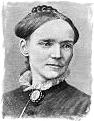
 Frances Ridley Havergal, daughter of the Rev. W. H. Havergal, was born at Astley,
Worcestershire [England], December 14, 1836. Five years later her father
removed to the Rectory of St. Nicholas, Worcester. In August, 1850, she entered
Mrs. Teed's school, whose influence over her was most beneficial. In the
following year she says. "I committed my soul to the Saviour, and earth and
heaven seemed brighter from that moment."
A short sojourn in Germany followed, and on her return she was confirmed
in Worcester Cathedral, July 17, 1853. In 1860 she left Worcester on her
father resigning the Rectory of St. Nicholas, and resided at different periods
in Leamington, and at Caswall Bay, Swansea, broken by visits to Switzerland,
Scotland, and North Wales. She died at Caswall Bay, Swansea, June 3, 1879.
Frances Ridley Havergal, daughter of the Rev. W. H. Havergal, was born at Astley,
Worcestershire [England], December 14, 1836. Five years later her father
removed to the Rectory of St. Nicholas, Worcester. In August, 1850, she entered
Mrs. Teed's school, whose influence over her was most beneficial. In the
following year she says. "I committed my soul to the Saviour, and earth and
heaven seemed brighter from that moment."
A short sojourn in Germany followed, and on her return she was confirmed
in Worcester Cathedral, July 17, 1853. In 1860 she left Worcester on her
father resigning the Rectory of St. Nicholas, and resided at different periods
in Leamington, and at Caswall Bay, Swansea, broken by visits to Switzerland,
Scotland, and North Wales. She died at Caswall Bay, Swansea, June 3, 1879.
Miss Havergal's scholastic acquirements were extensive, embracing several modem languages, together with Greek and Hebrew. She does not occupy, and did not claim for herself, a prominent place as a poet, but by her distinct individuality she carved out a niche which she alone could fill. Simply and sweetly she sang the love of God, and His way of salvation. To this end, and for this object, her whole life and all her powers were consecrated. She lives and speaks in every line of her poetry. Her poems are permeated with the fragrance of her passionate love of Jesus.
Her religious views and theological bias are distinctly set forth In her poems, and may be described as mildly Calvinistic, without the severe dogmatic tenet of reprobation. The burden of her writings is a free and full salvation, through the Redeemer's merits, for every sinner who will receive it, and her life was devoted to the proclamation of this truth by personal labours, literary efforts, and earnest interest in Foreign Missions.
Miss Havergal's hymns were frequently printed by J. & R. Parlane as leaflets, and printed by Caswell & Co. as ornamental cards. They were gathered together from time to time and published in her works as follows:
(1) Ministry of Song, 1869?;
(2) Under the Surface, 1874;
(3) Loyal Responses, 1879?;
(4) Life Mosaic, 1879;
(5) Life Chords, 1880;
(6) Life Echoes, 1883.
Selected Hymns Annotated:
I am trusting Thee, Lord Jesus.
Frances R. Havergal. [Faith.] Written Sept. 1874, at Ormont Dessons.
(P. 1874) Published in Loyal Responses, 1878, and Life Chords,
1880. Miss Havergal's tune, Urbane (Snepp's S. of G. & G., 1048),
was composed for this hymn. The hymn was the author's "own favourite," and
was found in her pocket Bible after her death.
I gave My life for thee.
Frances R. Havergal. [Christ desiring the entire devotion of His Servants.]
Miss M. V. G. Havergal's MS. account of this hymn is:
"In F. R. H.'s MS. copy, she gives this title, 'I did this for thee; what hast thou done for Me?' Motto placed under a picture of our Saviour in the study of a German divine. On Jan. 10, 1858, she had come in weary, and sitting down she read the motto, and the lines of her hymn flashed upon her. She wrote them in pencil on a scrap of paper. Reading them over she thought them so poor that she tossed them on the fire, but they fell out untouched. Showing them some months after to her father, he encouraged her to preserve them, and wrote the tune Baca specially for them. The hymn was printed on a leaflet, 1859, and in Good Words, Feb., 1860. Published also in The Ministry of Song, 1869. Though F. R. H. consented to the alterations in Church Hymns, she thought the original more strictly carried out the idea of the motto, 'I gave My life for thee, What hast thou done for Me?' " (H. MSS.).
Miss F. R. Havergal also refers to this hymn in a letter quoted in her Memoirs, p. 105:
"I was so overwhelmed on Sunday at hearing three of my hymns touchingly sung in Perry Church, I never before realized the high privilege of writing for the 'great congregation,' especially when they sang 'I gave My life for thee' to my father's tune Baca."
The recast of this hymn for the S. P. C. K. Church Hymns, 1871, referred to above, begins, "Thy life was given for me." The original appeal of Christ to the disciple is thus changed into an address by the disciple to Christ. This recast has not become popular. The original, as in Snepp's Songs of G. & G., 1872, is in extensive use in Great
Golden harps are sounding.
Frances R. Havergal. [Ascension.] Written at Perry Barr, Dec., 1871,
under the following circumstances:-
"When visiting at Perry Barr, F. R. H. walked to the boys' schoolroom, and being very tired she leaned against the play-ground wall, while Mr. Snepp [editor of S. of Grace & Glory, 1872] went in. Returning in ten minutes he found her scribbling on an old envelope. At his request she gave him the hymn just pencilled, 'Golden harps,' &c. Her popular tune Hermas was composed for this hymn. Hermas was the tune she sang, as 'the pearly gates opened' for her, June 3, 1879." [HAV. MSS.]
The use of this "Ascension Hymn for Children," in Great Britain is limited, but in America it has attained to great popularity. It was published in the Day Spring Magazine, and the Day, Under the Surface, 1874, and in Life Mosaic, 1879.
Lord, speak to me, that I may speak.
Frances R. Havergal. [Lay Helpers.] Written, April 28,1872, at Winterdyne,
and first printed as one of Parlane's musical leaflets in the same year.
In 1874 it was published in her Under the Surface, and in 1879 in Life
Mosaic. In the original MS. it is headed "A Worker's Prayer. 'None of
us liveth to himself.' Rom. xiv. 7." This hymn has become very popular, and
is highly esteemed by those engaged in Christian work.
O Master, at Thy feet.
Frances R. Havergal. [Adoration.] We have been furnished with the
following interesting account of this hymn from Miss Havergal's private papers:
"I felt that I had not written anything specially in praise to Christ. A longing to do so possessed me. I wanted to show forth His praise to Him, not to others, even if no mortal ever saw it, He would see every line, would have known the unwritten longing to praise Him even if words failed utterly. It describes, as most of my poems do, rather reminiscence than present feeling. I cannot transcribe at the moment of strong feeling. I recall it afterwards and write It down. 'O Master!' It is perhaps my favorite title because it implies rule and submission; and this is what love craves. Men may feel differently, but a true woman's submission is inseparable from deep love. I wrote it ['O Master!'] in the cold and twilight in the little back room, uncarpeted, at Shareshill Parsonage, Dec. 31, 1866. I began my book [Ministry of Song] with the expression of its devotion to God's glory, I wished to close it with a distinctive ascription of praise to Jesus, and, therefore, without any hesitation, at once decided upon placing 'Adoration' [this hymn] where it stands."
The hymn was given in the Sunday Magazine, 1867; in her Ministry of Song, 1869; and in Life Mosaic, 1879, in 5 stanzas of
Take my life, and let it be.
Frances R. Havergal. [Self-Consecration to Christ.] This hymn was
written at Areley House, Feb. 4,1874, in 11 stanzas of 2 lines, and published
in her Loyal Responses, 1878; the musical ed. of the same, 1881; And
in Life Chords, 1880. It has also been printed as a leaflet, in various
forms for Confirmation, Self-Consecration, and for enclosing in letters,
some being accompanied by her father's tune Patmos. It has been translated
into French, German, Swedish, Russian, and other European languages, and
into several of those of Africa and Asia. The history of its origin is thus
given in the HAV. MSS.:
"Perhaps you will be interested to know the origin of the Consecration hymn 'Take my life.' I went for a little visit of five days [to Areley House]. There were ten persons in the house, some unconverted and long prayed for, some converted, but not rejoicing Christians. He gave me the prayer 'Lord, give me all in this house!' And He just did! Before I left the house every one had got a blessing. The last night of my visit after I had retired, the governess asked me to go to the two daughters. They were crying, &c; then and there both of them trusted and rejoiced; it was nearly midnight. I was too happy to sleep, and passed most of the night in praise and renewal of my own consecration; and these little couplets formed themselves, and chimed in my heart one after another till they finished with 'Ever, ONLY, ALL for Thee!'"
The music to which Miss Havergal invariably sang this hymn, and with which it was always associated in the publications over which she had any influence, was her father's tune Patmos, and the family's desire is that this course may be followed by others.
From A Dictionary of Hymnology... edited by John Julian. New York: Charles Scribner's Sons, 1892.
>> More Frances Ridley Havergal