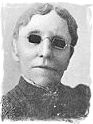
 One
of the great powers that influence the world is the writer of favorite
songs and hymns. Such a person approaches nearer to the hearts of
the people than any one else. Wherever the religion of Christ has
found lodgment, the countless songs of Fanny Crosby, the subject
of this sketch, have brought comfort to Christian hearts and stirred
up inspiration that will abide as long as life shall last.
One
of the great powers that influence the world is the writer of favorite
songs and hymns. Such a person approaches nearer to the hearts of
the people than any one else. Wherever the religion of Christ has
found lodgment, the countless songs of Fanny Crosby, the subject
of this sketch, have brought comfort to Christian hearts and stirred
up inspiration that will abide as long as life shall last.
Frances Jane Crosby, the daughter of John and Mercy Crosby, was born in Southeast, Putnam County, New York [United States], March 24, 1820. She became blind at the age of six weeks from maltreatment of her eyes during a period of sickness. When she was eight years old she moved with her parents to Ridgefield, Connecticut, the family remaining there four years. At the age of fifteen she entered the New York Institution for the Blind, where she received a good education. She became a teacher in the Institution in 1847, and continued her work until March 1, 1858. She taught English grammar, rhetoric, Roman and American history. This was the great developing period in her life. During the vacations of 1852 and 1853, spent at North Reading, Massachusetts, she wrote the words to many songs for Dr. Geo. F. Root, then the teacher of music at the Institution. Among them were, "Hazel Dell," "The Honeysuckle Glen," "Rosalie, the Prairie Flower," "Music in the Air," "Proud World, Good-bye, I'm Going Home," "All Together," "Never Forget the Dear Ones," and others. Subsequently she wrote the words for the cantatas of "The Flower Queen" and "The Pilgrim Fathers," all of which were very popular in their day, though it was not generally known at the time that she was the author.
While teaching at the Institution she met Presidents Van Buren and Tyler, Hon. Henry Clay, Governor Wm. H. Seward, General Winfield Scott, and other distinguished characters of American history. Concerning Mr. Clay, she gives the following: "When Mr. Clay came to the Institution during his last visit to New York, I was selected to welcome him with a poem. Six months before he had lost a son at the battle of Monterey, and I had sent him some verses. In my address I carefully avoided any allusion to them, in order not to wound him. When I had finished he drew my arm in his, and, addressing the audience, said through his tears: 'This is not the first poem for which I am indebted to this lady. Six months ago she sent me some lines on the death of my dear son.' Both of us were overcome for a few moments. Soon, by a splendid effort, Mr. Clay recovered himself, but I could not control my tears."
In connection with her meeting these notable men, we might add that Miss Fanny Crosby had the honor of being the first woman whose voice was heard publicly in the [United States] Senate Chamber at Washington. She read a poem there on one occasion.
In addition to the thousands of hymns that she has written (about eight thousand poems in all), many of which have not been set to music, she has published four volumes of verses. The first was issued in 1844, and was entitled "The Blind Girl, and Other Poems"; a second volume, "Monterey, and Other Poems," followed in 1849, and the third, "A Wreath of Columbia's Flowers," in 1858. The fourth, "Bells at Evening and Other Verses," with a biographical sketch by Rev. Robert Lowry, and a fine half-tone portrait, in 1897, the sales of which have reached a fourth edition. The book is published by The Biglow & Main Co., New York.
Though these show the poetical bent of her mind, they have little to do with her world-wide fame. It is as a writer of Sunday-school songs and gospel hymns that she is known wherever the English language is spoken, and in fact, wherever any other language is heard.
Fanny was married March 5, 1858, to Alex. Van Alstyne, who was also a scholar in the same institution in which she was educated.
She began to write Sunday-school hymns for Wm. B. Bradbury in 1864. Her first hymn,
We are going, we are going
To a home beyond the skies,"
was written at the Ponton Hotel on Franklin Street, New York City, on February 5th of that year. This hymn was sung at Mr. Bradbury's funeral in January, 1868.
Since 1864 she has supported herself by writing hymns. She has resided in New York City nearly all her life, where, she says, she is "a member of the Old John Street M. E. Church in good standing." She spends regular hours on certain days at the office of The Biglow & Main Co., the firm for which she does most of her writing, and for whom she has composed over four thousand hymns.
Her hymns have been in great demand and have been used by many of our most popular composers, among whom may be mentioned Wm. B. Bradbury, Geo. F. Root, W. H. Doane, Rev. Robert Lowry, Ira, D. Sankey, J. R. Sweney, W. J. Kirkpatrick, H. P. Main, H. P. Danks, Philip Phillips, B. C. Unseld, and others. She can compose at any time and does not need to wait for any special inspiration, and her best hymns have come on the spur of the moment... She learned to play on the guitar and piano while at the Institution, and has a clear soprano voice. She also received a technical training in music, and for this reason she can, and does, compose airs for some of her hymns. One of these is,
"Jesus, dear, I come to Thee,
Thou hast said I may,"
both words and music of which are wonderfully sweet. "Safe in the arms of Jesus," probably one of her best known hymns, is her own favorite.
Fanny loves her work, and is happy in it. She is always ready either to sympathize or join in a mirthful conversation, as the case may be. The secret of this contentment dates from her first composition at the age of eight years. "It has been the motto of my life," she says. It is:
"O what a happy soul am I!
Although I cannot see,
I am resolved that in this world
Contented I will be;How many blessings I enjoy
That other people don't!
To weep and sigh because I'm blind,
I cannot, and I won't.''
This has continued to be her philosophy. She says that had it not been for her affliction she might not have so good an education, nor so great an influence, and certainly not so fine a memory. She knows a great many portions of the Bible by heart, and had committed to memory the first four books of the Old Testament, and also the four Gospels before she was ten years of age.
Her scope of subjects is wide, embracing everything from a contemplation of heaven, as in "The Bright Forever" and "The Blessed Homeland," to an appeal to the work of this world, as in "To the Work" and "Rescue the Perishing." The majority of Fanny's published hymns have appeared under the name of Fanny J. Crosby or Mrs. Van Alstyne, but quite a large number have appeared under the nom de plumes of Grace J. Frances, Mrs. C. M. Wilson, Lizzie Edwards, Ella Dale, Henrietta E. Blair, Rose Atherton, Maud Marion, Leah Carlton, nearly two hundred different names.
Among her most widely-known hymns may be named the following: "There's a cry from 'Macedonia," "I feel like singing all the time," "Never be afraid to speak for Jesus," "Lord, at Thy mercy seat," "Jesus the water of life will give," "'Give,' said the little stream," "We are marching on with shield and banner bright," "Pass me not, O gentle Saviour," "Jesus, keep me near the cross," "Rescue the Perishing," "Sing with a tuneful spirit," "Praise Him, praise Him," "To the work, to the work," "The Bright Forever," "Blessed Assurance," "Close to Thee," "Blessed Homeland," "Saved by Grace," "Thy Word is a lamp to my feet, O Lord," "Hast thou trimmed thy lamp, my brother?" "Never say goodbye."
Mr. Van Alstyne (her husband) was said to be a good musician. He died in 1902. Fanny is extremely young for her age, and she laughingly avers that she "will live to be 103." When her time comes to pass into the glory-world, her eyes will be opened, and she "shall see Him face to face, and tell the story — Saved by grace."
From Biography of Gospel Song and Hymn Writers by J. H. Hall. New York: Fleming H. Revell Company, ©1914.
>> More Fanny Crosby