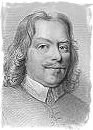
 John
Bunyan was born in November, 1628, at Elstow, a little village about a mile
south of Bedford in Bedfordshire [England]. His ancestors, who were in very
humble circumstances, lived in Bedfordshire probably as early as the twelfth
century; and the name, under various spellings, appears in the records of that
county at intervals from that time until very recently. Thomas Bunyan, the
grandfather of John, left at his death in 1641 a small property, one-half of
which he bequeathed to his son Thomas. This second Thomas, who was a maker
and mender of pots and kettles, described himself in certain documents as a
brazier or tinker. He did not belong to the rather disreputable class of vagrant
tinkers for whom seventeenth century literature expressed great contempt, and
who were usually of gypsy origin, but was a freeholder, settled permanently
in Elstow and plying his trade in the neighboring towns and villages. The mother
of John Bunyan, Margaret Bentley of Elstow, came from people of some substance
and of a slightly higher social position than the Bunyans.
John
Bunyan was born in November, 1628, at Elstow, a little village about a mile
south of Bedford in Bedfordshire [England]. His ancestors, who were in very
humble circumstances, lived in Bedfordshire probably as early as the twelfth
century; and the name, under various spellings, appears in the records of that
county at intervals from that time until very recently. Thomas Bunyan, the
grandfather of John, left at his death in 1641 a small property, one-half of
which he bequeathed to his son Thomas. This second Thomas, who was a maker
and mender of pots and kettles, described himself in certain documents as a
brazier or tinker. He did not belong to the rather disreputable class of vagrant
tinkers for whom seventeenth century literature expressed great contempt, and
who were usually of gypsy origin, but was a freeholder, settled permanently
in Elstow and plying his trade in the neighboring towns and villages. The mother
of John Bunyan, Margaret Bentley of Elstow, came from people of some substance
and of a slightly higher social position than the Bunyans.
The life of the family was a severe struggle with poverty. Bunyan's parents were able, nevertheless, to send him to school. In his own words, "It pleased God to put it into their hearts to put me to school, to learn me both to read and write." The only book that we know of his reading in childhood was the Life of Sir Bevis of Southampton, probably one of the cheap pamphlets known as chapbooks. This book was ever after in his mind the type of profane and worldly literature. We know very little of Bunyan's life during this period, but it is clear that the intensity of his inner life, even as a child, was extraordinary. He tells us that it was his delight "to be taken captive by the devil at his will, being filled with all unrighteousness," and that he had few equals for his years "both for cursing, swearing, lying, and blaspheming the holy name of God." At the same time, he was "greatly afflicted and troubled with the thoughts of the fearful torments of hell-fire." Already he had begun to dream dreams and see visions.
In 1644 his mother died, and within two months his father married again. This marriage apparently caused an estrangement between father and son, and the son spent the three following years as a soldier. There is in Bunyan's works one allusion to his military service, and there are many passages which could not have been so realistically managed except for this experience, but there is not a single line to indicate on which side be fought. This is the more remarkable when we remember that the issues in the English Civil War were as much religious as political. The fact is that Bunyan took very little interest in political questions and literally obeyed the injunction to render unto Caesar the things that are Caesar's. In the absence of direct proof Macaulay assumed, in his article on Bunyan in the Encyclopædia Britannica, that Bunyan was on the side of Parliament. Froude, on the other hand relying upon the facts that Bunyan's parents were adherents of the Established Church and that he himself was baptised in the parish church, felt sure that he was on the side of the King. There was really not a particle of direct evidence on the subject until, a few years ago, the muster rolls of the garrison at Newport Pagnell were discovered. By them it was shown that Bunyan served under Sir Samuel Luke, a well-known Parliamentary commander, who is commonly supposed to be the original of Hudibras, the hero of Butler's celebrated satirical poem. What battles Bunyan engaged in under the leadership of Sir Samuel are entirely unknown, but there is a probability that he was present at the siege of Leicester.
After leaving the army, probably in 1647 or 1648, Bunyan married, but no record of his marriage has yet been found, and both the Christian and the family name of his wife are unknown. It seems likely that she was not a native of Elstow. "This woman and I," says Bunyan, "though we came together as poor as poor might be (not having so much household stuff as a dish or a spoon betwixt us both), yet this she had for her part, 'The Plain Man's Pathway to Heaven' and 'The Practice of Piety.'" By means of these books and the assistance of his wife, he recovered the art of reading, which he apparently had forgotten. He seems also to have resumed his tinker's trade. In 1905 his anvil, stamped with his name and the date 1647, was found in a pile of rubbish at St. Neots, near Bedford.
The four years following his marriage were the period of the intense spiritual struggles which Bunyan records in the autobiography, written many years later, entitled Grace Abounding. It was this experience which made it possible for him to write The Pilgrim's Progress. His pathway to the New Life was the same that the Pilgrim trod. He knew the Valley of Humiliation, and the Valley of the Shadow of Death; he had lain in the dungeons of Doubting Castle; and he finally overcame Giant Despair. He felt himself to be a great sinner and constantly stood in fear of the wrath of God, yet many of the sins of which he accuses himself seem at least venial. One of his weaknesses was a fondness for playing the game of cat, especially on Sunday afternoons. He himself tells us how he overcame this: "But the same day, as I was in the midst of a game at cat, and having struck it one blow from the hole, just as I was about to strike it a second time, a voice did suddenly dart from heaven into my soul which said, 'Wilt thou leave thy sins and go to heaven, or have thy sins and go to hell?'" Another worldliness was a delight in ringing the bells in the tower of Elstow Church. His conscience troubled him in the matter, and he gave up the practice, yet not without reluctance. "I would go to the steeple-house and look on, though I durst not ring, ... but quickly after I began to think how if one of the bells should fall? So after this I would yet go to see them ring, but would not go any farther than the steeple-door; but then it came into my head, how if the steeple itself should fall? And this thought ... did continually so shake my mind that I durst not stand at the steeple-door any longer, but was forced to flee for fear the steeple should fall upon my head."
It was years before he found peace, but he was helped to it by intercourse with John Gifford, the pastor of an independent religious body in Bedford. During the Protectorate, this congregation occupied St. John's Church in Bedford, Gifford being in fact the rector of the parish. In 1653 Bunyan joined this body, although still living in Elstow, and two years later, having removed to Bedford, he was chosen a deacon in the church. He continued to employ himself as a tinker, but this new interest in the Bedford church must have come to be of paramount importance. His fervor and his power of expression, shown in extemporaneous exhortation, soon brought him into prominence among, his co-religionists, who formally recognized his "call to preach." This recognition was not a legal license, but Bunyan, nevertheless, was in the habit of preaching in the surrounding towns. As a result of this disregard of the law he was indicted in 1658. Apparently the indictment was not pressed, for there is no record of any trial or sentence. It is impossible to believe that Bunyan desisted from preaching.
Bunyan had been preaching a year when he became entangled in a controversy with the Quakers. These followers of the "inner light," who believed that the individual conscience was the only safe guide to conduct, seemed to some to disparage the written word. Bunyan, of course, believed the Bible to be literally the word of God. This controversy was the beginning of Bunyan's literary career. In 1656 appeared Some Gospel Truths Opened, in which, according to Offor, the editor of the most recent edition of Bunyan's complete works, Bunyan "attacked the follies of the time, exposed and condemned heresies without mercy." The pamphlet was answered by Edward Burroughs, a somewhat well-known Quaker of the time, who died six years later in prison at Newgate. Bunyan replied with a Vindication of Some Gospel Truths Opened. The title of his third book (1658), which deals with the parable of Lazarus and the rich man, is highly characteristic; it is called, A Few Sighs from Hell, or the Groans of a Damned Soul; by that poor and contemptible servant of Jesus Christ, John Bunyan. For thirty years he continued to publish books with hardly any cessation, and he is one of the most voluminous writers of his time. In most instances, Bunyan's books seem to have been built up from sermons that were originally preached extemporaneously.
1660 was the year of the Restoration, and in spite of the promises of toleration made by Charles, the old acts against the Nonconformists were revived. Bedfordshire had long been a hot-bed of nonconformity, and the county magistrates in Quarter Sessions at Bedford entered upon the work of subjugation with extraordinary zeal. An order was issued for the restoration of the Prayer Book in all churches. One of the justices, Sir Francis Wingate, learned that Bunyan was intending to preach near the small village of Lower Samsall, and issued a warrant for his arrest. Bunyan might easily have escaped, but he felt that it was his duty to persevere. In the midst of the sermon the constable entered and arrested him. The following day he appeared before Wingate. There was really nothing to charge him with, the Act of Uniformity, which required all public religious worship to be according to the Liturgy of the Church of England not being passed until over a year later. Nevertheless, Wingate committed Bunyan to Bedford Jail to await the next Quarter Sessions.
At the Sessions, he was convicted under the unrepealed but almost forgotten "Conventicle Act" of 1593, of "perniciously abstaining from coming to church to hear divine service, and for being a common upholder of several unlawful meetings and conventicles to the great disturbance and distraction of the good subjects of this kingdom." The judgment of the court was that he must be taken back to jail for three months, and if then he "should not submit to go to church and leave off preaching," he should be "banished the realm." If found in the country after that, he should hang. The actual sentence was not executed. Instead, Bunyan was kept in jail for twelve years.
The twelve years' imprisonment was interrupted by an interval of a few weeks of freedom in 1666, and during the whole period the closeness of his confinement seems to have depended upon the disposition of his jailers. Sometimes he was allowed to go out to preach, and he was in the habit of preaching to audiences of forty and fifty within the jail. One of his visitors has told us that the books to which he had access were the Bible and Foxe's Book of Martyrs. The greater part of his time while in jail must have been taken up with preaching and writing, but for the support of his family he made "long tagged laces."
Many of Bunyan's books were written during these twelve years, and the tradition was that The Pilgrim's Progress was one of them, but it seems more likely that this famous book was written during a later imprisonment. In 1666 was published the first edition of Grace Abounding to the Chief of Sinners. This is Bunyan's spiritual autobiography. It tells us surprisingly little about the external affairs of his career, but as a record of the inner life it is to be ranked with the Confessions of St. Augustine. In spite of its poverty in matters of fact, it remains the principal source of information in regard to Bunyan's life up to the time of his imprisonment.
In 1672 the long imprisonment came to an end. Charles II., in his eagerness to benefit the Catholics, had suspended all the statutes against the Nonconformists. Bunyan received royal authority to preach and was called to the pastorate of the Bedford church, having been chosen for this office before his release. At the Restoration, St. John's Church had been returned to the Episcopalians, and the congregation now met in a barn belonging to one of its members. During these years Bunyan enjoyed prosperity in his work, and his reputation extended as far as London, where great crowds gathered to hear him preach. Because of his habit of making many visits to places in the neighboring country, he gained in friendly jest the title of Bishop Bunyan.
This comparative ease was not to last long. In 1675 the attitude of the government towards Nonconformists changed, and many licenses to preach were withdrawn. In March of the following year, a warrant was issued for the arrest of Bunyan on the charge of "having preached to or teached at a Conventicle meeting or assembly under colour or pretense of exercise of religion in other manner than according to the Liturgie or Practice of the Church of England." He seems to have been imprisoned at this time for six months, probably in the tiny one-room jail on the bridge over the River Ouse. Numerous engravings have made the cell and the bridge familiar to millions of persons, and it was long thought that here was the scene of the twelve years' imprisonment. It seems more likely that Bunyan spent those years in the county jail in the central part of Bedford. There can be little doubt, however, that The Pilgrim's Progress was written, in great part at any rate, in the bridge jail during this six months' imprisonment, and that to this extent the tradition is well founded.
The Pilgrim's Progress, which appeared in 1678, became almost at once a popular book, and it made Bunyan the best-known Nonconformist in England. His success led him to undertake other religious allegories. In 1680 he brought out The Life and Death of Mr. Badman, which he intended to be the counterpart of The Pilgrim's Progress. The title indicates clearly enough the nature of the book. Because of its lack of vivacity and the unpleasantness of the subject-matter it is not comparable with the earlier work. Two years later appeared The Holy War, next to The Pilgrim's Progress and perhaps Grace Abounding, his most popular book. It is an account of the defense of the City of Mansoul against the attacks of the Devil. In writing this allegory, Bunyan's military experience was of immense value to him. In some respects it is more direct and logical in plan than The Pilgrim's Progress, but it is decidedly inferior to it in realism; one does not find oneself forgetting the allegory. But of this book Macaulay has said, "If there had been no Pilgrim's Progress, The Holy War would have been the first of religious allegories."
During these later years Bunyan enjoyed immense influence, and his services were demanded in almost every part of England. He died August 31, 1688, in London, whither he had gone to effect a reconciliation between a father and a son. He was buried in Bunhill Fields, Finsbury, the "Campo Santo of the Dissenters."
A contemporary, whose identify is unknown, has left the following account of Bunyan's character and person:
A Brief Character of Mr. John Bunyan
"He appeared in countenance to be of a stern and rough temper, but in his conversation mild and affable; not given to loquacity or much discourse in company, unless some urgent occasion required it; observing never to boast of himself or his parts, but rather seem low in his own eyes, and submit himself to the judgment of others; abhorring lying and swearing, being just in all that lay in his power to his word, not seeming to revenge injuries, loving to reconcile differences and make friendship with all; he had a sharp quick eye, accomplished with an excellent discerning of persons, being of good judgment and quick wit. As for his person, he was tall of stature, strong boned, though not corpulent, somewhat of a ruddy face, with sparkling eyes, wearing his hair on his upper lip, after the old British fashion; his hair reddish, but in his latter days time had sprinkled it with grey; his nose well set, but not declining or bending, and his mouth moderate large; his forehead something high, and his habit always plain and modest. And thus we have impartially described the internal and external parts of a person whose death hath been much regretted — a person who had tried the smiles and frowns of time, not puffed up in prosperity nor shaken in adversity, always holding the golden mean.
In him at once did three great worthies shine
Historian, poet, and a choice divine:
Then let him rest in undisturbed dust,
Until the resurrection of the just."
BIBLIOGRAPHY
The standard biography is John Bunyan, His Life, Times, and Work by
John Brown, D.D., Minister of the Bunyan Church at Bedford (London: Isbister
and Co.). The edition of 1902 was largely rewritten, and includes many
new facts in regard to Bunyan's life. The book by Froude in the English
Men of Letters Series, although occasionally inaccurate, contains much
suggestive and penetrating criticism of Bunyan's works. The reader will find
there an interesting summary of Bunyan's theology.
More useful for general reference, however, is Canon Venables' John Bunyan, in the Great Writers Series. There is in this book a carefully compiled bibliography. A recent book, John Bunyan by W. Hale White (Scribner's) contains some useful outlines of Bunyan's more important works.
Every student of Bunyan should read Macaulay's Essay on Southey's edition of The Pilgrim's Progress, as well as his sketch of Bunyan contributed to the Encyclopædia Britannica.
From The Pilgrim's Progress by John Bunyan. Edited for school use by George W. Latham. Chicago: Scott, Foresman and Company, 1906.
>> More John Bunyan