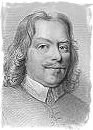
 John
Bunyan (1628-1688), author of the "Pilgrim's Progress," "Holy
War," "Grace abounding," &c., was born at the village
of Elstow, Bedfordshire [England], a little more than a mile south
of the town of Bedford, in November 1628. His baptism is recorded in
the parish register of Elstow on the 30th of that month. The family
of Buignon, Buniun, Bonyon, or Binyan (the name is found spelt in no
fewer than thirty-four different ways), had been settled in the county
of Bedford from very early times. Their first place of settlement appears
to have been the parish of Pulloxhill, about nine miles from John Bunyan's
native village. In 1199 one William Buniun held land at Wilstead, a
mile from Elstow. In 1327 one of the same name, probably his descendant,
William Boynon, was living at the hamlet of Harrowden, at the south-eastern
boundary of the parish, close to the very spot which tradition marks
out as John Bunyan's birthplace, and which the local names of "Bunyan's
End," "Bunyan's Walk," and "Farther Bunyan's" (as
old, certainly, as the middle of the sixteenth century) connect beyond
all question with the Bunyan family. A field known as "Bonyon's
End" was sold in 1548 by "Thomas Bonyon of Elstow, labourer," son
of William Bonyon, to Robert Curtis, and other portions of his ancestral
property gradually passed to other purchasers, little being left to
descend to John Bunyan's grandfather, Thomas Bunyan (d. 1641), save
the "cottage or tenement" in which he carried on the occupation
of "petty chapman," or small retail trader. This, in his
still extant will, he bequeathed to his second wife, Ann, and after
her death to her stepson Thomas and her son Edward in equal shares.
Thomas, the elder son, the father of the subject of this biography,
was married three times, the first time (10 Jan. 1623) when only in
his twentieth year, his second and third marriages occurring within
a few months of his being left a widower. John Bunyan was the first
child by his second marriage, which took place on 23 May 1627. The
maiden name of his second wife was Margaret Bentley. She, like her
husband, was a native of Elstow, and was born in the same year with
him, 1603. A year after her marriage, her sister Rose became the wife
of her husband's younger half-brother, Edward. The will of John Bunyan's
maternal grandmother, Mary Bentley (d. 1632), with its "Dutch-like
picture of an Elstow cottage interior two hundred and fifty years ago," proves
(J. Brown, Biography of John Bunyan, to which we are indebted
for all these family details) that his mother "came not of the
very squalid poor, but of people who, though humble in station, were
yet decent and worthy in their ways."
John
Bunyan (1628-1688), author of the "Pilgrim's Progress," "Holy
War," "Grace abounding," &c., was born at the village
of Elstow, Bedfordshire [England], a little more than a mile south
of the town of Bedford, in November 1628. His baptism is recorded in
the parish register of Elstow on the 30th of that month. The family
of Buignon, Buniun, Bonyon, or Binyan (the name is found spelt in no
fewer than thirty-four different ways), had been settled in the county
of Bedford from very early times. Their first place of settlement appears
to have been the parish of Pulloxhill, about nine miles from John Bunyan's
native village. In 1199 one William Buniun held land at Wilstead, a
mile from Elstow. In 1327 one of the same name, probably his descendant,
William Boynon, was living at the hamlet of Harrowden, at the south-eastern
boundary of the parish, close to the very spot which tradition marks
out as John Bunyan's birthplace, and which the local names of "Bunyan's
End," "Bunyan's Walk," and "Farther Bunyan's" (as
old, certainly, as the middle of the sixteenth century) connect beyond
all question with the Bunyan family. A field known as "Bonyon's
End" was sold in 1548 by "Thomas Bonyon of Elstow, labourer," son
of William Bonyon, to Robert Curtis, and other portions of his ancestral
property gradually passed to other purchasers, little being left to
descend to John Bunyan's grandfather, Thomas Bunyan (d. 1641), save
the "cottage or tenement" in which he carried on the occupation
of "petty chapman," or small retail trader. This, in his
still extant will, he bequeathed to his second wife, Ann, and after
her death to her stepson Thomas and her son Edward in equal shares.
Thomas, the elder son, the father of the subject of this biography,
was married three times, the first time (10 Jan. 1623) when only in
his twentieth year, his second and third marriages occurring within
a few months of his being left a widower. John Bunyan was the first
child by his second marriage, which took place on 23 May 1627. The
maiden name of his second wife was Margaret Bentley. She, like her
husband, was a native of Elstow, and was born in the same year with
him, 1603. A year after her marriage, her sister Rose became the wife
of her husband's younger half-brother, Edward. The will of John Bunyan's
maternal grandmother, Mary Bentley (d. 1632), with its "Dutch-like
picture of an Elstow cottage interior two hundred and fifty years ago," proves
(J. Brown, Biography of John Bunyan, to which we are indebted
for all these family details) that his mother "came not of the
very squalid poor, but of people who, though humble in station, were
yet decent and worthy in their ways."
John Bunyan's father, Thomas Bunyan, was what we should now call a whitesmith, a maker and mender of pots and kettles. In his will he designates himself a "brasier;" his son, who carried on the same trade and adopted the same designation when describing himself, is more usually styled a "tinker." Neither of them, however, belonged to the vagrant tribe, but had a settled home at Elstow, where their forge and workshop were, though they doubtless travelled the country round in search of jobs. Contemporary literature depicts the tinker's craft as disreputable; but we must distinguish between the vagrant and the steady handicraftsmen, dwelling in their own freehold tenements, such as the Bunyans evidently were. Bunyan, in his intense self-depreciation writes: "My descent was of a low and inconsiderable generation, my father's house being of that rank that is meanest and most despised of all the families of the land." This is certainly not language that we should be disposed to apply to a family which had from time immemorial occupied the same freehold, and made testamentary dispositions of their small belongings. The antiquity of the family in Bunyan's native county effectually disposes of the strange hallucination which even Sir Walter Scott was disposed to favour, that the Bunyans, "though reclaimed and settled," may have sprung from the gypsy tribe.
Bunyan's parents sent their son to school, either to the recently founded Bedford grammar school, or, which is more probable, to some humbler school at Elstow. He learned reading and writing "according to the rate of other poor men's children." "I never went to school," he writes, "to Aristotle or Plato, but was brought up at my father's house in a very mean condition, among a company of poor countrymen." And what little he learned, he confesses with shame, when he was called from his primer and copy-book to help his father at his trade, was soon lost, "even almost utterly."
In his sixteenth year (June 1644) Bunyan suffered the irreparable misfortune of the loss of his mother, which was aggravated by his father marrying a second wife within two months of her decease. The arrival of a stepmother seems to have estranged Bunyan from his home, and to have led to his enlisting as a soldier. The civil war was then drawing near the end of its first stage. Bedfordshire was distinctly parliamentarian in its sympathies. In the west it was cut off from any communication with the royalists by a strong line of parliamentary posts. These circumstances lead to the conclusion that a Bedfordshire lad was more likely to be found in the parliamentarian than in the royalist, forces. This is Lord Macaulay's conclusion, and is supported by Bunyan's latest and most painstaking biographer, the Rev. J. Brown. Mr. Froude, on the other hand, together with Mr. Offor and Mr. Copner, holds that "probability is on the side of his having been with the royalists." As there is not a tittle of evidence either way, the question can never be absolutely settled. But we hold, against Mr. Froude, that all probability points to the parliamentary force as that in which Bunyan served. In all likelihood, on his attaining the regulation age of sixteen, which he did in November 1644, he was one of the "able and armed men" whom the parliament commanded his native county to send "for soldiers" to the central garrison of Newport Pagnel, and included in one of the levies. The army was disbanded in 1646. Before this occurred Bunyan's providential preservation from death, which, according to his anonymous biographer, "was a frequent subject of thankful reference by him in later years." "When I was a soldier," he says, "I with others, was drawn out to go to such a place to besiege it. But when I was just ready to go, one of the company desired to go in my room; to which when I consented, he took my place, and coming to the siege, as he stood sentinel he was shot in the head with a musket bullet and died." Bunyan gives no hint as to the locality of the siege; but, on the faith of a manifestly incorrect account of the circumstance in an anonymous life, published after his death, it has been currently identified with Leicester, which we know to have been taken by the royalist forces in 1645; and in direct contradiction to Bunyan's own words -- for he says plainly that he stayed behind, and a comrade went in his room -- he is described, and that even by Macaulay, as having taken part in the siege, either as a royalist assailant or as a parliamentary defender. Wherever the siege may have been, it is certain that Bunyan was not there.
When the forces were disbanded, Bunyan must have returned to his native village and resumed his paternal trade. He "presently afterwards changed his condition into a married state." With characteristic reticence Bunyan gives neither the name of his wife nor the date of his marriage; but it seems to have occurred at the end of 1648 or the beginning of 1649, when he was not much more than twenty. He and his wife were "as poor as poor might be," without "so much household stuff as a dish or spoon between them." But his wife came of godly parents, and brought two pious books of her father's to her new home, the reading of which awakened the slumbering sense of religion in Bunyan's heart, and produced an external change of habits. Up to this time, though by no means what would be called "a bad character" -- for he was no drunkard, nor licentious -- Bunyan was a gay, daring young fellow, whose chief delight was in dancing, bell-ringing, and in all kinds of rural sports and pastimes, the ringleader of the village youth at wake or merrymaking or in the Sunday sports after service time on the green. As a boy he had acquired the habit of profane swearing, in which he became such an adept as to shock those who were far from scrupulous in their language as "the ungodliest fellow for swearing they ever heard." All this the influence of his young wife and her good books gradually changed. One by one he felt himself compelled to give up all his favourite pursuits and pastimes. He left off his habit of swearing at once and entirely. He was diligent in his attendance at services and sermons, and in reading the Bible, at least the narrative portions. The doctrinal and practical part, "Paul's epistles and such like scriptures," he "could not away with." The reformation was real, though as yet superficial, and called forth the wonder of his neighbours. "In outward things," writes Lord Macaulay, "he soon became a strict Pharisee;" "a poor painted hypocrite," he calls himself. For a time he was well content with himself. "I thought no man in England could please God better than I." But his self-satisfaction did not last long. The insufficiency of such a merely outward change was borne in upon him by the spiritual conversation of a few poor women whom he overheard one day when pursuing his tinker's craft at Bedford, "I sitting at a door in the sun and talking about the things of God." Though by this time somewhat of "a brisk talker on religion," he found himself a complete stranger to their inner experience. This conversation was the beginning of the tremendous spiritual conflict described by him with such graphic power in his "Grace abounding." It lasted some three or four years, at the end of which, in 1653, he joined the nonconformist body, to which these poor godly women belonged. This body met for worship in St. John's Church, Bedford, of which the "holy Mr. Gifford," once a loose young officer in the royal army, had been appointed rector in the same year. His temptations ceased, his spiritual conflict was over, and he entered on a peace which was rendered all the more precious by the previous mental agony. The sudden alternations of hope and fear, the fierce temptations, the torturing illusions, the strange perversions of isolated texts, the harassing doubts of the truth of Christianity, the depths of despair and the elevations of joy through which he passed are fully described "as with a pen of fire" in that marvellous piece of religious autobiography, unrivaled saved by the "Confessions" of St. Augustine, his "Grace abounding to the Chief of Sinners."
Bunyan was at this time still resident at Elstow, where his blind child Mary and his second daughter Elizabeth were born. It was probably in 1655 that Banyan removed to Bedford. Here he soon lost the wife to whose piety he had owed so much, and about the same time his pastor and friend the "holy Mr. Gifford." His own health also suffered; he was threatened with consumption, but his naturally robust constitution carried him safely through what at one time he expected would have been a fatal illness.
In 1655 Bunyan, who had been chosen one of the deacons, began to exercise his gift of exhortation, at first privately, and as he gained courage and his ministry proved acceptable "in a more publick way." In 1657 his calling as a preacher was formally recognised, and he was set apart to that office, "after solemn prayer and fasting," another member being appointed deacon in his room, "brother Bunyan being taken off by preaching the gospel." His fame as a preacher soon spread, When it was known that the once blaspheming tinker had turned preacher, they flocked "by hundreds, and that from all parts," to hear him, though, as he says, "upon sundry and divers accounts" -- some to marvel, some to mock, but some with an earnest desire to profit by his words. After his ordination Bunyan continued to pursue his trade as a brasier, combining with it the exercise of his preaching gifts as occasion served in the various villages visited by him, "in woods, in barns, on village greens, or in town chapels." Opposition was naturally aroused among the settled ministry by such remarkable popularity. "All the midland counties," writes Mr. Froude, "heard of his fame and demanded to hear him." In some places, as at Meldreth and Yelden, at the latter of which he had preached on Christmas day by the permission of the rector, Dr. William Dell, master Gonville and Caius, the pulpits of the churches were opened to him; in other places the incumbents of the parishes were his bitterest enemies. They, in the words of Mr. Henry Deane when defending Bunyan against the attacks of Dr. T. Smith, keeper of the university library at Cambridge, were "angry with the tinker because he strove to mend souls as well as kettles and pans." "When I went first to preach the word abroad," he writes, "the doctors and priests of the country did open wide against me."
In 1658 he was indicted at the assizes for preaching at Eaton Socon, but with what result is unrecorded. He was called "a witch, a Jesuit, a highwayman;" he was charged with keeping "his misses," with "having two wives at once," and other equally absurd and groundless accusations. His career as an author now began. His earliest work, "Some Gospel Truths opened," published at Newport Pagnel in 1656, with a commendatory letter by his pastor, John Burton, was a protest against the mysticism of the teaching of the quakers. Having been answered by Edward Burrough, an ardent and somewhat foul-mouthed member of that sect, Bunyan replied the next year in "A Vindication of Gospel Truths," in which he repays his antagonist in his own coin, calling him "a gross railing Rabshakeh," who "befools himself," and proves his complete ignorance of the gospel. Like the former work it is written in a very, nervous style, showing a great command of plain English, as well as a thorough acquaintance with Holy Scripture. A third book was published by Bunyan in 1668 on the parable of the rich man and Lazarus, under the horror-striking title of "Sighs from Hell, or the Groans of a Damned Soul." It issued from the press a few days before Cromwell's death. In this work, as its title would suggest, Bunyan gives full scope to his vivid imagination in describing the condition of the lost. It contains many touches of racy humour, especially in his similes, and the whole is written in the nervous, forcible English of which he was master.
On the Restoration the old acts against nonconformists were speedily revived. The meeting-houses were closed. All persons were required under severe penalties to attend their parish church. The ejected clergy were reinstated. It became an illegal act to conduct divine service except in accordance with the ritual of the church, or for one not in episcopal orders to address a congregation. Bunyan continued his ministrations in barns, in private houses, under the trees, wherever he found brethren ready to pray and hear. So daring and notorious an offender was not likely to go long unpunished. Within six months of Charles's landing he was arrested, on 12 Nov. 1660, at the little hamlet of Lower Samsell by Harlington, about thirteen miles from Bedford to the south, where he was going to hold a religious service in a private house. The issuing of the warrant had become known, and Bunyan might have escaped if he had been so minded, but be was not the man to play the coward. If he fled, it would "make an ill-savour in the county" and dishearten the weaker brethren. If he ran before a warrant, others might run before "great words." While he was conducting the service he was arrested and taken before Mr. Justice Wingate, who, though really desirous to release him, was compelled by his obstinate refusal to forbear preaching to commit him for trial to the county gaol, which, with perhaps a brief interval of enlargement in 1666, was to be his "close and uncomfortable" place of abode for the next twelve years. The prison to which Bunyan was committed was not, as an obstinate and widespread error has represented, the "town gaol," or rather lock-up house, which occupied one of the piers of the many-arched Ousebridge, for the temporary incarceration of petty offenders against municipal law, but the county gaol, a much less confined and comfortless abode. A few weeks after his committal the quarter sessions for January 1661 were held at Bedford, and Bunyan was indicted for his offence. The proceedings seem to have been irregular. There was no desire on the part of the justices to deal hardly with the prisoner; but he confessed the indictment, and declared his determination to repeat the offence on the first opportunity. The justices had therefore no choice in the matter. They were bound to administer the law as it stood. So he was sentenced to a further three months' term of imprisonment, and if then he persisted in his contumacy he would be "banished the realm," and if he returned without royal license he would "stretch by the neck for it." Towards the end of the three months, with an evident desire to avoid proceeding to extremities, the clerk of the peace was sent to him by the justices to endeavour to induce him to conform. But, as might have been anticipated, all attempts to bend Bunyan's sturdy nature were vain. Every kind of compromise, however kindly and sensibly urged, was steadily refused. He would not substitute private exhortation, which might have been allowed him, for public preaching. "The law," he replied, "had provided two ways of obeying -- one to obey actively, and if he could not bring his conscience to that, then to suffer whatever penalty the law enacted."
Three weeks later, 23 April 1661, the coronation of Charles II afforded an opportunity of enlargement. All prisoners for every offence short of felony were to be released. Those who were waiting their trials might be dismissed at once. Those convicted and under sentence might sue out a pardon under the great seal at any time within the year. Bunyan failed to profit by the royal clemency. Although he had not been legally convicted, for no witnesses had been heard against him, nor had he pleaded to the indictment, his trial having been little more than a conversation between him and the court, the authorities chose to regard it as a legal conviction, rendering it necessary that a pardon should be sued for.
About a year before his apprehension at Samsell, Bunyan bad taken a second wife, Elizabeth, to watch over his four little motherless children. This noble-hearted woman showed undaunted courage in seeking her husband's release. She travelled to London with a petition to the House of Peers, from some of whom she met with kindly sympathy but little encouragement. "The matter was one for the judges, not for them." At the next midsummer assize, therefore, the poor woman on three several occasions presented her husband's formal request that he might be legally put on his trial and his case fully heard. Sir Matthew Hale, who was one of the judges of that assize, listened to her pitiful tale, and manifested much kind feeling. But he was powerless. "Her husband had been duly convicted. She must either sue out his pardon, or obtain a writ of error." Neither of these courses was adopted; and wisely so, for, as Mr. Froude remarks, "a pardon would have been of no use to Bunyan because he was determined to persevere in disobeying a law which he considered to be unjust. The most real kindness which could be shown him was to leave him where he was." At the next spring assizes, in 1662, a strenuous effort was again made to get his case brought into court. This again failed. After this he seems to have desisted from any further attempt, and, with a slight interval in 1666, he remained in prison, not altogether unhappily, till 1672, twelve years from his first committal. The character of his imprisonment varied with the disposition of his gaolers. During the earlier part of the time he was allowed to follow his wonted course of preaching, "taking all occasions to visit the people of God," and even going to "see Christians in London." The Bedford church books show that he was frequently present at church meetings during some periods of his imprisonment. Such indulgence, however, was plainly irregular. Its discovery nearly cost the gaoler his place, and brought on Bunyan a much more rigorous confinement. He was forbidden "even to look out at the door." For seven years out of the twelve, 1661-8, his name never occurs in the records of the church. In 1666, after six years of prison life, "by the intercession of some in trust and power that took pity upon his suffering," Bunyan was released. But in a few weeks he was arrested once more for his former offence, at a meeting, and returned to his former quarters for another six years. Being precluded by his imprisonment from carrying on his trade he betook himself, for the support of his family, to making long tagged laces, many hundred gross of which he sold to the hawkers. Nor was "the word of God bound." The gaol afforded him the opportunity of exercising his ministerial gifts forbidden outside its walls. Many of his co-religionists from time to time were his fellow-prisoners, at one time as many as sixty. He gave religious instruction and preached to his fellow-prisoners, and furnished spiritual counsel to persons who were allowed to visit him. Some of his prison sermons were the rough drafts of subsequent more elaborate publications. His two chief companions were the Bible and Foxe's "Book of Martyrs." Bunyan, as we have seen, had ventured on authorship before his imprisonment. The enforced leisure of a gaol gave him abundant opportunity for its pursuit. Books and tracts, some in prose, some in verse, were produced by his fertile pen with great rapidity. His first prison book was in metre -- we can hardly call it poetry -- entitled "Profitable Meditations," in the form of dialogue, and has "small literary merit of any sort" (BROWN, p. 172). This was followed by "Praying in the Spirit," written in 1662 and published in 1663; "Christian Behaviour," written and published in the same year; the "Four Last Things" and "Ebal and Gerizim," both in verse, the "Holy City," the "Resurrection of the Dead," and "Prison Meditations," a reply in verse to a friend who had written to him in prison, which all appeared between 1663 and 1665. These minor productions were succeeded by his "Grace abounding to the Chief of Sinners," one of the three books by which Bunyan's name is chiefly known, which will ever hold a high place among records of spiritual experience. This appeared in 1666. About this time took place the few months' release from prison previously alluded to. Our knowledge of this second six years' incarceration is almost a blank. Even his literary activity appears to have suffered a temporary paralysis. It was not till 1672 that his "Defence of Justification by Faith" appeared. This was a vehement attack on the "brutish and beastly latitudinarianism" of the "Design of Christianity," a book written by the Rev. Edward Fowler, rector of Northill, which had recently attained great popularity, and which Richard Baxter also deemed worthy of a reply. Fowler's book seemed to Bunyan to aim a deadly blow at the very foundations of the gospel, and he took no pains to conceal his abhorrence of the attempt. With "a ferocity" that, as Lord Macaulay has said, "nothing can justify," he assails the book and its author with a shower of vituperative epithets savouring of the earlier stage in his career when he was notorious for the bold license of his talk. He describes Fowler as "rotten at heart," "heathenishly dark," "a prodigious blasphemer" "dropping venom from his pen," "an ignorant Sir John," one of "a gang of rabbling, counterfeit clergy," "like apes covering their shame with their tail."
An anonymous reply, entitled "Dirt wip't off," supposed to be the joint production of Fowler and his curate, appeared the same year, almost rivalling Bunyan in the mastery of abusive epithets. Bunyan's last work before his enlargement, written in the early part of 1672, was the "Confession of my Faith and Reason of my Practice." Its object was to vindicate his teaching and if possible to secure his liberty. That the imperishable allegory on which Bunyan's claim to immortality chiefly rests, the "Pilgrim's Progress," was also written in prison, we know on Bunyan's own authority. The "den" in which he dreamed his wonderful dream is identified by himself, in the third or first, complete edition of 1679, with "the gaol." That this gaol was the strait and unwholesome lock-up house on Bedford bridge was long accepted as an undoubted fact. When it was shown that being a county prisoner it was impossible for him to have passed his twelve years' captivity in a town gaol intended for casual offenders, it was concluded that the county gaol, which was certainly the place of his incarceration, was also the place of the composition of the "Pilgrim's Progress." This conclusion has been recently called in question by the Rev. J. Brown, who gives reasons for believing that the composition of the allegory belongs to a short six months' confinement, which, according to the story told by his anonymous biographer and confirmed by Charles Doe, he was subjected to at a later period. The date of this imprisonment is fixed by Mr. Brown as 1675, and, according to the account preserved in Asty's "Life of Owen," he was released from it by the intervention of Dr. Thomas Barlow, bishop of Lincoln, whose diocese then included the county of Bedford. The strongest argument in support of Mr. Brown's view is the improbability that if the "Pilgrim's Progress" had been written during the twelve years' imprisonment which came to an end in 1672, it should have remained six years unpublished, the first edition not appearing till 1678. It was not Bunyan's way to keep his works so long in manuscript. Besides, in the author's poetical "Apology for his Book," his account of its composition and publication suggests that there was no such prolonged interval as the common accounts represent.
Bunyan's twelve years imprisonment came to an end in 1672. With the covert intent of setting up the Roman catholic religion in England, Charles II had suspended all penal statutes against nonconformists and popish recusants. Bunyan was one of those who profited by this infamous subterfuge. His pardon under the great seal bears date 13 Sept 1672. This, however, was no more than official sanction of what had been already virtually granted and acted on. For Bunyan had received one of the first licenses to preach given by the royal authority, dated 9 May of that year, and had been called to the pastorate of the nonconformist congregation at Bedford, of which he had been so long a member, on the 21st of the preceding January. The church of St. John, which had been occupied by this congregation during the Protectorate, had, on the Restoration, returned to its rightful owners, and the place licensed for the exercise of Bunyan's ministry was a barn in the orchard belonging to a member of the body. This continued to be the place of meeting of the congregation until 1707, when a new chapel was erected on its site. Though Bunyan made Bedford the center of his work, he extended his ministrations through the whole county, and even beyond its limits. One of his first acts after his liberation was to apply to the government for licenses for preachers and preaching places in the country round. Among these he made stated circuits, being playfully known as "Bishop Bunyan," his diocese being a large one, and, in spite of strenuous efforts at repression by the ecclesiastical authorities, steadily increasing in magnitude and importance. It is interesting to notice that Bunyan's father, the tinker of Elstow, lived on till 1676, being buried at Elstow on 7 Feb. of that year. In his will, while leaving a shilling apiece to his famous son and his three other children, he bequeathed all be had to his third wife, Ann, who survived him four years, and was buried in the same churchyard as her husband on 25 Sept. 1680.
Bunyan's active ministerial labours did not interfere with his literary work; this continued as prolific as when writing was almost the only relief from the tedium of his confinement. Besides minor works, in 1676 appeared the "Strait Gate," directed against an inconsistent profession of Christianity by those who, in his graphic language, can "throw stories with both hands, alter their religion as fast as their company, can live in water and out of water, run with the hare and kill with the hounds, carry fire in one hand and water in the other, very anythings." This was succeeded in 1678 by the first edition of the "Pilgrim's Progress," and in the same year by the second, and the next year by the third, each with very important additions, including some of the best-known and most characteristic personages, such as Mr. Worldly Wiseman, Mr. By-ends and his family, and Mrs. Diffidence, the wife of Giant Despair. "Come and welcome to Jesus Christ," "with its musical title and soul-moving pleas," was published in 1678, and his "Treatise of the Fear of God" in 1679. The next year gave to the world one of Bunyan's most characteristic works, "The Life and Death of Mr. Badman," which, though now almost forgotten, and too disagreeable in its subject and its boldly drawn details to be altogether wholesome reading, displays Banyan's inventive genius as powerfully as the universally popular "Pilgrim," of which, as Bunyan intended it to be, it is the strongly drawn contrast and foil. The one gives a picture of a man "in the rank of English life with which Bunyan was most familiar," to quote Mr. Froude, "a vulgar, middle-class, unprincipled scoundrel," "travelling along the primrose path to the everlasting bonfire," while the other sets before us a man essentially of the same social rank, fleeing from the wrath to come, and making his painful way "to Emmanuel's Land through the Slough of Despond and the Valley of the Shadow of Death." As a portrait of rough English country-town life in the days of Charles II, the later book is unapproached, save by the unsavoury tales of Defoe. "The Life and Death of Mr. Badman" was followed, after a two years' interval, by Bunyan's second great work, "The Holy War made by Shaddai upon Diabolus," of which Macaulay has said, with somewhat exaggerated eulogy, that "if there had been no "Pilgrim's Progress," the "Holy War" would have been the first of religious allegories." There is a necessary unreality about the whole narrative as compared with Bunyan's former allegory. The characters are shadowy abstractions by the side of the "representative realities" of the other work. With a truer estimate of the relative value of the two works, Mr. Froude says: ""The Holy War" would have entitled Bunyan to a place among the masters of English literature. It would never have made his name a household word in every English-speaking family in the globe." Other works, notably the "Barren Fig Tree" and "The Pharisee and the Publican," were given to the world in 1682 and the four succeeding years. In 1684 appeared the second part of the "Pilgrim's Progress," completing the history of Christian's pilgrimage with that of his wife Christiana and her children, and her companion, the young maiden Mercy. Like most second parts of popular works, this shows a decided falling off. It is "but a feeble reverberation of the first part. Christiana and her children are tolerated for the pilgrim's sake to whom they belong." But it bears the stamp of Bunyan's genius, and not a few of the characters, Old Honest, Mr. Valiant-for-the-Truth, Mr. Despondency and his daughter Miss Much-afraid, and the "young woman whose name was Dull," have a vitality that can never decay.
There is little more to notice in Bunyan's life. His activity was ceaseless, but "the only glimpses we get of him during this time are from the church records, and these were but scantily kept," and are quite devoid of public interest, chiefly dealing with the internal discipline of the body. Troublous times fell upon nonconformists. The Declaration of Indulgence was withdrawn the same year it was issued. The Test Act became law the next year (1673). In 1675 the acts against nonconformists were put in force. Bunyan's preaching journeys were not always free from risk. There is a tradition that he visited Reading disguised as a wagoner, with a long whip in his hand, to escape detection. But he continued free from active molestation, with the exception of the somewhat hazy imprisonment placed by Mr. Brown in 1675. In Mr. Froude's words, "he abstained, as he had done steadily throughout his life, from all interference with politics, and the government in turn never meddled with him." He frequently visited London to preach, always getting large congregations. Twelve hundred would come together to hear him at seven o'clock on a weekday morning in winter. When he preached on a Sunday, the meetinghouse would not contain the throng, half being obliged to go away. A sermon delivered by him at Pinners' Hall in Old Broad Street was the basis of one of his theological works. He was on intimate terms with Dr. John Owen, who, when Charles II expressed his astonishment that so learned a divine could listen to an illiterate tinker, is recorded to have replied that he would gladly give up all his learning for the tinker's power of reaching the heart. In the year of his death he was chaplain, though perhaps unofficially, to Sir John Shorter, then lord mayor of London. He did not escape temptation to leave Bedford for posts of greater influence and dignity; but all such offers he steadily refused, as he did any opportunities of pecuniary gain for himself and his family, quietly staying at his post through all "changes of ministry, popish plots, and Monmouth rebellions, while the terror of a restoration of popery was bringing on the revolution, careless of kings and cabinets" (FROUDE p. 174). When James II was endeavouring to remodel the corporations, Bunyan was pointed out as a likely instrument for carrying out the royal purpose in the corporation of Bedford. It seems that some place under government was offered as the price of his consent; but he declined all such overtures, and refused to see the bringer of them, though by no means unwilling to give his aid in securing the repeal of the penal laws and tests under which he and his flock had so long smarted. This was in November 1687, barely twelve months before James's abdication. Three years before he had felt it so possible that he might be called again to suffer for conscience' sake under these same laws, that he executed a deed of gift, dated 23 Dec. 1685, making over all his worldly possessions to his wife, Elizabeth Bunyan.
Bunyan did not live to see the revolution. His death took place in 1688, four months after the acquittal of the seven bishops. In the spring of that year he had been enfeebled by an attack of "sweating sickness." He caught a severe cold on a ride through heavy rain to London from Reading, whither he had gone to effect a reconciliation between a father and a son. A fever ensued, and he died on 31 Aug. at the house of his friend John Strudwick, who kept a grocer's and chandler's shop at the sign of the Star, Holborn Bridge, two months before he had completed his sixtieth year. He continued his literary activity to the last. Four books from his pen had been published in the first half of the year, and he partly revised the sheets of a short treatise entitled "The Acceptable Sacrifice" on his deathbed. He was buried in Mr. Stradwick's vault in the burial-ground in Bunhill Fields, Finsbury. His personal estate was sworn under 100£.
Bunyan was the father of six children, four by his first wife, and two by the second. His elder child Mary, his blind child (born in 1650), of whom he writes in the "Grace abounding" with such exquisite tenderness, died before her father. His children, John, Thomas, and Elizabeth by his first wife, and Sarah and Joseph by his second wife, survived him. His heroic wife lived only a year and a half after him, and died early in 1691. The only known representatives of Bunyan are the descendants of his youngest daughter Sarah. In 1686, two years before her father's death, she had married her fellow-parishioner, William Browne, and her descendants form a rather numerous and widespread clan.
Bunyan's personal appearance is thus described by a contemporary: "He was tall of stature, strong-boned though not corpulent, somewhat of a ruddy face with sparkling eyes, wearing his hair on his upper lip after the old British fashion; his hair reddish, but in his latter days had sprinkled with grey; his nose well-set, but not declining or bending, and his mouth moderately large, his forehead something high, and his habit always plain and modest." Another contemporary writes: "His countenance was grave and sedate, and did so to the life discover the inward frame of his heart, that it was convincing to the beholders, and did strike something of awe into them that had nothing of the fear of God." A third thus describes his manner and bearing: "He appeared in countenance to be of a stern and rough temper, but in his conversation mild and affable, not given to loquacity or much discourse in company, unless some urgent occasion required it, observing never to boast of himself in his parts, but rather seem low in his own eyes, and submit himself to the judgment of others."
The works left in manuscript at Bunyan's death were given to the world by his devoted friend and admirer, the good, simple-minded combmaker by London Bridge, Charles Doe, who soon after his decease set about a folio edition of his collected works as "the best work he could do for God." The first volume, published in 1692, contained ten of these posthumous books, most of which had been prepared for the press by Bunyan himself. These were followed by the "Heavenly Footman," one of the most characteristic of Bunyan's works, published by Doe in 1698, and by the "Account of his Imprisonment," that invaluable supplement to his biography, which was not given to the world till 1765. Doe's second intended folio was never published, The first complete collected edition of Bunyan's works, containing twenty-seven in addition to the twenty previously published by Doe, appeared in 1736, edited by Samuel Wilson of the Barbican. A third issue of the collected works was published in two volumes folio in 1767, with a preface by George Whitefield. Other editions of the whole works are that by Alexander Hogg in six volumes 8vo, in 1780; that by Mr. G. Offor, in three volumes imperial 8vo, in 1853, revised in 1862; and that by the Rev. H. Stebbing, in four volumes imperial 8vo, in 1859.
The following is a list of Bunyan's works, arranged in chronological succession,
based on that drawn up by Charles Doe and annexed to the first issue of the "Heavenly
Footman" in 1698. The full titles are not given, which in some cases extend
to ten or a dozen lines:
1. "Some Gospel Truths opened," 1656.
2. "A Vindication of 'Some Gospel Truths opened,'" same year.
3. "A few Sighs from Hell, or the Groans of a Damned Soul," 1658.
4. "The Doctrine of the Law and Grace unfolded," 1659.
All the preceding were published previous to his imprisonment. The first book
written by him in prison was in verse:
5. "Profitable Meditations, fitted to Man's different Conditions. In nine
particulars" (no date).
6. "I will pray with the Spirit and with the Understanding also," 1663.
7. "Christian Behaviour; being the Fruits of True Christianity," 1663.
8, 9, 10. "The Four Last Things," "Ebal and Gerizim," and "Prison
Meditations." All in verse, and published in one volume. The date of the
first edition is not known.
11. "The Holy City," 1665.
12. "The Resurrection of the Dead and Eternal Judgment," 1665.
13. "Grace abounding to the Chief of Sinners," 1666.
14. "Defence of the Doctrine of Justification by Faith," 1672.
15. "Confession of Faith," 1672.
These two were the last books published by him in prison. His release was speedily
followed by:
16. "Difference of Judgment about Water Baptism no Bar to Communion," 1673.
17. "Peaceable Principles and True" (a rejoinder to attacks on the
preceding work), 1674.
18. "Reprobation asserted, or the Doctrine of Eternal Election promiscuously
handled" (no date). This work, though accepted by Charles Doe and inserted
by him in the catalogue of Bunyan's works, and included by Hogg and Offor in
their collected editions, is rejected by Mr. Brown on internal evidence of
style and substance, but hardly perhaps on sufficient grounds.
19. "Light for them that sit in Darkness," 1675.
20. "Instruction for the Ignorant, or a Salve to heal that great want
of knowledge which so much reigns in Old and Young," 1675. A "Catechism
for Children," written in prison, but not published till after his release.
21. "Saved by Grace," 1675.
22. "The Strait Gate, or the great Difficulty of going to Heaven," 1676.
This is an expansion of a sermon on Luke xiii.24, preached by Bunyan after
his release.
23. "The Pilgrim's Progress," 1678. Two other editions with large
additions appeared in the same and the following year, evidencing its rapid
popularity.
24. "Come and welcome to Jesus Christ," 1678. The expansion of a
sermon on John vi.37.
25. "A Treatise of the Fear of God," 1679.
26. "The Life and Death of Mr. Badman," 1680.
27. "The Holy War," 1682.
28. "The Barren Fig Tree, or the Doom and Downfall of the Fruitless Professors," 1682.
29. "The Greatness of the Soul," 1683. Originally a sermon preached
at Pinners' Hall, expanded. 30. "A Case of Conscience resolved," 1683.
A curious little tract on the propriety of women meeting separately for prayer, &c., "without
their men."
31. "Seasonable Counsel or Advice to Sufferers," 1684.
32. "A Holy Life the Beauty of Christianity," 1684.
33. "A Caution to stir up to Watch against Sin," 1684. A half-sheet
broadside poem in sixteen stanzas.
34. "The second part of the Pilgrim's Progress," 1684.
35. "Questions about the Nature and Perpetuity of the Seventh-day Sabbath," 1685.
36. "The Pharisee and the Publican," 1685.
37. "A Book for Boys and Girls, or Country Rhymes for Children," in
verse; or, as in later editions, "Divine Emblems, or Temporal Things spiritualised," 1686.
38. "The Jerusalem Sinner saved, or Good News for the Vilest of Men," 1688.
39. "The Work of Jesus Christ as an Advocate," 1688.
40. "Discourse of the Building, Nature, Excellency, and Government of
the House of God," 1688. A poetical composition in twelve divisions.
41. "The Water of Life," 1688.
42. "Solomon's Temple spiritualised, or Gospel-light fetcht out of the
Temple at Jerusalem," in seventy particulars, 1688.
43. "The Acceptable Sacrifice, or the Excellency of a Broken Heart," the
proofs of which were corrected by the author on his deathbed and published,
with a preface, after his decease by his friend George Cokayn, 21 Sept. 1688.
44. His "Last Sermon," on John i.13, preached on 19 Aug. 1688, two
days before he sickened, and about twelve days before his death, was published
from notes shortly after his decease. The "Dying Sayings," which
appeared immediately after his death, bears internal evidence of being "a
compilation from various sources made in haste for some publisher with a shrewd
eye to business and trading on the interest attaching to Bunyan's name" (BROWN).
Posthumous publications. --Ten of these were contained in the folio edition
of 1692, which had been prepared for the press by Bunyan himself:
45. "An Exposition of the Ten first Chapters of Genesis and part of the
Eleventh." A fragment of an intended continuous commentary on the Holy
Scriptures. 46. "Justification by imputed Righteousness."
47. "Paul's Departure and Crown," an expansion of a sermon on 2 Tim.
iv.6-8.
48. "Israel's Hope encouraged," a discourse on Ps. cxxx.7.
49. "The Desires of the Righteous granted," a sermon on Prov. x.24
and xi.23.
50. "The Saint's Privilege and Profit," a treatise on prayer based
on Heb. iv.16.
51. "Christ a Compleat Saviour," a discourse on the intercession
of Christ, on Heb. vii.25.
52. "The Saint's Knowledge of Christ's Love," an exposition of St.
Paul's prayer, Ephes. iii.18-19.
53. "The House of the Forest of Lebanon," a discourse on I Kings
vii.2, in which by a fanciful and baseless analogy he makes this palace a type
of the church under persecution.
54. "Antichrist and her Ruin, and the Slaying of the Witnesses," a
work which singularly enough breathes the most profound loyalty to the sovereign,
though that sovereign was then doing all in his power to establish popery.
To these ten posthumous works must be added:
55. "The Heavenly Footman," a discourse on I Cor. ix.24, bought of
Bunyan's eldest son, John, in 1691 by Charles Doe, and published by him in
1698.
56. The "Relation of his Imprisonment," which was not given to the
world till 1765, a hundred years after it was written in Bedford gaol.
Neither 57. "The Christian Dialogue," nor
58. "The Pocket Concordance," enumerated by Charles Doe, "though
diligently sought," has been discovered.
59. The "Scriptural Poems," in which a far from unsuccessful attempt
has been made to versify the histories of Joseph, Samson, Ruth, the Sermon
on the Mount, and the Epistle of St. James, are regarded as spurious by Mr.
Brown on the ground that they were unknown to Charles Doe and were not published
till twelve years after Bunyan's death, and then by one Blare, who issued other
certainly spurious works in Bunyan's name. The internal evidence he also regards
as unfavourable to their genuineness: "There is but little to remind us
of Bunyan's special verse." Mr. Froude's verdict on this point is altogether
different: "The "Book of Ruth" and the "History of Joseph" done
into blank verse are really beautiful idylls, which if we found in the collected
works of a poet laureate we should consider that a difficult task had been
accomplished successfully, and the original grace completely preserved."
[Bunyan's Grace Abounding and Relation of his Imprisonment; Doe's The Struggler; Life and Actions of John Bunyan, 1692; Life of John Bunyan, 1700; Southey's Life of John Bunyan, 1830; Lord Macaulay's John Bunyan, a Biography, 1853; Offer's Life of John Bunyan, 1862; The Book of the Bunyan Festival, edited by W. H. Wylie, 1874; The Hero of Elstow, 1874; Clarendon Press Series, Bunyan, by Precentor Venables, 1879; English Men of Letters, Bunyan, by J. A. Froude, 1880; Copner's John Bunyan, a Memoir, 1883; Brown's John Bunyan, his Life, Times, and Work, 1885.]
From Dictionary of National Biography. London: Smith, Elder, & Co., 1886.
>> More John Bunyan